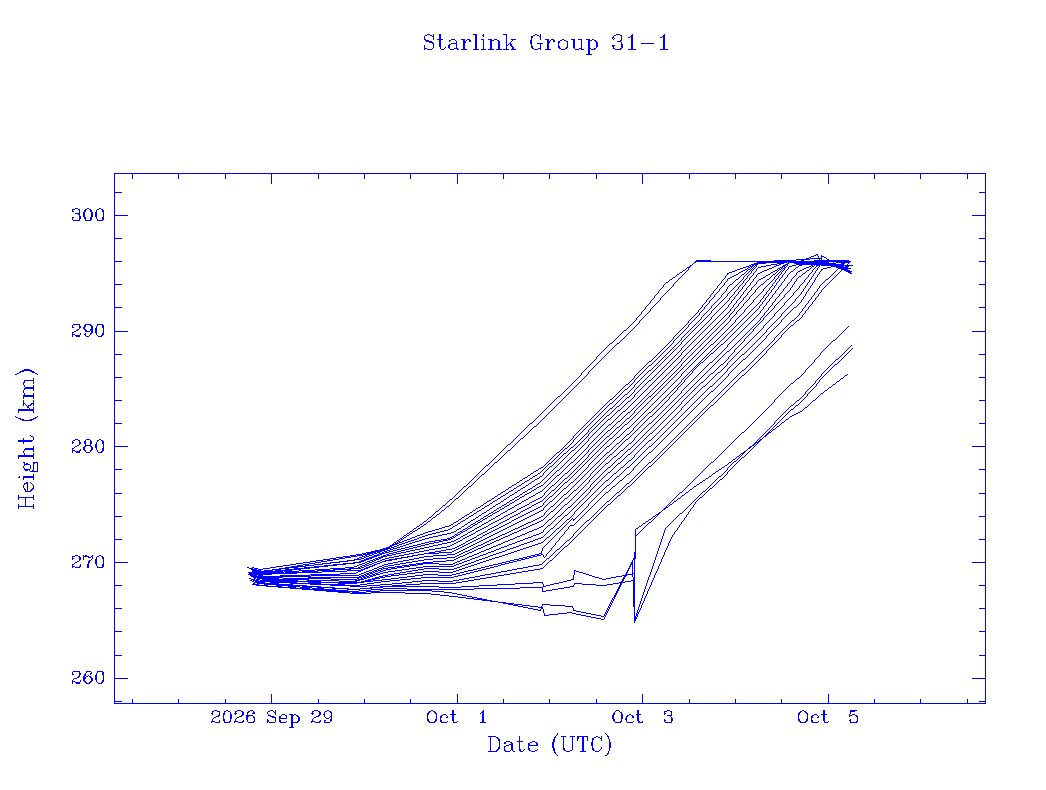
One week after Starship made history by deploying its first operational payload, all 26 Starlink V3 satellites from the Group 31-1 mission have begun raising their orbits — and the maneuver sequence they're executing reveals just how precisely SpaceX is choreographing this new class of deployment. According to orbital analyst Jonathan McDowell, most of the satellites are staging at 295 km altitude to perform differential orbital plane drift adjustments before continuing their ascent to operational altitudes over the coming weeks.

What the 295 km Pause Actually Means
Starship Flight 14 (Ship 41, Booster 21) launched from Starbase, Texas on September 28, 2026 and deployed the 26 satellites into an initial orbit with a perigee of roughly 262 km and an apogee of 275 km — a deliberately low insertion altitude. From there, the satellites were always going to need to climb under their own propulsion. What McDowell's tracking now confirms is that the climb isn't a straight shot upward.
The intermediate hold at 295 km is a technique for passive orbital plane separation. At very low altitudes, the rate at which a satellite's orbital plane drifts westward (due to Earth's oblateness, known as nodal regression) is highly sensitive to altitude. By parking different satellites at slightly different altitudes for a period of weeks, SpaceX can let the natural physics of low Earth orbit spread them into their target plane configuration — without burning extra propellant to do it actively. It's fuel-efficient orbital mechanics, and it's a standard SpaceX technique that becomes especially relevant when deploying a large batch from a single release point, as Starship does.
The fact that Starship deposited all 26 satellites from a single vehicle at nearly the same orbital plane means more adjustment work is required post-deployment compared to Falcon 9 missions, which typically target more precise insertion orbits. The tradeoff is raw payload capacity: Starship's payload volume and mass margin dwarf Falcon 9's, making the technique worthwhile at scale.
The Satellites Themselves
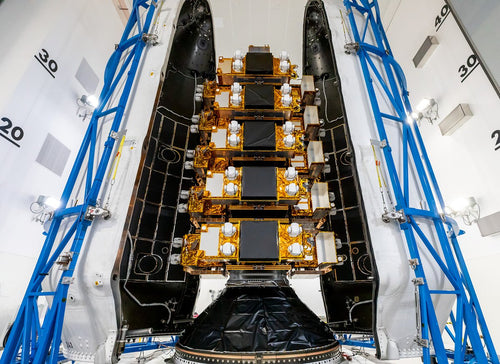
These aren't standard Starlink hardware. Each V3 satellite is designed to contribute 1 Tbps of capacity to the constellation — a significant step up from earlier generations. SpaceX confirmed contact with all 26 satellites shortly after separation on launch day, via laser inter-satellite links, ground stations, and Starlink user terminals. The on-orbit checkout phase — antenna and solar array deployment, systems verification — has been running in parallel with the early orbital raising.
The 30.5° orbital inclination of this batch targets mid-latitude coverage, consistent with SpaceX's strategy of layering capacity over high-demand regions before pushing into higher-inclination shells.
Timeline to Service
McDowell's observation that the satellites will "presumably resume ascent after some weeks" at 295 km aligns with how SpaceX has handled prior large-batch deployments. The full climb to operational altitude — typically in the 540–570 km range for this shell — takes additional weeks beyond that. Realistically, these satellites are unlikely to be contributing to live customer traffic before late November at the earliest, though SpaceX has not published a specific activation timeline for this batch.
What's already confirmed is the milestone itself: Starship has successfully deployed operational Starlink satellites and all of them are healthy and maneuvering. The orbital mechanics now unfolding are the last procedural step between a historic launch and a meaningful expansion of Starlink's network capacity. For our full SpaceX coverage, see our SpaceX coverage.
🚀 Following the Starship program? See every test flight, official outcome and the next launch window in our SpaceX Starship Tracker.
Sources & reporting notes
The links below identify the material source records used for this report.
- @planet4589 on X (2026-10-05T11:35:30.000Z) — Direct source
Source links are preserved as published or accessed. See our editorial standards and corrections policy.
The BASENOR Editorial Desk covers Tesla, SpaceX, and related technology, curating reporting from primary sources — official accounts, regulatory filings, and software release data. Every article passes source-record and fact-checking review before publication. About the newsroom.
This report was curated by the BASENOR Editorial Desk from the sources listed above. Read our editorial standards or email editorial@basenor.com to report an error.