📌 UPDATE — July 26, 2026
Construction of the Terafab joint venture chip fabrication facility at Giga Texas is now officially underway. Four new building permits have been issued specifically for the Advanced Technology Chip Fabrication facility, confirming the project has moved from planning into active construction. Aerial observer Joe Tegtmeyer (@JoeTegtmeyer) reported the permits on July 26, noting they are typically issued to general contractors and Tesla's own construction team for large-scale builds. The permit filings represent the clearest official paper trail yet that Terafab is no longer just a rumor — it's breaking ground.

📌 UPDATE — July 22, 2026
Elon Musk revealed during Tesla's earnings call that the full Terafab location will be announced at its own dedicated event — not on an earnings call — saying it "deserves to have its own day in the spotlight." He also confirmed that equipment orders have already been placed for a development fab in Austin, signaling that early-stage buildout is actively underway. This is the first official confirmation of a formal location announcement event on the horizon, and suggests the Austin development fab is a precursor to the larger, yet-to-be-named main Terafab site.

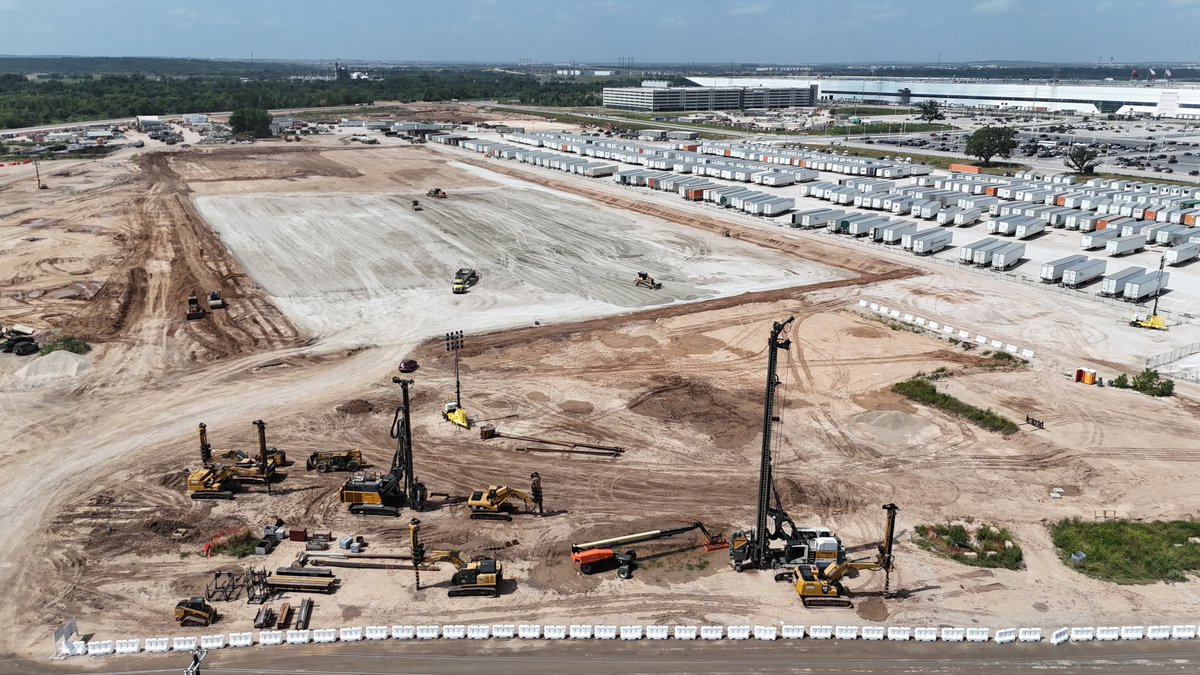
Ground is actively moving at Giga Texas's North Campus. Drone footage captured this morning shows a defined rectangular excavation, GeoPiers already in the ground, and gravel mix being applied — the first visible signs that the joint Tesla and SpaceX Advanced Technology Chip Fabrication facility, internally called Terafab, is becoming a real structure. Here's everything worth knowing about what's being built and why it matters.

What exactly is Terafab?
Terafab is a joint chip fabrication facility being built by Tesla, SpaceX, and xAI on the North Campus of Giga Texas in Austin. Unlike a commercial semiconductor foundry, the Giga Texas site is designed as a research fab and pilot line — a place to test new chip designs and manufacturing processes at relatively small scale before committing to mass production. According to previous reporting, the facility is targeting 2-nanometer process technology, with Intel involved as a partner leveraging its 14A process.
What chips will it actually produce?
The facility is built to serve three distinct product lines across the partner companies. For Tesla, it will manufacture advanced chips for the Full Self-Driving stack, the Cybercab robotaxi fleet, and Optimus humanoid robots. For SpaceX, it will produce radiation-hardened processors designed for satellites, orbital data centers, and deep-space missions. The shared infrastructure reflects how tightly the compute needs of autonomous vehicles and space hardware have converged — both require custom silicon that commercial foundries aren't optimized to supply on demand.
How big is the investment, and how does this fit into a larger picture?
The Giga Texas research fab carries a $3 billion investment, according to previous announcements. That's significant on its own, but it's worth understanding it as one piece of a much larger semiconductor independence strategy. SpaceX has separately filed plans for a far larger Terafab campus in Grimes County, Texas, with an initial investment reported at $55 billion and a potential total reaching $119 billion. The Giga Texas facility appears to function as the prototype and validation layer — prove the processes here, then scale them there.
When did this project start, and when will it be finished?
Elon Musk publicly announced the Terafab venture in late March 2026. Tesla formally broke ground on the research chip fabrication facility at Giga Texas in April 2026. Today's drone footage confirms that foundation work — excavation, GeoPiers, and gravel base — is now visibly underway and expanding. Construction of the facility is expected to complete in 2027. On the production side, small-batch runs of AI5 chips are anticipated later in 2026, with volume production projected for 2027 once the facility is fully operational.
What are GeoPiers, and why does their presence matter?
GeoPiers — sometimes called rammed aggregate piers — are ground improvement columns driven into the soil to increase its load-bearing capacity before a heavy foundation is poured. Their presence in the Terafab excavation signals that the building's structural loads are substantial, consistent with the weight of cleanroom-grade semiconductor equipment. It also confirms the project has moved well past permitting and site prep into genuine structural foundation work — a meaningful milestone for a facility that was announced just four months ago.
What does this mean for Tesla owners and the FSD roadmap?
In the near term, nothing changes — today's FSD hardware and software updates continue to come through the existing supply chain. But the longer-term implication is significant: if Tesla can design, test, and iterate on its own AI chips in-house rather than waiting on third-party foundry cycles, the pace of FSD and Optimus development could accelerate materially. Vertical integration of silicon is the same playbook Tesla ran with battery cells and electric motors. Owning the chip pipeline would give the company a level of control over its AI compute roadmap that no external supplier relationship can match.
🤖 Tracking Tesla's humanoid robot? See every Optimus production milestone and appearance in our Tesla Optimus Tracker.
Related Gear
Gear up your Tesla with tested, custom-fit BASENOR accessories — shop Tesla accessories →
Sources & reporting notes
The links below identify the material source records used for this report.
- @JoeTegtmeyer on X (2026-07-20T11:47:15.000Z) — Direct source
Source links are preserved as published or accessed. See our editorial standards and corrections policy.
The BASENOR Editorial Desk covers Tesla, SpaceX, and related technology, curating reporting from primary sources — official accounts, regulatory filings, and software release data. Every article passes source-record and fact-checking review before publication. About the newsroom.
This report was curated by the BASENOR Editorial Desk from the sources listed above. Read our editorial standards or email editorial@basenor.com to report an error.