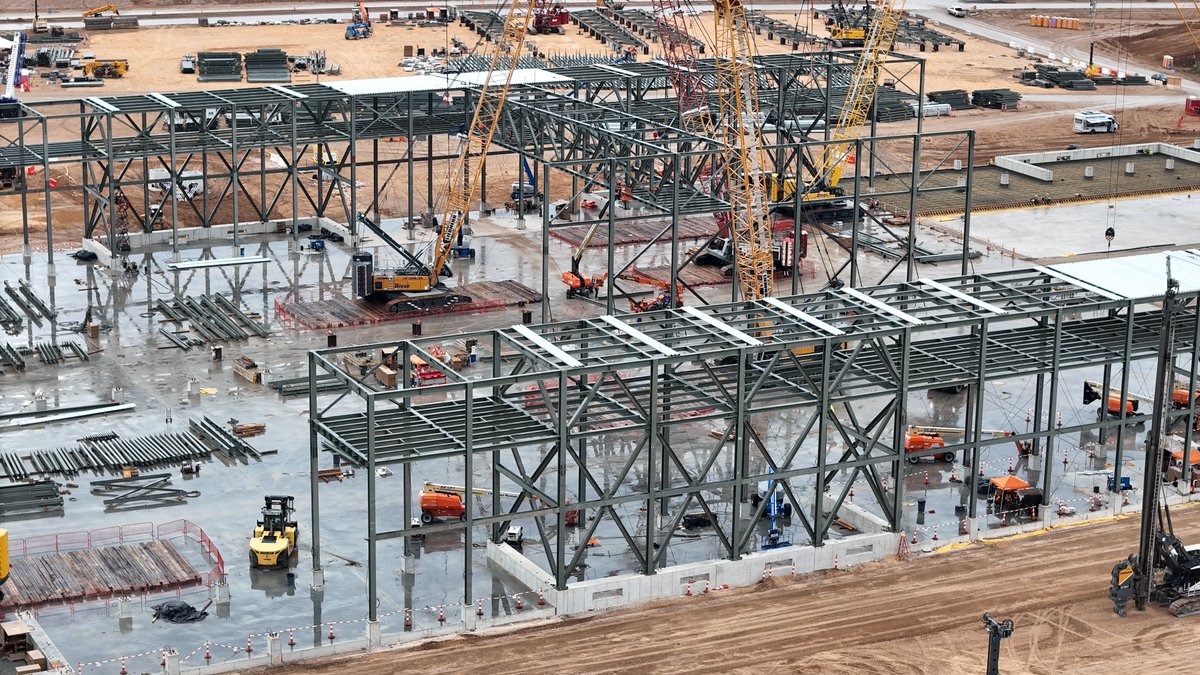
Aerial observer Joe Tegtmeyer posted fresh construction photos on October 30 showing the Tesla-SpaceX joint chip fabrication facility — officially named Terafab — taking unmistakable shape, with large steel trusses now rising from what he describes as a 'highly reinforced foundation.' The pace of vertical assembly marks a clear shift from groundwork to structure, and the scale of what's being built here is worth understanding in full.


1. There Are Actually Two Terafab Sites
Terafab isn't a single building — it's a two-site strategy. The first is a smaller research fabrication facility on the north campus of Gigafactory Texas in Austin, where Tesla broke ground in April 2026. That site is designed for early-stage chip development and process validation. The second, and far larger, production complex is being built in Grimes County, Texas, near the Gibbons Creek Reservoir — announced jointly by Texas Governor Greg Abbott, Tesla, and SpaceX on August 6, 2026. The construction activity Tegtmeyer photographed is consistent with the rapid build-out pace both sites have maintained since summer.

2. The Investment Numbers Are Staggering
The Grimes County facility's first phase carries a confirmed investment of more than $16.8 billion — already one of the largest single manufacturing commitments in U.S. history. County filings from May 2026 suggest a potential multi-phase expansion could reach up to $119 billion in total investment over time. For context, that would dwarf most existing semiconductor fabs in the Western world. The original $3 billion figure cited by Tegtmeyer in his tweet appears to reference an earlier or partial project cost estimate; the full Grimes County commitment is substantially larger according to official filings.
3. The Planned Footprint Is Enormous
When complete, the Grimes County production complex is planned to cover more than 100 million square feet of manufacturing space — a figure that would make it one of the largest chip manufacturing facilities anywhere on the planet. The first phase alone is expected to create at least 3,000 jobs in the region. The steel truss structures now visible in Tegtmeyer's photos are the early skeleton of what will eventually be an industrial campus on a scale Texas hasn't seen before, even accounting for Gigafactory Texas next door.

4. The First Chip Target Is Less Than a Year Away
According to previous reporting, Tesla and SpaceX are targeting production of their first functional test chip — specifically SRAM (Static Random-Access Memory) circuits — at the Austin research facility around May or June 2027. That's roughly seven months from now. The Austin site's foundation work was already accelerating with rebar placement underway as of September 2026, meaning the structural phase Tegtmeyer is now documenting at the main facility represents parallel progress across both locations. Whether the Austin research fab hits that mid-2027 milestone will be the first real proof-of-concept moment for Terafab's chip process.
5. Volume Production Is Targeted for Late 2028
The Grimes County production facility — the one generating today's construction photos — is targeting volume chip production in Q3 or Q4 of 2028. That's the timeline when Terafab-produced silicon could realistically start flowing into Tesla vehicles, Optimus robots, and SpaceX systems at scale. The jump from steel trusses to operational cleanrooms is a long road, but the pace of construction so far suggests both companies are treating that 2028 target seriously. Elon Musk officially announced the Terafab venture on March 21, 2026 — meaning the project has gone from announcement to structural steel in under eight months.
The construction photos Tegtmeyer shared today are a useful reminder of how quickly this project has moved from concept to concrete and steel. Whether Terafab ultimately reshapes how Tesla and SpaceX source their most critical silicon — rather than depending on TSMC or Samsung — is still years from being answered. But the foundation, quite literally, is being laid.
Related Gear
Gear up your Tesla with tested, custom-fit BASENOR accessories — shop Tesla accessories →
Sources & reporting notes
The links below identify the material source records used for this report.
- @JoeTegtmeyer on X (2026-10-30T16:11:50.000Z) — Direct source
Source links are preserved as published or accessed. See our editorial standards and corrections policy.
The BASENOR Editorial Desk covers Tesla, SpaceX, and related technology, curating reporting from primary sources — official accounts, regulatory filings, and software release data. Every article passes source-record and fact-checking review before publication. About the newsroom.
This report was curated by the BASENOR Editorial Desk from the sources listed above. Read our editorial standards or email editorial@basenor.com to report an error.