Code spotted inside the Tesla app suggests the company is quietly building the infrastructure to bring Optimus robots into private homes — and it includes a dedicated screen asking owners to consent to video and spatial data collection. The discovery mirrors the consent framework Tesla already uses for FSD shadow data, and it tells us a lot about how Tesla plans to train Optimus once it leaves the factory floor.

What exactly was found in the Tesla app?
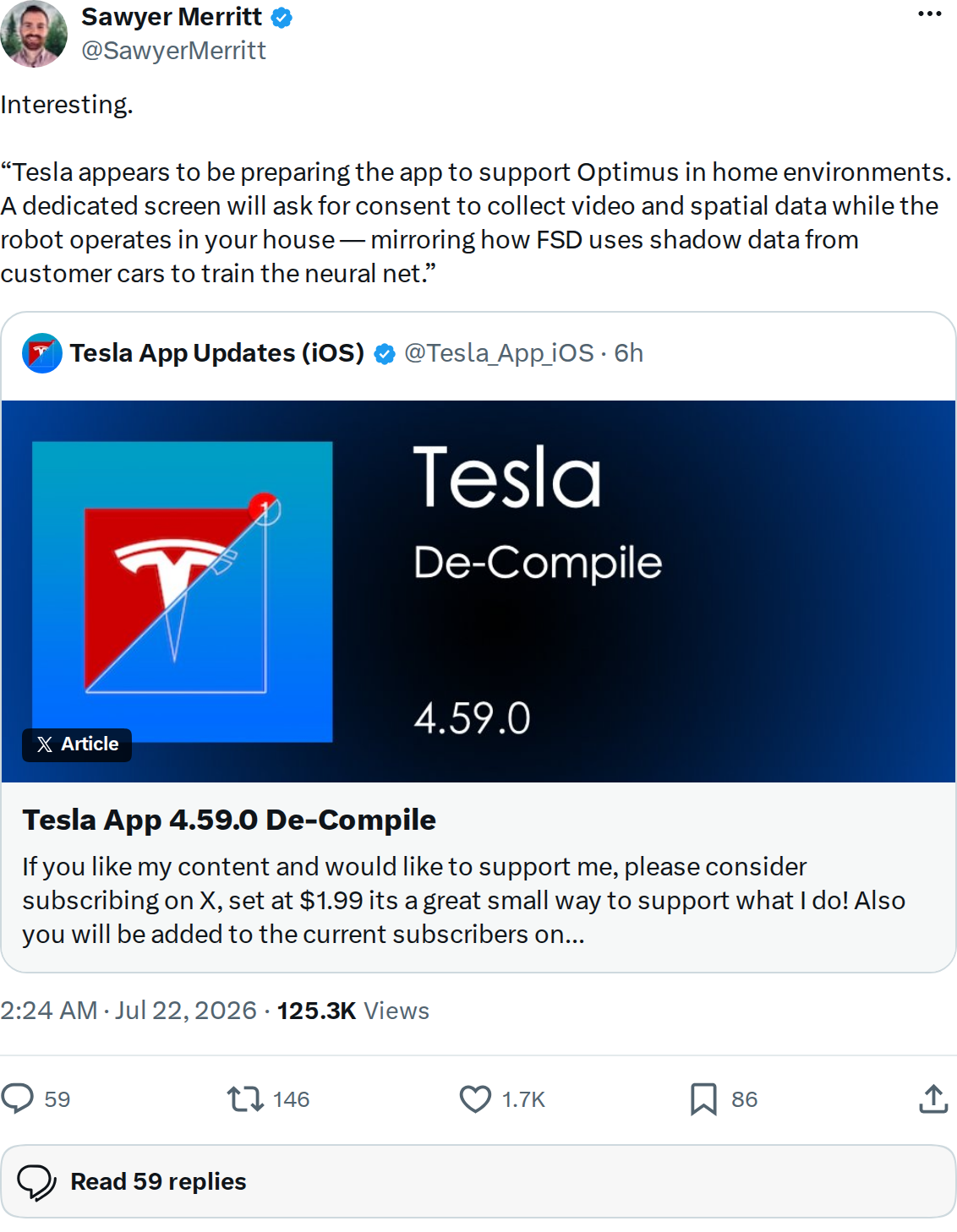
According to reporting shared by Sawyer Merritt, Tesla's app contains a dedicated screen that will ask users for consent before Optimus collects video and spatial data while operating inside their home. This is not a live, publicly released feature — it's code-level preparation discovered within the app, indicating Tesla is building the groundwork ahead of any consumer rollout. No official announcement has been made by Tesla.
Why does Optimus need to collect video and spatial data in your home?
Optimus is equipped with stereoscopic cameras, multi-array microphones, tactile sensors across both hands, and full spatial mapping capabilities — all active during normal operation. For the robot to navigate real-world home environments reliably, it needs to learn from them. Tesla's approach with FSD has always been fleet-scale learning: millions of real-world miles feed the AI model. The same logic applies to Optimus. A robot stumbling through a factory is one dataset; a robot navigating a cluttered kitchen, a staircase, or a child's bedroom is an entirely different one. Home environment data is irreplaceable for that training.
How does this compare to how FSD shadow data works?
With FSD, Tesla asks owners to opt in to sharing anonymized camera footage and driving data, which gets used to improve the neural network without being tied back to a specific vehicle or driver unless a safety event occurs. The Optimus consent screen appears to follow the same model — a clear opt-in moment before any data leaves your home. Tesla's existing privacy policy states it never sells user data to third parties and that camera recordings are not shared with Tesla by default without explicit user permission. The Optimus screen would formalize that same consent structure for a robot operating in a far more intimate environment than a car.
When would this actually affect Optimus owners?
Not immediately. Optimus robots currently operate exclusively inside Tesla's own factories — Fremont and Giga Texas — for task training and data collection. According to supply chain sources, mass production of Optimus is set to begin at the end of July 2026, with limited B2B sales targeted for late 2026. Elon Musk has stated consumer sales could begin as early as 2027. The presence of a home-consent screen in the app now suggests Tesla is engineering the privacy infrastructure well ahead of that consumer launch — which is the right order of operations, but it does mean this screen won't appear for most people for some time.
Should current Tesla owners be concerned about privacy?
The consent screen itself is actually a reassuring signal. Tesla building an explicit opt-in mechanism — rather than defaulting to data collection — is consistent with how the company has handled FSD data sharing. Owners will be presented with a clear choice before any video or spatial data from inside their home is used for training. That said, the stakes are meaningfully higher than a dashcam: home environments contain far more sensitive context than a highway drive. Anyone planning to bring Optimus home should read the consent terms carefully when they appear, and treat the opt-in decision the same way they would any home security camera consent — deliberately, not reflexively.
What does this tell us about Tesla's broader Optimus strategy?
Building consent infrastructure into the app before consumer units ship is a deliberate sequencing choice. It suggests Tesla intends to scale Optimus home deployment using the same data flywheel that made FSD competitive — real-world usage feeding a central model, improving performance for every robot in the fleet. The difference is that home data is richer, more varied, and more personal than driving data. If Tesla can build a large enough consenting dataset of home environments, it would create a significant moat: no competitor without millions of robots in homes could replicate that training corpus. The app code we're seeing today is the foundation of that strategy.
🤖 Tracking Tesla's humanoid robot? See every Optimus production milestone and appearance in our Tesla Optimus Tracker.
Related Gear
Gear up your Tesla with tested, custom-fit BASENOR accessories — shop Tesla accessories →
Sources & reporting notes
The links below identify the material source records used for this report.
- @SawyerMerritt on X (2026-07-22T02:24:05.000Z) — Direct source
Source links are preserved as published or accessed. See our editorial standards and corrections policy.
The BASENOR Editorial Desk covers Tesla, SpaceX, and related technology, curating reporting from primary sources — official accounts, regulatory filings, and software release data. Every article passes source-record and fact-checking review before publication. About the newsroom.
This report was curated by the BASENOR Editorial Desk from the sources listed above. Read our editorial standards or email editorial@basenor.com to report an error.