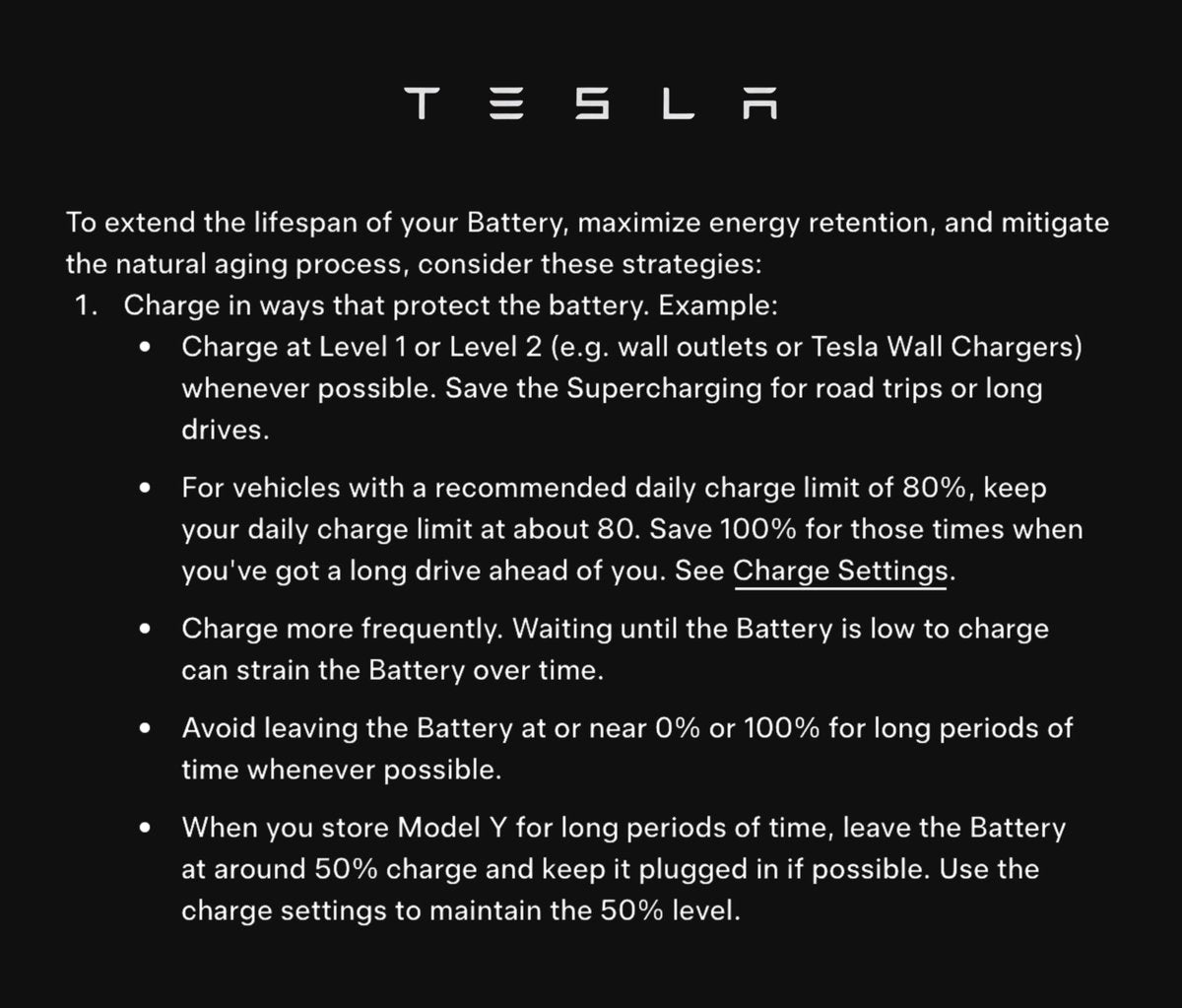
📌 UPDATE — March 4, 2026
Tesla has issued new official battery care guidance explicitly cautioning owners against regular or frequent Supercharging as a primary charging method. The updated tips reinforce that DC fast charging should remain an occasional convenience rather than a routine habit, as repeated high-power sessions accelerate long-term battery degradation. Tesla recommends relying on Level 2 home charging for daily top-ups whenever possible, reserving Superchargers for road trips and time-sensitive situations. This marks one of the clearest direct statements from Tesla on Supercharging frequency and its impact on battery longevity.

The News: Community guidance — amplified by Whole Mars Catalog — consolidates the most effective practices for keeping your Tesla battery healthy well beyond the 100,000-mile warranty period.
Why It Matters: Battery degradation is the single biggest long-term cost concern for Tesla owners. Real-world data shows that following these habits can keep capacity above 90% past 100,000 miles and above 80% past 200,000 miles — potentially saving thousands in replacement costs.
Source: @wholemars on X

Your Tesla battery is engineered to outlast your expectations — but only if you treat it right. Tesla's own 2026 Impact Report data confirms that Model 3 and Model Y Long Range vehicles average just 15% capacity loss after 200,000 miles, while Model S and X fare even better at around 12% loss over the same distance. Real-world owner reports frequently show 85–90% capacity still intact at the 200,000-mile mark.
That's remarkable longevity — and it doesn't happen by accident. The owners hitting those numbers are following a consistent set of habits. Here's exactly what they're doing, and what you should be doing too.
📊 What the Data Actually Shows
| Milestone | Average Capacity Retained | Models |
|---|---|---|
| 100,000 miles | 90%+ | All models |
| 200,000 miles | ~85–88% (Model 3/Y LR); ~88% (S/X) | All models |
| 7 years (any mileage) | ~93% | All models |
| 10+ years | ~80%+ | All models |
Source: Tesla 2026 Impact Report; real-world fleet data aggregators.
🔋 Know Your Battery Chemistry First
Before applying any charging advice, you need to know which battery chemistry your Tesla uses — because the optimal strategy differs significantly between the two main types:
| Chemistry | Which Vehicles | Daily Charge Target |
|---|---|---|
| LFP (Lithium Iron Phosphate) | Standard Range / RWD Model 3 & Y | 100% regularly (weekly minimum) |
| NCA/NCM (Nickel-based) | Model S, X, Long Range & Performance Model 3 & Y | 80% for daily use |
LFP chemistry is uniquely tolerant of regular full charges — in fact, Tesla recommends charging to 100% at least once a week to keep the battery management system (BMS) properly calibrated. Nickel-based batteries, by contrast, experience measurably more wear when regularly topped to 100%.
🚦 Owner's Action Plan
ESSENTIAL
1. Set Your Daily Charge Limit Correctly
Go to Charging → Set Limit in your Tesla app or touchscreen. If you have an NCA/NCM battery (Model S, X, Long Range/Performance Model 3 & Y), set your daily limit to 80%. Only increase to 100% the night before a long road trip. If you have an LFP battery (Standard Range/RWD Model 3 & Y), charge to 100% regularly — at least once per week.
2. Never Park at 0% or 100% for Extended Periods
Leaving your battery at either extreme for hours or days accelerates chemical degradation. If you're storing your Tesla for more than a few days, target a 50% state of charge. Enable Battery Saver mode if leaving the car for extended periods to reduce vampire drain.
3. Keep It Above 20% in Daily Driving
Consistently depleting below 20% creates stress on the cells. Plan your charging so that your daily low point stays comfortably above the 20% mark. Most owners find that charging every 2–3 days at home is sufficient to maintain this buffer.
RECOMMENDED
4. Prioritize Home Charging Over Supercharging
Tesla's own guidance is explicit: Supercharging is for road trips, not daily use. DC fast charging — even Tesla's excellent Supercharger network — generates more heat and charges at higher rates that, over thousands of cycles, contribute to more degradation than slower Level 1 or Level 2 AC home charging. If you have access to a home charger, use it as your primary charging source. Your battery will thank you at 150,000 miles.
5. Charge Frequently in Shallow Sessions
Shorter, more frequent charging sessions are healthier than running the battery low and doing a large top-up. Think of it like a phone — topping up from 60% to 80% repeatedly is better for the cells than repeatedly draining to 10% and charging to 90%.
6. Use Preconditioning Before Supercharging
When navigating to a Supercharger using your Tesla's built-in navigation, the car automatically preconditions the battery to an optimal temperature. This not only speeds up the charging session but also reduces the stress on cells caused by fast charging at sub-optimal temperatures. Always use in-car navigation when Supercharging — don't rely on third-party apps that won't trigger preconditioning.
7. Manage Thermal Exposure
Heat is the enemy of lithium-ion batteries. Parking in shade or a garage during extreme heat, and avoiding leaving the car in direct sun for hours, meaningfully reduces thermal stress on the pack. In cold climates, use the scheduled departure feature so the car warms the battery while still plugged in — rather than drawing down the battery to heat itself while driving.
INFORMATIONAL
8. Monitor Battery Health in the App
Tesla introduced an in-car battery health test in software update 2025.8.3 via Controls → Service → Battery Health. Note that as of update 2025.26, availability of this test has become limited and varies by model, vehicle age, and test history — so not all owners will see it. If available on your vehicle, the test requires connection to an AC charger for up to 16 hours. Consider running it annually to establish a baseline and track degradation over time.
📰 Deep Dive
The timing of this renewed focus on battery longevity isn't coincidental. Tesla is simultaneously expanding its warranty coverage for 2026 — introducing a new 7-year or 70,000-mile High-Priced Propulsion-Related Part Warranty for Model S, 3, X, and Y (covering components like the Power Conversion System and inverter), and reportedly developing extended high-voltage battery warranty plans that could stretch coverage to 12 years for some configurations. These moves signal that Tesla is increasingly confident in long-term battery durability — and is willing to back that confidence with coverage.
That confidence is validated by the data. The average Tesla battery retains approximately 93% of original capacity after seven years of use. At 200,000 miles, the average capacity loss is just 12–15% depending on model — figures that are genuinely exceptional by automotive standards and compare favorably to any combustion vehicle's powertrain longevity. The owners achieving those numbers are, without exception, following the core habits outlined above.
The LFP vs. NCA/NCM distinction deserves particular attention because it's the most common source of well-intentioned but counterproductive advice in Tesla owner communities. The rule to "never charge above 80%" applies specifically to nickel-based chemistries. Applying that rule to an LFP vehicle actually impairs BMS calibration and can lead to inaccurate range estimates over time. Knowing your chemistry — checkable in your vehicle's manual or via the Tesla app's energy section — is the prerequisite to everything else.
For owners approaching or past the 100,000-mile mark: the warranty period expiring does not mean degradation accelerates. The degradation curve for Tesla batteries is steepest in the first 20,000–30,000 miles (typically 5–8% as the battery settles), then flattens significantly. The miles between 100,000 and 200,000 often see less total capacity loss than the first 30,000. Consistent adherence to these habits at any mileage is the most reliable way to keep your Tesla performing as intended for the long haul.
📋 Tracking Tesla software? See every firmware, FSD and app version in one place in our Tesla Software Update Tracker.
Related Gear
Gear up your Tesla with tested, custom-fit BASENOR accessories — shop Tesla accessories →
Sources & reporting notes
The links below identify the material source records used for this report.
- @wholemars on X (2026-03-01T01:59:52.000Z) — Direct source
- @NotATeslaApp on X (2026-02-27T20:18:36.000Z) — Direct source
Source links are preserved as published or accessed. See our editorial standards and corrections policy.
The BASENOR Editorial Desk covers Tesla, SpaceX, and related technology, curating reporting from primary sources — official accounts, regulatory filings, and software release data. Every article passes source-record and fact-checking review before publication. About the newsroom.
This report was curated by the BASENOR Editorial Desk from the sources listed above. Read our editorial standards or email editorial@basenor.com to report an error.