📌 UPDATE — April 22, 2026
Elon Musk has clarified key details on Terafab, confirming the research fab at Giga Texas carries a $3 billion investment — significantly lower than the $20–25B total figure cited for the broader initiative. Musk noted Tesla is still working out deployment details and that the project involves testing "new physics" in chip manufacturing. Notably, SpaceX will handle the initial phase of scaling up Terafab technology, while Tesla focuses on the research fab itself — a division of responsibility not previously disclosed.

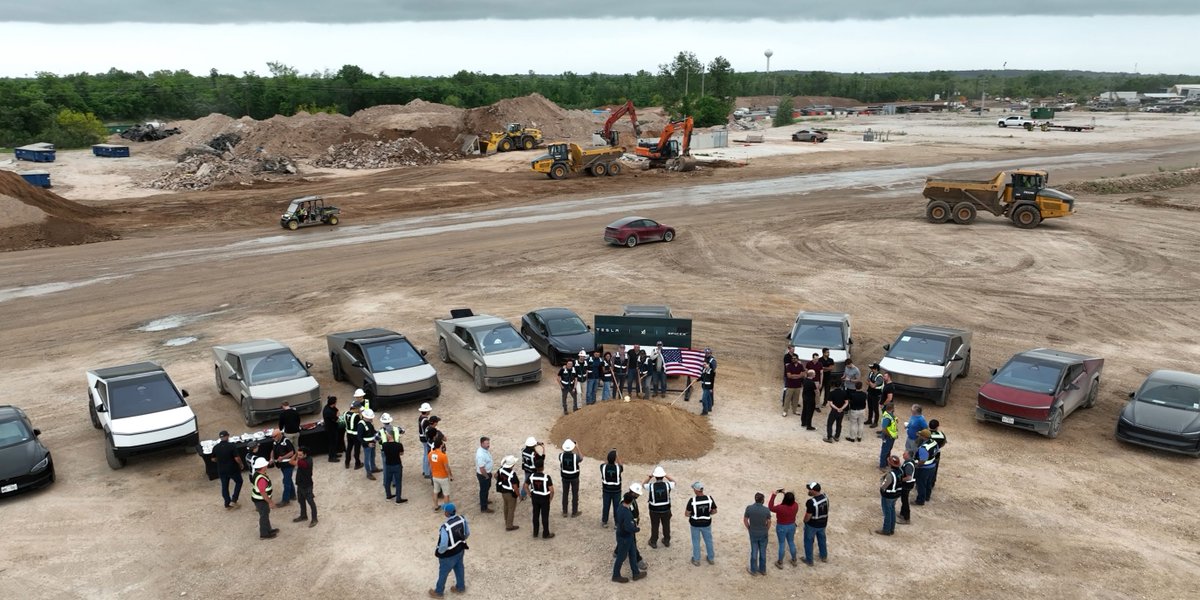
The News: Tesla has officially broken ground on its Terafab research chip fabrication facility on the North Campus of Gigafactory Texas in Austin.
Why It Matters: This is the moment Tesla's semiconductor independence moves from announcement to construction — with direct implications for FSD, Cybercab, and Optimus.
Source: @SawyerMerritt on X
Tesla Breaks Ground on Terafab Chip Fabrication Facility at Giga Texas
Shovels are in the ground. Tesla has officially begun construction on Terafab — its in-house semiconductor fabrication complex — at the North Campus of Gigafactory Texas in Austin. What started as an Elon Musk announcement in late March 2026 is now a construction site, and the implications for every Tesla owner run deeper than most realize.

What Is Terafab — And Why Is Tesla Building Its Own Chip Fabs?
Terafab is not a single building. According to verified reporting, the complex will consist of two separate chip fabrication plants operating side by side on Giga Texas's North Campus — a joint venture between Tesla, SpaceX, and xAI.
The division of labor between the two facilities tells you everything about Tesla's ambitions:
- Facility 1 (Terrestrial): Produces chips for Tesla vehicles — specifically targeting Full Self-Driving compute, the Cybercab robotaxi program, and Optimus humanoid robots.
- Facility 2 (Space-grade): Focused on high-powered AI chips designed for orbital data centers — essentially AI satellites in space, supporting what is expected to be a next-generation Starlink intelligence layer.
The target process node is 2 nanometers — putting Terafab in direct competition with TSMC's most advanced production lines. The stated computing output goal is staggering: 1 terawatt of computing power per year. That's 1 trillion watts of AI processing capacity manufactured annually, on American soil, under one roof.
📊 Key Figures
| Metric | Value | Context |
|---|---|---|
| Estimated Investment | $20B – $25B | Pilot facility valuation |
| Computing Output Target | 1 terawatt / year | 1 trillion watts of AI compute |
| Process Node | 2nm | Cutting-edge; matches TSMC N2 |
| Number of Fabs | 2 | Terrestrial + space-grade AI |
| Location | Austin, TX | North Campus, Giga Texas |
| Announcement Date | March 21–26, 2026 | ~4 weeks from announcement to groundbreaking |
Vertical Integration — Tesla's Actual Superpower
What makes Terafab structurally different from a contract fab relationship is the integration model. The facility is designed to bring every stage of semiconductor production under one roof: chip design, lithography, fabrication, memory production, advanced packaging, and testing. No handoffs to third parties. No supply chain exposure at critical nodes.
Tesla has already demonstrated what vertical integration does for manufacturing speed and cost at Giga Texas itself — the same factory where the Model Y's rear underbody is cast in a single piece rather than assembled from 70+ stamped parts. Apply that same philosophy to semiconductors, and the competitive advantage compounds fast.
For Tesla owners, the most direct near-term implication is FSD compute. Tesla's current AI inference hardware — the HW4 chip — is manufactured externally. Terafab, once operational, would give Tesla direct control over the silicon that runs your car's autonomous driving stack. That means faster iteration cycles, tighter hardware-software co-design, and potentially lower costs that could flow through to vehicle pricing or FSD subscription fees over time.
🔭 The BASENOR Take
Timeline: Groundbreaking April 22, 2026 — approximately four weeks after Elon Musk's official Terafab announcement in late March 2026. That is an unusually fast transition from announcement to construction, suggesting significant pre-planning and site preparation had already occurred.
Impact Level: 🔴 High — This is a long-cycle infrastructure play, but its downstream effects on FSD hardware, Cybercab economics, and Optimus production costs are material for every Tesla owner.
Confidence: High — Groundbreaking is confirmed by on-site reporting. Investment figures and technical specs are sourced from verified reporting around the original announcement.
Watch: The terrestrial fab's production timeline will be the key variable. Chip fabs at this scale typically require 3-5 years from groundbreaking to volume production. The real question is whether Tesla can compress that timeline the way it compressed Giga Berlin and Giga Texas construction schedules.
📰 Deep Dive
The semiconductor industry has long been one of the most capital-intensive and geographically concentrated sectors on earth — a vulnerability that became acutely visible during the 2021-2023 chip shortage that cost the auto industry an estimated $210 billion in lost revenue. Tesla, to its credit, navigated that crisis better than most by rewriting firmware to use alternative chips and maintaining tighter supplier relationships. But the lesson was clear: dependency on external fabs is a strategic liability at scale.
Terafab represents Tesla's answer to that liability — not just for vehicles, but for the entire Musk industrial ecosystem. The collaboration between Tesla, SpaceX, and xAI under one fab roof is significant. It means the fixed costs of building and operating a 2nm fabrication facility — which are enormous — get amortized across multiple high-volume chip consumers. Tesla needs FSD and Optimus chips. SpaceX needs compute for Starlink's next-generation satellite intelligence. xAI needs AI accelerators for Grok's inference infrastructure. Together, they create the demand base to justify a fab that none of them could individually sustain at this technology node.
For the broader EV and AI industry, Terafab signals something larger: the emergence of vertically integrated technology conglomerates that control their own silicon. If Tesla successfully produces 2nm chips at scale in Austin, it joins an extraordinarily short list of entities capable of that feat — currently limited to TSMC, Samsung, and Intel (in varying states of readiness). That is not a list Tesla was expected to join this decade. The groundbreaking today suggests the timeline is more aggressive than most analysts anticipated.
For Tesla owners tracking the FSD roadmap and the Cybercab launch window, Terafab is the infrastructure layer underneath everything. Better chips, designed and manufactured in-house, mean faster neural network training, more capable inference at the edge, and ultimately a more capable autonomous driving product. The shovels going into the ground at Giga Texas today are, in a very real sense, the foundation of Tesla's next decade.
🚕 Following the Robotaxi rollout? See every operating city, launch date and announced market in our Tesla Robotaxi Tracker.
🤖 Tracking Tesla's humanoid robot? See every Optimus production milestone and appearance in our Tesla Optimus Tracker.
Related Gear
Gear up your Tesla with tested, custom-fit BASENOR accessories — shop Tesla accessories →
Sources & reporting notes
The links below identify the material source records used for this report.
- @SawyerMerritt on X (2026-04-22T20:14:05.000Z) — Direct source
- @SawyerMerritt on X (2026-04-22T22:13:47.000Z) — Direct source
Source links are preserved as published or accessed. See our editorial standards and corrections policy.
The BASENOR Editorial Desk covers Tesla, SpaceX, and related technology, curating reporting from primary sources — official accounts, regulatory filings, and software release data. Every article passes source-record and fact-checking review before publication. About the newsroom.
This report was curated by the BASENOR Editorial Desk from the sources listed above. Read our editorial standards or email editorial@basenor.com to report an error.