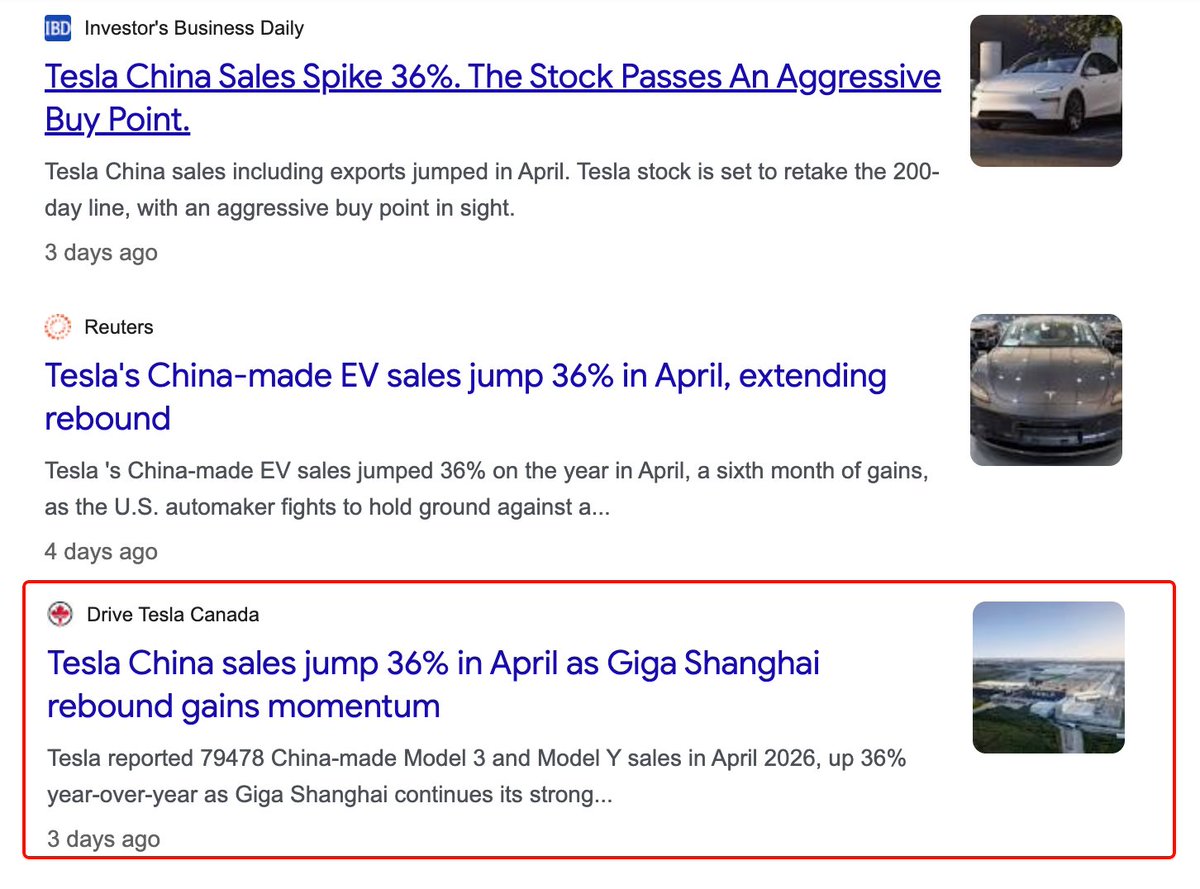
Last week, a wave of headlines declared Tesla's China sales had surged 36%. That figure was real — but it measured the wrong thing. When you look at what Tesla actually sold to Chinese customers in April 2026, the picture is considerably less flattering: retail sales declined nearly 10% year-over-year, marking the second consecutive month of annual decline in the world's largest EV market.

What the 36% Number Actually Measured
The confusion stems from a fundamental distinction in how China auto data gets reported: wholesale volume versus retail sales.
The 36% increase cited in most headlines refers to Giga Shanghai's wholesale output — the total number of vehicles that rolled off the production line, including units destined for export markets in Europe, Asia-Pacific, and beyond. According to data from the China Passenger Car Association (CPCA), Tesla's Shanghai factory produced 79,478 vehicles in April 2026, up roughly 36% year-over-year.
Of those 79,478 units, 53,522 were exported — an 80% increase year-over-year and the second-highest export figure ever recorded for the Shanghai plant. That export surge is genuinely impressive. But it tells you about Tesla's global manufacturing capacity, not about how Tesla is competing inside China.
The Retail Reality
Strip out the exports, and Tesla's domestic retail sales in China for April 2026 came to 25,956 vehicles — a 9.66% year-over-year decline, per CPCA data released May 11. Month-over-month, the drop was even sharper: retail sales fell 53.74% compared to March 2026, though that kind of sequential swing is partly seasonal and partly tied to end-of-quarter delivery patterns.
April 2026 China Scorecard
Source: China Passenger Car Association (CPCA)
A Market Share Problem, Not Just a Slow Month
The cumulative picture is harder to dismiss as a one-month blip. Through the first four months of 2026, Tesla's retail sales in China totaled 138,754 vehicles — down 15% from the same period in 2025. Its share of China's new energy vehicle retail market in April stood at 3.06%, the lowest reading since November 2025. In the battery-electric-only segment, Tesla's share was 4.48%, also a multi-month low.
China is not a market where you can afford to lose ground slowly. Domestic brands have been relentless on price, feature cadence, and local brand affinity. Tesla's competitive position — once dominant — has been steadily compressed, and the April data suggests that pressure isn't easing.
Why the Misleading Headlines Spread
Wholesale data from Giga Shanghai gets released earlier — it dropped on May 7 — while the CPCA's retail breakdown wasn't published until May 11. Most outlets ran with the first available number without waiting for the full picture, or without clearly labeling the distinction. The result: a 36% headline that was technically accurate but practically misleading for anyone trying to understand Tesla's competitive standing in China.
This isn't a minor editorial nuance. For Tesla owners and investors tracking the company's trajectory in its most important growth market, the difference between wholesale output and domestic retail sales is the difference between a good story and a concerning one. The Shanghai factory's export capacity is genuinely strong — but that strength is partly a function of redirecting production toward markets where Tesla is more competitive, not a sign that China demand is recovering.
The CPCA retail figures are the number worth watching each month. Everything else is noise.

David covers the EV industry, regulatory developments, and accessory ecosystem. 15+ years writing about consumer tech. Based in London.
Sources verified at publish time. Spotted an inaccuracy? Email editorial@basenor.com.