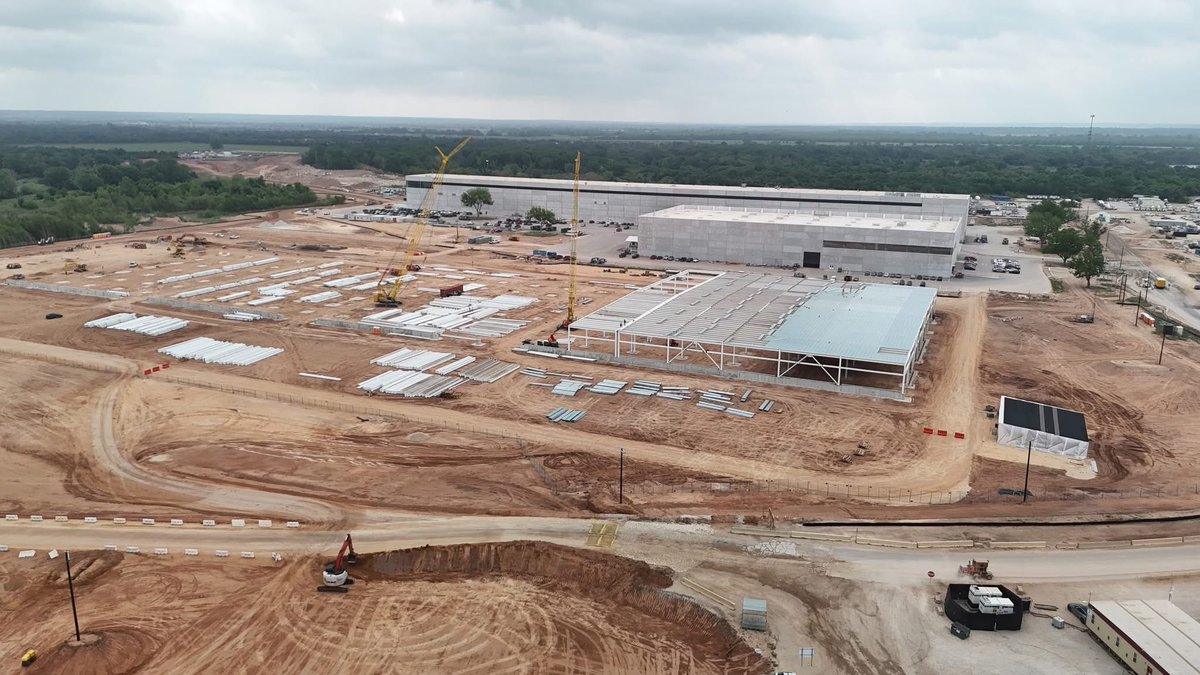
A year ago, Cortex 2.0 was a construction site. Today, it's a functioning AI supercomputer cluster running training workloads at Giga Texas — and a new comparison photo from aerial observer Joe Tegtmeyer makes the transformation impossible to ignore.

Tegtmeyer's April 30 photos place the two snapshots side by side — one from 2025, one from this week — and the scale of what Tesla has erected in twelve months is striking. He notes that even by Tesla's standards, a project of this magnitude takes time: sourcing the land, securing power agreements, procuring specialized hardware, and coordinating construction across a campus that never really stops expanding.
The numbers behind the buildout are substantial. Cortex 2.0 is built around roughly 100,000 Nvidia H100/H200 GPUs and was designed to come online in phases — an initial 250MW activation targeted for April 2026, scaling to a full 500MW by mid-year. That power draw alone puts it among the largest AI training facilities anywhere. The cluster feeds training workloads for FSD neural networks, the Robotaxi service, and Optimus robot development — three programs that all depend on the same underlying compute.
What the photos capture is the physical reality of Tesla's pivot toward AI infrastructure. The company's 2026 capital expenditure is expected to exceed $20 billion, a figure that reflects how seriously Tesla is treating compute capacity as a competitive moat. Cortex 2.0 isn't a side project — it's the engine that determines how fast FSD improves, how quickly Optimus learns new tasks, and how confidently Tesla can scale its Robotaxi fleet.
The full 500MW buildout isn't finished yet, and Tesla is already moving on the next layer: Dojo 3 development restarted in January 2026, and the company's AI chip roadmap now extends through AI5, AI6, AI7, and beyond on compressed nine-month design cycles. The pace of construction captured in Tegtmeyer's photos isn't the finish line — it's one milestone in a much longer race.
Related Gear
Gear up your Tesla with tested, custom-fit BASENOR accessories — shop Tesla accessories →
Sources & reporting notes
The links below identify the material source records used for this report.
- @JoeTegtmeyer on X (2026-05-01T04:39:53.000Z) — Direct source
Source links are preserved as published or accessed. See our editorial standards and corrections policy.
The BASENOR Editorial Desk covers Tesla, SpaceX, and related technology, curating reporting from primary sources — official accounts, regulatory filings, and software release data. Every article passes source-record and fact-checking review before publication. About the newsroom.
This report was curated by the BASENOR Editorial Desk from the sources listed above. Read our editorial standards or email editorial@basenor.com to report an error.