📌 UPDATE — September 4, 2026
Tesla's Cybercab has officially launched commercial operations in the US, with early riders reporting just a 2-minute wait time and fares priced at nearly half the cost of a Model Y Robotaxi. First impressions from riders describe the experience as "solid and extremely confident," with one standout feature being interior cabin lights that sync dynamically to music — an effect Sawyer Merritt called "almost euphoric." Tesla has separately confirmed the Cybercab will go on display in Beijing, Shanghai, and soon Hong Kong starting mid-September, but with no plans for sales or commercial operations in China at this time.
🎵 Cabin lights syncing to music — @SawyerMerritt

💰 Cybercab fare nearly half of Model Y Robotaxi — @DirtyTesLa
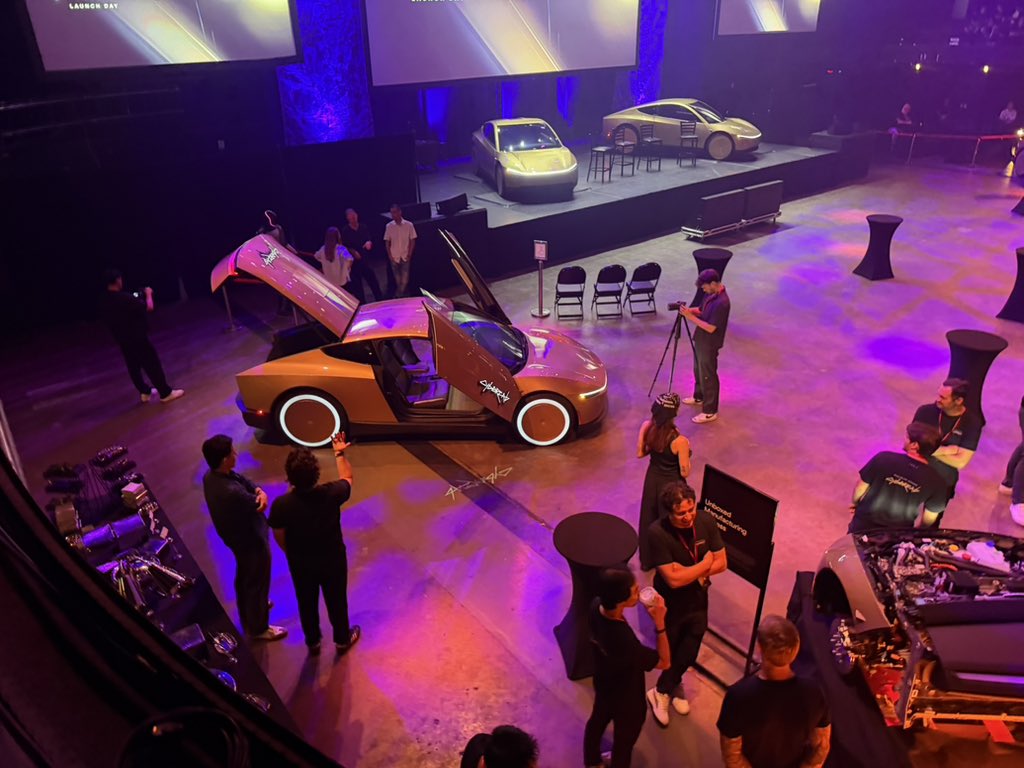
Tesla's purpose-built Cybercab robotaxi rolled onto Austin streets Wednesday night with its first public passengers on board, and the early videos coming out of the demonstration paint a picture of a vehicle that's more radical departure than iterative EV. Riders documented glowing wheel accents, a Starlink-connected infotainment stack, an exposed look at the 4680 structural battery pack, and — perhaps most tellingly — a cabin where nearly every function is controlled through the Tesla app rather than an in-car screen.
The demonstration follows Tesla's October 2024 concept reveal and confirms the timeline the company has been telegraphing all year: pilot production began at Gigafactory Texas in February 2026, with scale production kicking off in April, according to reporting from Electrek and Motor1.
What the First Rides Revealed
Whole Mars Catalog's Omar Qazi (@wholemars) posted a rapid-fire series of videos from what appears to be the first public Cybercab rides, capturing details enthusiasts have been speculating about for nearly two years.

The glowing wheel treatment — visible in the first post — is the design flourish most likely to dominate social feeds this week. It's a signature visual cue for a fleet vehicle that will need to be recognizable to riders hailing it curbside, particularly at night.

Under the Skin: The 4680 Structural Pack
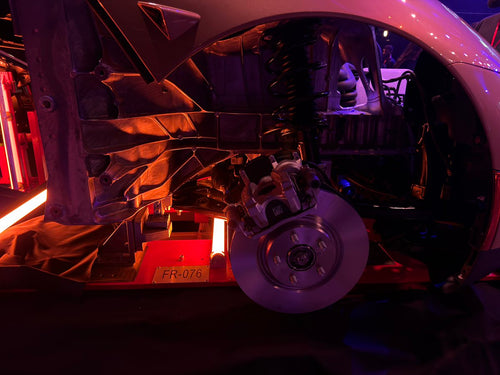
One of the more technically significant moments came when Qazi captured footage of the Cybercab's 4680 structural battery pack. This is the same architectural approach Tesla pioneered on Model Y and has been refining for years: the battery cells double as structural elements of the vehicle body, eliminating a separate pack enclosure and reducing part count.

For a purpose-built robotaxi designed to run high-utilization duty cycles, the structural pack approach is arguably more important than it was for consumer Teslas. Fewer parts typically means lower manufacturing cost, and a stiffer body-battery unit is well-suited to the constant stop-start driving a robotaxi will face.
Starlink Integration and In-Car Entertainment
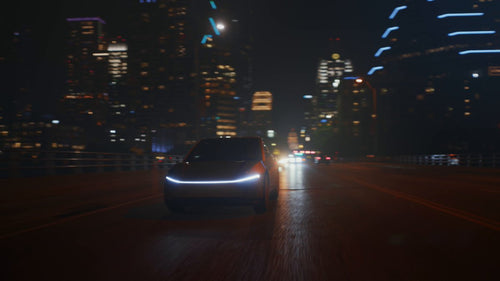
Perhaps the most unexpected feature captured in the rides is native Starlink integration. Qazi's video shows the Cybercab's connectivity setup, and Joe Tegtmeyer (@JoeTegtmeyer) followed up with footage of himself watching a Starship launch video while the Cybercab autonomously drove him through Austin at night.

Starlink connectivity is a strategic move: high-bandwidth, low-latency connectivity everywhere the Cybercab operates — including areas with spotty cellular coverage — is important both for streaming entertainment (a differentiator when riders have 15+ minutes of screen time in the cabin) and for continuous telemetry and remote assistance if the FSD stack needs a human backup.

The App Is the Interface
The most unusual observation from Tegtmeyer's coverage is that the Cybercab appears to move most vehicle-function controls onto the Tesla app rather than any in-car screen. In his video, he demonstrates adjusting cabin accent lighting entirely through his phone.
"Seems like most of the control of vehicle functions are on the app versus the screen in the car." — @JoeTegtmeyer

This makes sense in a shared-fleet context. Every rider who hails a Cybercab will already have the Tesla app installed (that's how they summon the vehicle in the first place). Pushing climate, lighting, and entertainment controls to the phone means Tesla doesn't need to design an in-cabin screen that has to accommodate strangers' preferences on every trip — the interface a rider already knows follows them into the car.
Qazi separately captured the Cybercab's climate control interface, confirming that basic environmental controls are accessible even without deep app navigation.

The First Ride
Qazi's video of his "first ever Cybercab ride" and Tegtmeyer's overnight run through Austin both emphasize the same thing: the driving experience itself feels routine. Tegtmeyer called it "so smooth and awesome," describing an autonomous ride at night with no theatrical hand-off moments or hesitation.

The Cybercab operates on Tesla's FSD software with no steering wheel, pedals, or manual controls — a distinction that separates it from every FSD-equipped consumer Tesla currently on the road. It is not a retrofit; it is purpose-built.
What This Means for Tesla Owners
For existing Tesla owners, the immediate takeaway is that the Cybercab is not a car you buy the way you buy a Model 3 or Model Y — it's the pointy end of Tesla's transition into a mobility service operator. But the technology on display tonight has strong implications for consumer vehicles:
- Starlink integration is a plausible future feature for consumer Teslas, particularly Cybertruck and any future off-road-oriented products where cellular gaps matter.
- App-first controls could signal a broader UX direction. Tesla has been progressively moving functions from stalks and buttons into the touchscreen; pushing them further into the phone is the logical next step.
- 4680 structural pack refinement in a high-volume robotaxi should accelerate cost-per-kWh reductions that eventually flow into consumer vehicles.
What to Watch Next
Several open questions remain from tonight's demonstrations:
- Public ride availability: Tonight's rides appear to be part of a curated event. When Austin (or any city) opens Cybercab rides to the general public through the Tesla app is the next major milestone.
- Pricing model: Tesla has previously suggested per-mile pricing dramatically below current rideshare rates. The first published fare will define the competitive dynamic against Waymo and Uber.
- Fleet scale: How many Cybercabs are operating in Austin today, and what's the ramp for the rest of 2026?
- Owner-operated fleet timeline: Elon Musk has repeatedly suggested individual owners will eventually be able to add their own Cybercabs to the network. The mechanics of that program remain unspecified.
Tonight was a proof-of-experience, not a proof-of-scale. The videos coming out of Austin show a vehicle that works — smoothly, at night, on real streets, with real passengers watching Starship replays instead of watching the road. Whether Tesla can turn that experience into a ridehail service that meaningfully competes on price and coverage is the question the next six months will answer.
🚕 Following the Robotaxi rollout? See every operating city, launch date and announced market in our Tesla Robotaxi Tracker.
🚀 Following the Starship program? See every test flight, official outcome and the next launch window in our SpaceX Starship Tracker.
Related Gear
Gear up your Tesla with tested, custom-fit BASENOR accessories — shop Tesla accessories →
Sources & reporting notes
The links below identify the material source records used for this report.
- @wholemars on X (2026-09-04T01:00:45.000Z) — Direct source
- @wholemars on X (2026-09-04T01:02:46.000Z) — Direct source
- @wholemars on X (2026-09-04T01:03:21.000Z) — Direct source
- @wholemars on X (2026-09-04T01:04:11.000Z) — Direct source
- @wholemars on X (2026-09-04T01:20:12.000Z) — Direct source
- @wholemars on X (2026-09-04T01:20:15.000Z) — Direct source
- @JoeTegtmeyer on X (2026-09-04T01:45:22.000Z) — Direct source
- @JoeTegtmeyer on X (2026-09-04T01:48:00.000Z) — Direct source
- @JoeTegtmeyer on X (2026-09-04T01:58:29.000Z) — Direct source
Source links are preserved as published or accessed. See our editorial standards and corrections policy.
The BASENOR Editorial Desk covers Tesla, SpaceX, and related technology, curating reporting from primary sources — official accounts, regulatory filings, and software release data. Every article passes source-record and fact-checking review before publication. About the newsroom.
This report was curated by the BASENOR Editorial Desk from the sources listed above. Read our editorial standards or email editorial@basenor.com to report an error.