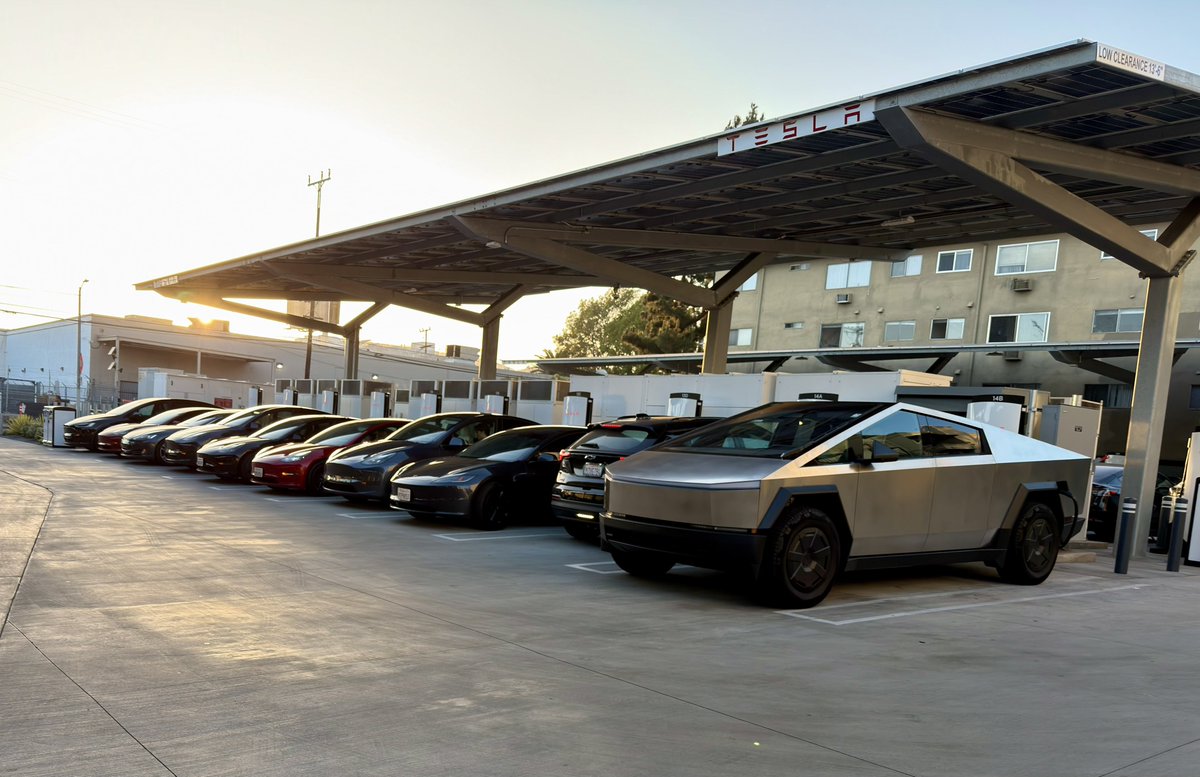
One year after opening its doors on Santa Monica Boulevard, the Tesla Diner in West Hollywood has settled the debate about whether destination Supercharging works: 80 stalls, 1,600 sessions a day, and a first-year energy throughput that's roughly double the second-busiest Supercharger on the planet. The numbers aren't close.

What the First-Year Data Shows
Tesla's senior director of charging, Max de Zegher, confirmed the figures publicly: 21.2 GWh of energy delivered between July 21, 2025 and July 21, 2026, across more than 580,000 total charging sessions. That works out to an average of 20 sessions per stall per day, and 726 kWh of throughput per stall — numbers that would be impressive for a busy urban Supercharger with a quarter of the capacity.
| Metric | Year 1 Figure |
|---|---|
| Total charging sessions | 580,000+ |
| Average daily sessions | ~1,600 |
| Total energy delivered | 21.2 GWh |
| Daily throughput per stall | 726 kWh |
| Sessions per stall per day | 20 |
| Global rank by energy throughput | #1 (≈2× #2) |
Sawyer Merritt's visit on a random Wednesday evening — not a weekend, not a holiday — found every single one of the 80 stalls occupied. That's not a fluke; it's a pattern the utilization data already implied.
Why This Location Works
The Diner's design solves a problem that standard Supercharger locations don't: it gives drivers a reason to stay. The 7001 Santa Monica Blvd site pairs 80 V4 stalls (capable of up to 500 kW peak output) with a 24/7 two-story American diner, over 250 seats, car-side food ordering through the vehicle's infotainment screen, and two 66-foot LED screens. Drivers aren't killing time in a parking lot — they're eating, watching something, or working. The dwell time that would feel frustrating at a standard stall becomes the point.
The station is also open to all NACS-compatible EVs, not just Teslas, which expands the addressable user base significantly. In a dense urban market like West Hollywood, that decision alone adds meaningful volume.
To manage the inevitable congestion, Tesla applies dynamic fees when all 80 stalls are near capacity, a vehicle has reached 100% state of charge, and a 35-minute grace period has elapsed. Owners receive a notification through the Tesla app. It's a mechanism borrowed from the standard Supercharger network, but at this scale it carries more weight — 80 occupied stalls means the fee structure is doing real work on a regular basis.
The Broader Implication
The Diner was always a proof-of-concept as much as a charging station. Tesla CEO Elon Musk has indicated that additional locations are planned — potential sites near Giga Texas and Tesla's Palo Alto engineering hub have been mentioned — though no firm timelines have been announced. What the first-year data gives Tesla is something more valuable than a flagship location: it's a replicable business case. A site that delivers 21.2 GWh in twelve months, at 500 kW per stall, in a market where EV adoption is high and real estate is expensive, demonstrates that the economics of destination charging can work even at premium locations.
The narrative that the Tesla Diner was an expensive vanity project hasn't survived contact with the utilization numbers. The harder question now is how quickly Tesla moves to replicate the model — and whether the next locations can match what West Hollywood has done in year one.
Related Gear
Gear up your Tesla with tested, custom-fit BASENOR accessories — shop Tesla accessories →
Sources & reporting notes
The links below identify the material source records used for this report.
- @SawyerMerritt on X (2026-07-30T03:35:41.000Z) — Direct source
Source links are preserved as published or accessed. See our editorial standards and corrections policy.
The BASENOR Editorial Desk covers Tesla, SpaceX, and related technology, curating reporting from primary sources — official accounts, regulatory filings, and software release data. Every article passes source-record and fact-checking review before publication. About the newsroom.
This report was curated by the BASENOR Editorial Desk from the sources listed above. Read our editorial standards or email editorial@basenor.com to report an error.