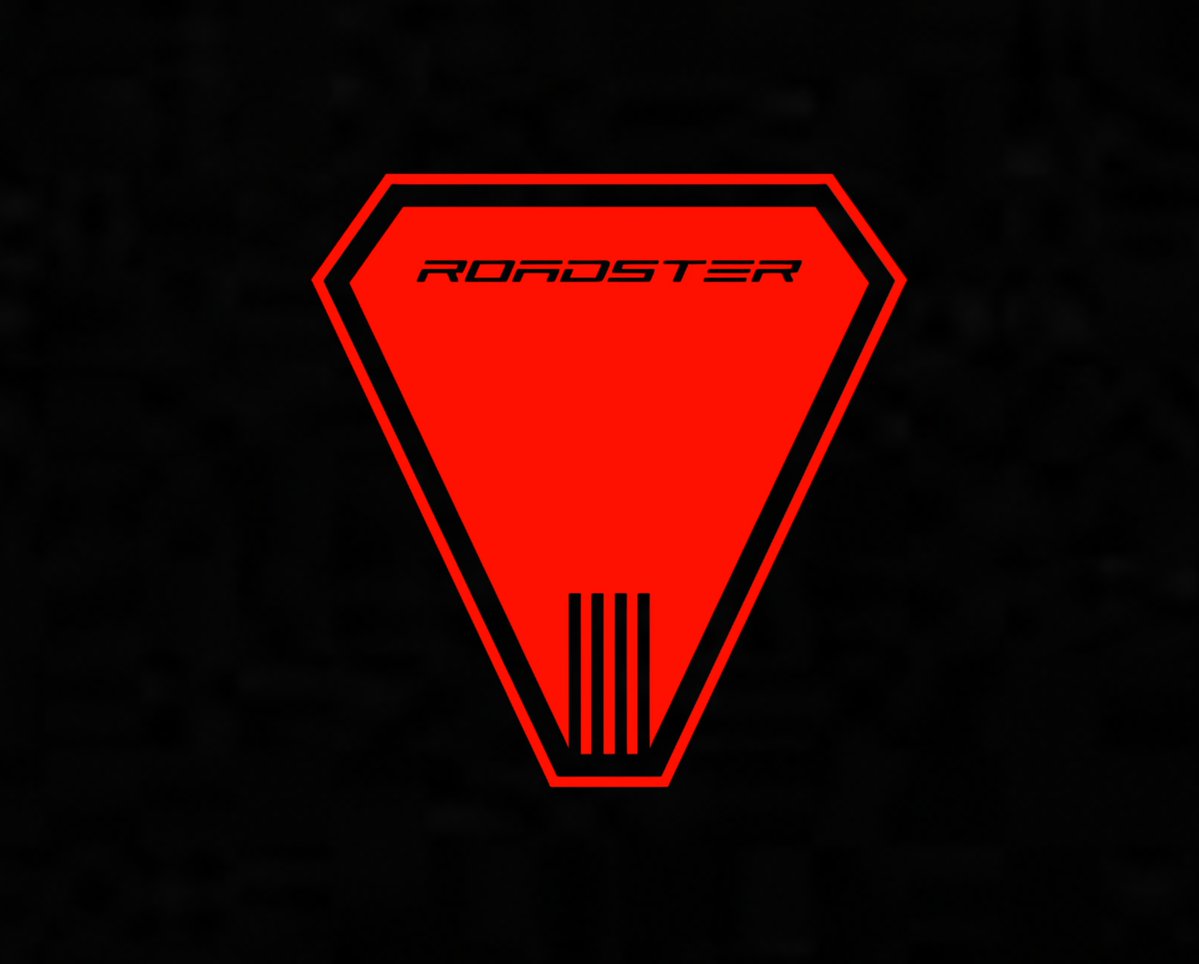
Tesla has quietly filed two trademark applications with the United States Patent and Trademark Office that may be the clearest signal yet of where the long-awaited next-generation Roadster stands. Researcher and Tesla watcher Sawyer Merritt spotted the filings and published what could be the car's official new logo — a triangular design of three flowing, curved lines described in the application as depicting speed, propulsion, heat, or wind.

What Tesla Filed
According to USPTO records, Tesla filed both applications on February 3, 2026, on an "intent to use" basis — meaning the company has declared a genuine plan to put these marks into commerce, but hasn't necessarily deployed them yet. There are two distinct filings:
The first covers a stylized ROADSTER wordmark — all-caps, stretched, and angular with segmented letterforms that lean into a futuristic, high-performance aesthetic. The second is the design mark: a triangle composed of three flowing curved lines that, per the filing's own language, evoke speed, propulsion, heat, or wind. Merritt rendered the badge in red to make it more legible, since trademark filings are typically submitted in black and white.
Merritt also compiled all three confirmed next-gen Roadster logos and wordmarks into a single reference image — giving the clearest consolidated look at Tesla's visual identity for the car to date.

Where the Roadster Stands Right Now
The trademark filings land at a moment when the Roadster's debut timeline is finally starting to sharpen. Elon Musk stated in March 2026 that an unveil would happen by the end of April — that date passed. During Tesla's Q1 2026 earnings call, Musk revised the window to "a month or so," citing the need for significant testing and validation before the demo event. That puts the unveiling tentatively in late May or early June 2026.
Production, by Musk's own framing, would follow 12 to 18 months after the demo — pointing to a real-world start date somewhere in mid-to-late 2027 or into 2028. Tesla also filed patents for one-piece seats designed for the Roadster in March 2026, and Musk has said the production version will look "very different" from what was shown at the original 2017 reveal.
The original 2017 spec sheet — 0-60 mph in 1.9 seconds, a top speed above 250 mph, 620-mile range from a 200 kWh pack, and a base price of $200,000 — remains the public benchmark, though those numbers are expected to be updated or surpassed at the actual unveil. The optional SpaceX package with cold-air thrusters, which Musk has floated as a potential sub-one-second 0-60 option, adds another layer of intrigue.
Why Trademark Filings Matter
"Intent to use" trademark applications carry legal weight — companies that file them are required to demonstrate actual commercial use within a defined window or risk losing the registration. The fact that Tesla filed in February 2026 and is now approaching the unveil window is consistent with a company that is genuinely preparing to bring these marks to market, not just reserving them speculatively.
The design language itself is worth noting. Three flowing curved lines forming a triangle is a departure from Tesla's typical flat wordmark approach and suggests the Roadster may carry its own distinct visual identity — separate from the broader Tesla badge system used on the Model 3, Y, S, X, and Cybertruck. Whether this mark appears on the car's bodywork, wheel centers, or marketing materials remains to be seen.
With an unveil now likely just weeks away, these filings are the kind of pre-launch paperwork that tends to surface right before a product goes public. The Roadster's identity — at least on paper — is taking shape.

Marcus covers Tesla's software releases, FSD rollouts, and OTA changes. Background in automotive engineering. Based in Austin.
Sources verified at publish time. Spotted an inaccuracy? Email editorial@basenor.com.