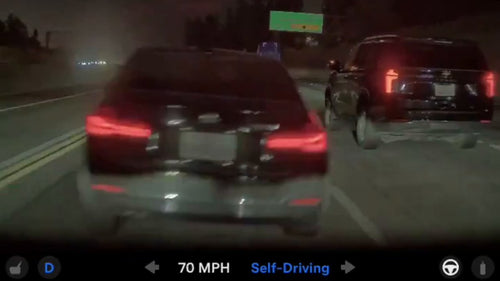
The News: Three previously unseen FSD (Supervised) UI elements were observed during official demo rides in Europe — none of which appear in any published release notes.
Why It Matters: These changes hint at a more communicative, transparency-focused FSD interface being developed specifically for the European regulatory environment — and may preview what's coming globally.
Source: @TeslaNewswire on X
Tesla's FSD Europe Demo Rides Reveal 3 Unannounced UI Changes
As Tesla inches toward full regulatory approval for FSD (Supervised) in Europe, demo rides are surfacing interface details that haven't appeared in any official changelog. Spotted during hands-on rides in the EU, three distinct UI changes suggest Tesla is quietly refining how the system communicates with drivers — and the changes are more meaningful than cosmetic.

🔍 What Was Observed
None of these three changes appear in Tesla's published release notes. Here's what was spotted and what each likely signals:
1. Lead Vehicle Turns Yellow When You're Getting Close
The vehicle representation directly ahead of your Tesla in the FSD visualization now shifts from its default color to yellow as following distance decreases. This is a clear proximity warning built directly into the FSD display — giving drivers an at-a-glance indicator that the system is registering a tightening gap. Think of it as a visual equivalent of the audible following-distance chime, but baked into the FSD UI itself.
2. A New Button — Possibly a Shortcut to the FSD View
A new on-screen button was observed during the demo rides. Based on its placement and behavior, observers believe it may function as a dedicated shortcut to the FSD visualization view — similar to how the Nav button provides quick access to navigation. If confirmed, this would reduce the number of taps needed to pull up the FSD camera and sensor display, a friction point current FSD users know well.
3. A Question Mark on the Speed Limit Display
Perhaps the most interesting of the three: a question mark appearing on or near the speed limit indicator. The most logical interpretation is that this signals uncertainty in the system's speed limit detection — essentially FSD flagging to the driver, in real time, that it isn't fully confident in the speed limit it's reading. This kind of explicit uncertainty communication is notable. It's the system saying "I'm not sure" rather than silently defaulting to a potentially incorrect value.
📊 Key Figures
| Metric | Value |
|---|---|
| EU road testing completed | 1.6M+ km (~1M miles) |
| Customer ride-alongs conducted | 13,000+ |
| Track test scenarios | 4,500+ |
| FSD version observed in Netherlands | v14.2.2.5 |
| Expected Netherlands RDW approval | April 10, 2026 |
| Broader EU rollout target | Summer 2026 |
🔭 The BASENOR Take
Timeline: Observed during active EU demo rides, March 31, 2026. Netherlands RDW approval expected April 10, 2026.
Impact Level: Medium — these are UI refinements, not capability changes, but they signal a meaningful shift in how Tesla is designing FSD communication for a regulatory audience.
Confidence: Medium — observed firsthand during official demo rides, but not yet confirmed in release notes or official Tesla communications.
The timing here is deliberate. Tesla is in the final stretch of regulatory approval in Europe — the Dutch RDW is expected to formally greenlight FSD (Supervised) around April 10, 2026, with a broader EU rollout anticipated by summer 2026 through mutual recognition provisions. These UI changes aren't accidental leaks; they're almost certainly part of Tesla's compliance and communication strategy for European regulators and drivers.
European road safety regulators have historically demanded more explicit driver communication from ADAS systems than their US counterparts. The speed limit question mark is the clearest example of this philosophy in action: rather than silently acting on uncertain data, the system surfaces its own confidence level to the driver. That's a significant design choice, and one that could well migrate back to the US version of FSD as Tesla refines the interface globally.
For current FSD users in North America, none of these changes are live yet — but they're worth watching. If the yellow proximity warning and uncertainty indicators prove effective in European testing, expect them to appear in a future stateside update. You can follow all the latest developments in our FSD coverage.
📰 Deep Dive
What makes these three UI changes collectively interesting is the story they tell about where Tesla's FSD interface design is heading. Each one addresses a different type of driver uncertainty: proximity awareness (yellow lead vehicle), interface accessibility (new shortcut button), and system confidence (speed limit question mark). Together, they represent a more communicative FSD — one that keeps the driver meaningfully in the loop rather than operating as a black box.
The speed limit question mark deserves particular attention. Speed limit detection has been a known edge case for FSD — temporary signs, obscured signs, and recently changed limits can all trip up the system. Historically, FSD would simply act on its best guess. Surfacing that uncertainty to the driver in real time is a fundamentally different approach, and one that aligns closely with the "supervised" framing Tesla has leaned into. The driver isn't just a fallback; they're an active participant with access to the system's confidence state.
It's also worth noting the scale of testing behind these demo rides. According to verified data, Tesla has logged over 1.6 million kilometers of FSD testing on EU roads over the past 18 months, with more than 13,000 customer ride-alongs. The UI details emerging now aren't early prototypes — they're coming out of a mature, extensively validated testing program. That context makes these observations more credible, and more likely to reflect what the production EU release will actually look like.
Whether these specific changes arrive in Europe first and then roll out globally, or get folded into a broader FSD update simultaneously, remains to be seen. But for European Tesla owners waiting on FSD access — and for North American owners watching the EU rollout closely — these are the first real glimpses of what the next generation of FSD's interface looks like in practice.
📋 Tracking Tesla software? See every firmware, FSD and app version in one place in our Tesla Software Update Tracker.
Related Gear
Gear up your Tesla with tested, custom-fit BASENOR accessories — shop Tesla accessories →
Sources & reporting notes
The links below identify the material source records used for this report.
- @TeslaNewswire on X (2026-03-31T19:32:59.000Z) — Direct source
Source links are preserved as published or accessed. See our editorial standards and corrections policy.
The BASENOR Editorial Desk covers Tesla, SpaceX, and related technology, curating reporting from primary sources — official accounts, regulatory filings, and software release data. Every article passes source-record and fact-checking review before publication. About the newsroom.
This report was curated by the BASENOR Editorial Desk from the sources listed above. Read our editorial standards or email editorial@basenor.com to report an error.