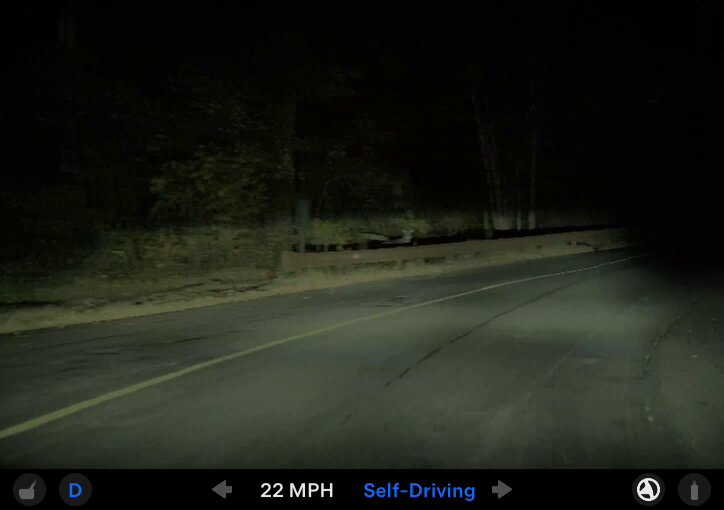
A video circulating on X shows Tesla's FSD (Supervised) system braking for an animal the driver hadn't yet noticed — the latest in a growing string of documented incidents where the system's perception outpaced human reaction time. It's a quiet but consequential capability, and recent software updates suggest Tesla has been deliberately sharpening it.

A Pattern, Not a One-Off
This isn't an isolated clip. Tesla's official account shared a video in July 2026 showing FSD detecting a deer in direct sunlight and initiating braking before the driver intervened — a scenario that tests both perception speed and the system's ability to handle high-contrast lighting. Earlier documented cases include a Cybertruck braking for four deer on a pitch-dark road and a separate highway-speed deer avoidance in Calgary, Canada. Each incident adds to a body of evidence that wildlife detection is a repeatable capability, not a lucky edge case.
The consistency matters. Deer-vehicle collisions cause roughly 1.5 million accidents annually in the US alone, with most occurring at dusk and dawn when visibility is worst and human reaction time is most compromised. A system that can perceive an animal at the edge of headlight range — or in glare — and begin decelerating before the driver processes the threat represents a genuine safety delta.
What the Software Has Been Doing
The capability hasn't been static. FSD v14.3, released in April 2026, included a reported 20% faster reaction time alongside enhanced detection of smaller animals — a meaningful improvement given that smaller animals (rabbits, raccoons, cats) are precisely the objects most likely to be missed at speed. According to release notes and community tracking, FSD v14.3.11 and v14.3.13 — both released in October 2026 — further refined hazard and animal detection, with documented examples of the system identifying small animals at night and executing smooth, natural-feeling slowdowns rather than hard emergency stops.
That last detail is worth noting. A system that brakes abruptly for every perceived hazard creates its own risks — rear-end collisions, passenger injury, driver distrust that leads to disengagement. Smooth, graduated responses that still intervene early enough to prevent a strike are harder to engineer and more useful in practice.
The Harder Problem Still Ahead
Tesla CEO Elon Musk publicly identified the core remaining challenge in early October 2026: small dark animals on dark pavement at night. It's a camera-system problem — low contrast, low light, small target. Musk framed the solution as a software challenge rather than a hardware one, which aligns with Tesla's broader approach of extracting more capability from existing sensor arrays through improved neural net processing.
The longer-term answer may be FSD v15. Tesla VP of AI Ashok Elluswamy stated that v15 carries roughly ten times the parameters of its predecessor — scaling from approximately 1 billion to 10 billion — and was targeted for fleet-wide rollout in October 2026 to support round-the-clock Robotaxi operations. That parameter increase would, in theory, allow the model to handle the kind of low-signal, high-ambiguity scenarios where small animals on dark roads currently slip through. However, Tesla has not made an official announcement confirming v15 has reached the broad public fleet, so owners should not assume they're running it yet.
What This Means for Owners Now
If you're running FSD (Supervised) on a Hardware 4 vehicle, the October updates — v14.3.11 and v14.3.13 — are the builds most likely to reflect the current state of wildlife detection. Owners in rural areas or regions with high deer density are the most direct beneficiaries, but the underlying perception improvements apply to any low-contrast road hazard: debris, pedestrians in dark clothing, cyclists at dusk.
FSD (Supervised) remains an assistance system that requires active driver attention. The wildlife detection capability doesn't change that requirement — but it does mean the system is increasingly likely to catch something you didn't. That's a meaningful shift in what the driver-system partnership actually looks like on a dark country road at 11 p.m.
Related Gear
Gear up your Tesla with tested, custom-fit BASENOR accessories — shop Tesla accessories →
Sources & reporting notes
The links below identify the material source records used for this report.
- @TeslaNewswire on X (2026-11-02T21:04:54.000Z) — Direct source
Source links are preserved as published or accessed. See our editorial standards and corrections policy.
The BASENOR Editorial Desk covers Tesla, SpaceX, and related technology, curating reporting from primary sources — official accounts, regulatory filings, and software release data. Every article passes source-record and fact-checking review before publication. About the newsroom.
This report was curated by the BASENOR Editorial Desk from the sources listed above. Read our editorial standards or email editorial@basenor.com to report an error.