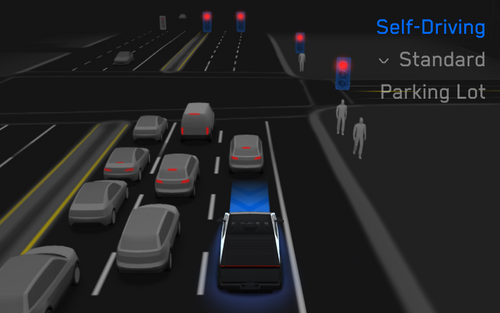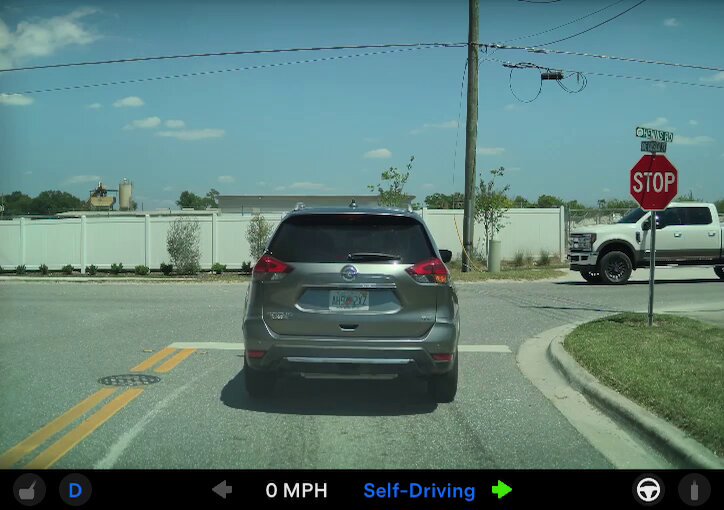
The News: A video clip shows Tesla FSD (Supervised) detecting a parked trailer, choosing not to squeeze past it, reversing to create extra clearance, and then proceeding safely.
Why It Matters: This multi-step decision sequence — detect, pause, reverse, advance — is exactly the kind of nuanced spatial reasoning that separates a capable FSD system from a basic lane-keeping aid.
Source: @TeslaNewswire on X
FSD Sees the Trailer — and Thinks Twice
Most drivers have been there: you're rolling down a narrow street and a parked trailer is blocking your lane. The instinct is to judge the gap and creep through. But what does Tesla FSD (Supervised) do when it faces the same call? According to a clip shared by The Tesla Newswire, the answer is surprisingly deliberate — and it's worth breaking down step by step.

The Four-Step Maneuver, Explained
The clip captures a clean sequence that reveals how FSD's spatial reasoning is maturing:
- Detection: FSD identifies the trailer as an obstacle extending into the vehicle's path — not just a static wall, but an irregular object with depth and overhang.
- Restraint: Rather than attempting to pass through the available gap, the system decides the clearance isn't sufficient. It holds position.
- Reversal: FSD backs up to create more working room — a proactive move that requires the system to model not just the current gap, but the geometry it needs to thread the maneuver safely.
- Controlled advance: With the extra space created, the car moves forward while maintaining a generous buffer from the trailer, completing the pass cleanly.
That four-beat sequence — detect, pause, reverse, advance — is not a scripted trick. It reflects the system weighing its options and choosing the safer, more conservative path rather than the fastest one.
Why Trailers Are a Hard Problem for Autonomous Systems
Trailers are genuinely difficult for computer vision systems. They're long, low, often poorly lit, and their geometry changes depending on the angle of approach. They don't behave like cars or pedestrians, which means the training data for them is far less abundant. Tesla's own owner documentation explicitly warns against towing a trailer while FSD is active — but the challenge shown here is different: detecting and navigating around a stationary trailer parked by someone else.
The most recent FSD (Supervised) release — v14.3.2, which arrived on April 23, 2026 as part of software version 2026.2.9.8 — specifically called out improvements to handling "rare and unusual objects extending, hanging, or leaning into the vehicle path by sourcing infrequent events from the fleet." A parked trailer fits that description precisely. Tesla's approach here is fleet-sourced: the more edge cases the fleet encounters and flags, the more the neural network learns to handle them. The clip above is a visible output of that flywheel working.
The same update also rewrote the AI compiler and runtime using MLIR, delivering a 20% faster reaction time. That speed improvement matters in tight-clearance scenarios where a half-second hesitation can be the difference between a clean pass and a scrape.
🔭 The BASENOR Take
Timeline: FSD v14.3.2 released April 23, 2026 — clip surfaced April 25, 2026
Impact Level: Medium — not a headline feature, but a meaningful signal of capability depth
Confidence: High on the maneuver shown; moderate on whether this is a consistent, repeatable behavior across all scenarios
What to watch: Whether Tesla formally documents trailer-obstacle handling in future release notes, and whether community testing confirms this behavior across different trailer types and lighting conditions
One clip doesn't make a capability. But it does make a point. The fact that FSD chose to reverse rather than gamble on a tight gap is the kind of conservative, human-like judgment that builds trust in the system over time. It's not flashy — it's the right call.
What's also notable is the absence of driver intervention in the clip. The system handled the full sequence autonomously, which is the whole point of the "Supervised" label: the driver is there as a backstop, but ideally never needs to be.
For owners using FSD on a regular basis, this is a useful reminder that the system's edge-case handling is improving with each update — even when Tesla doesn't headline those improvements in the release notes. The fleet is always learning, and clips like this are how that learning becomes visible.
📰 Deep Dive
The broader significance of this clip sits at the intersection of perception and planning. Detecting a trailer is a perception task — the camera array and neural network have to correctly classify an irregular, low-profile object. But deciding to reverse is a planning task: the system has to model its own trajectory, the trailer's geometry, and the clearance needed, then determine that the current position doesn't give it enough room to execute safely. That's a two-layer problem, and the fact that FSD solved both without intervention is the real story here.
Tesla's vision-only approach means there's no LIDAR fallback for edge cases like this. Everything depends on the neural network's ability to build an accurate 3D model of the scene from camera data alone. The v14.3.2 upgrade to the vision encoder — specifically designed to improve 3D geometry understanding — is directly relevant to exactly this kind of scenario. A better geometry model means more accurate clearance estimates, which means more confident (and correct) decisions about whether to proceed or pull back.
It's also worth noting that the reversal maneuver requires FSD to think ahead, not just react. The system isn't just avoiding a collision in the moment — it's creating the conditions for a successful forward pass. That kind of anticipatory planning is one of the harder problems in autonomous driving, and seeing it executed cleanly in an unscripted real-world scenario is a meaningful data point for anyone tracking FSD's maturation.

Marcus covers Tesla's software releases, FSD rollouts, and OTA changes. Background in automotive engineering. Based in Austin.
Sources verified at publish time. Spotted an inaccuracy? Email editorial@basenor.com.