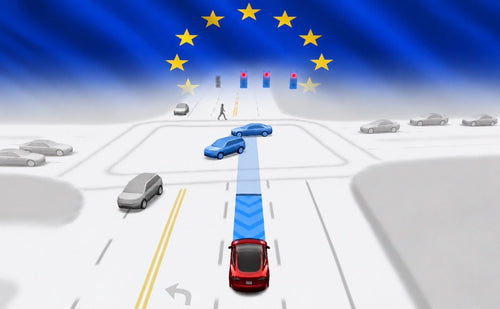
The News: Tesla FSD (Supervised) has demonstrated the ability to read physical detour signs and respond correctly to road closures — without driver input.
Why It Matters: This is a meaningful leap in real-world environmental perception. FSD isn't just following map data — it's reading and acting on temporary, physical signage that no map can predict.
Source: @ray4tesla on X
FSD Just Passed a Test Most Humans Take for Granted
Reading a detour sign sounds simple. Spot the orange arrow, turn right, continue to your destination. Humans do it without thinking. For an autonomous driving system, it's a genuinely complex problem — the sign is temporary, not in any map database, and requires the car to override its planned route based purely on what its cameras see in the moment.
Tesla FSD (Supervised) just did exactly that. Long-time FSD tester Ray (@ray4tesla) captured the moment on video: his Tesla recognized that its intended route was physically closed, spotted a detour sign with a directional arrow indicating an immediate right turn, and executed the correct maneuver — all without driver intervention.

What makes this particularly notable: Ray points out that he could have turned left at the intersection and been rerouted via a different path. FSD didn't just find any way around the closure — it specifically read and obeyed the detour sign's directional instruction. That's a distinction worth paying attention to.
📊 What This Capability Involves
| Capability Layer | What FSD Did | Why It's Hard |
|---|---|---|
| Route Awareness | Detected that its planned route was physically blocked | Closures are temporary and absent from map data |
| Sign Recognition | Read a physical detour sign with a directional arrow | Signs vary in design, placement, and lighting conditions |
| Decision Override | Chose the sign-directed path over a valid alternative route | Required prioritizing real-world visual cues over navigation logic |
| Execution | Turned right immediately as indicated, without driver input | Requires integrating perception, planning, and control in real time |
According to background research, FSD version 14.2.2.4 (released January 24, 2026) introduced an upgraded neural network vision encoder that integrates navigation and routing directly into the vision-based neural network — enabling exactly this kind of real-time handling of closures and detours. This clip appears to be a real-world demonstration of that capability in action.
🚦 Owner's Action Plan
Verdict: Informational — No update or setting change required. This capability is already present if you're running a recent FSD build.
- Confirm your FSD version. Go to Controls → Software on your touchscreen. If you're on 14.2.2.4 or later, the neural network vision encoder upgrade is already on your car.
- Keep FSD enabled through detour zones. If you encounter a road closure, don't immediately grab the wheel. Give FSD a moment to assess the environment — it may recognize the situation and respond correctly on its own.
- Stay engaged as required. FSD (Supervised) still requires an attentive driver ready to intervene. Detour scenarios are exactly the kind of edge case where conditions can change quickly.
- Capture and share edge cases. The FSD team improves the system through real-world data. If you encounter a scenario where FSD handles (or mishandles) a road closure, recording it contributes to the broader improvement loop.
- Check for pending updates. If you're not on the latest FSD build, tap Controls → Software → Check for Updates to ensure you have the most capable version available.
Known Limitations to Keep in Mind
This is an impressive demonstration, but a few caveats are worth noting. A single user report, however compelling, represents one data point. Detour sign recognition will vary based on sign condition, lighting, angle of approach, and how clearly the arrow is visible to the camera array. FSD's performance in construction zones and temporary traffic control setups has historically been one of the more challenging categories — this clip suggests meaningful progress, but it's not a guarantee of consistent behavior across all scenarios.
Additionally, NHTSA currently has an ongoing investigation into FSD (Supervised) regarding alleged traffic violations, with Tesla having faced a data submission deadline of March 9, 2026. Regulatory scrutiny of the system remains active, which is worth keeping in mind as capabilities continue to expand. For more on FSD's broader development trajectory, see our FSD coverage.
📰 Deep Dive
What Ray's clip illustrates is a qualitative shift in how FSD interacts with the physical world. Earlier versions of the system were heavily dependent on high-definition map data — they knew where roads were, where lanes were, and what the speed limits were because that information was pre-loaded. Temporary conditions like construction closures, detour signs, and emergency rerouting were weak points precisely because they exist outside any map.
The move toward a vision-first, neural network-driven architecture changes that equation. If the system can read and act on a physical sign it has never seen before — in a location it had no prior knowledge of — that's a fundamentally different kind of capability. It's closer to how a human driver actually navigates: by reading the environment in real time rather than executing a pre-planned script.
The detail Ray highlights — that FSD chose the detour-directed right turn over a perfectly valid left-turn reroute — is the most technically interesting part of this clip. It suggests FSD is not just detecting that its route is blocked and finding any alternative. It's reading the intent of the signage and treating it as an instruction. That's a meaningful distinction, and one that will matter enormously as Tesla pushes toward unsupervised operation in complex urban environments.
Related Gear
Gear up your Tesla with tested, custom-fit BASENOR accessories — shop Tesla accessories →
Sources & reporting notes
The links below identify the material source records used for this report.
- @ray4tesla on X (2026-03-17T05:40:59.000Z) — Direct source
Source links are preserved as published or accessed. See our editorial standards and corrections policy.
The BASENOR Editorial Desk covers Tesla, SpaceX, and related technology, curating reporting from primary sources — official accounts, regulatory filings, and software release data. Every article passes source-record and fact-checking review before publication. About the newsroom.
This report was curated by the BASENOR Editorial Desk from the sources listed above. Read our editorial standards or email editorial@basenor.com to report an error.