📌 UPDATE — September 18, 2026
Tesla has now released official safety statistics from those 160 million FSD kilometres in Australia and New Zealand, compared against 2.4 billion km of manual driving data. Vehicles using FSD (Supervised) recorded 40% fewer collisions — one collision per 1.1M miles on FSD versus one per 665k miles manually. Beyond collision rates, the data shows a 66% reduction in Automatic Emergency Braking events, a 90% reduction in harsh braking, and an 86% reduction in harsh steering events, painting a broad picture of smoother, safer operation under FSD control.

| Metric | FSD (Supervised) | Manual Driving | Improvement |
|---|---|---|---|
| Collision rate | 1 per 1.1M mi | 1 per 665k mi | −40% |
| Auto Emergency Braking events | — | — | −66% |
| Harsh braking | — | — | −90% |
| Harsh steering | — | — | −86% |
Source: @TeslaAUNZ, September 18, 2026
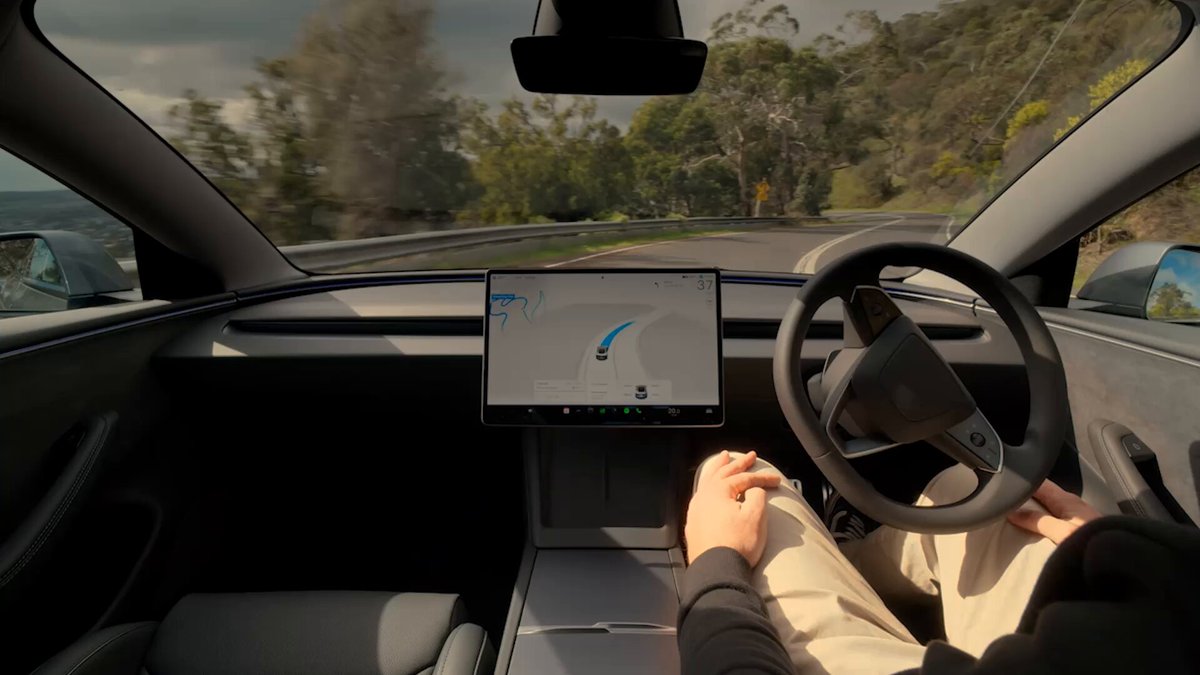
One year in, Tesla's Full Self-Driving Supervised has racked up a number worth pausing on: more than 160 million kilometers driven across Australia and New Zealand — roughly 4,000 laps around the planet. Tesla's regional account marked the anniversary on September 18, 2026, exactly one year after FSD Supervised first went live in the two countries, making them among the earliest markets outside North America to receive the technology.

What 160 Million Kilometers Actually Represents
The headline figure is striking, but the context matters more. Australia and New Zealand together represent a relatively small Tesla market compared to the United States, Europe, or China. Roads here are less densely mapped in many areas, driving conditions range from urban Sydney grid traffic to long rural highway stretches, and right-hand traffic adds a layer of complexity that left-hand-drive FSD training data doesn't automatically transfer to. Getting 160 million kilometers of real-world supervised driving data out of this market in year one signals that adoption wasn't a novelty — owners are genuinely using the feature regularly.
For context, 160 million kilometers is roughly the distance from Earth to Mars at a close approach. It's also a meaningful data contribution to Tesla's global fleet learning loop, which aggregates anonymized driving data across all FSD-equipped vehicles to refine the neural network underpinning the system.
Why the ANZ Market Is a Meaningful Test Case
Australia and New Zealand weren't obvious candidates for an early FSD rollout. Both countries drive on the left, use roundabouts extensively, and have road-marking conventions that differ from the US baseline. The fact that Tesla chose to launch here in September 2025 — and that the fleet has now accumulated this kind of mileage — suggests the company is actively stress-testing FSD across diverse regulatory and infrastructure environments, not just padding numbers in familiar markets.
That diversity is arguably more valuable than raw kilometers. Edge cases encountered on a poorly lit country road outside Auckland or navigating a multi-lane roundabout in Melbourne feed back into a system that needs to generalize globally. Each of those 160 million kilometers was driven under human supervision, meaning a driver was present and able to intervene — the data collected reflects real-world performance against a safety baseline, not a closed-course demonstration.
The Bigger Picture for FSD's Global Expansion
Tesla has been methodical about expanding FSD Supervised beyond North America. The ANZ launch in September 2025 was part of a broader international rollout strategy, and the one-year milestone gives the company a concrete data point to reference as it pursues regulatory approvals and market expansions elsewhere. A cumulative distance figure from a market with distinct road conditions is a more persuasive argument to regulators than theoretical capability claims.
For owners in Australia and New Zealand who have been using FSD Supervised over the past year, the anniversary is a reminder that their daily drives are contributing to something larger than their commute. The question now is what year two looks like — whether Tesla pushes toward an unsupervised version in the region, and how the accumulated dataset from ANZ roads shapes the next generation of the system globally.
Related Gear
Gear up your Tesla with tested, custom-fit BASENOR accessories — shop Tesla accessories →
Sources & reporting notes
The links below identify the material source records used for this report.
- @TeslaAUNZ on X (2026-09-18T04:16:46.000Z) — Direct source
- @wholemars on X (2026-09-18T04:29:31.000Z) — Direct source
Source links are preserved as published or accessed. See our editorial standards and corrections policy.
The BASENOR Editorial Desk covers Tesla, SpaceX, and related technology, curating reporting from primary sources — official accounts, regulatory filings, and software release data. Every article passes source-record and fact-checking review before publication. About the newsroom.
This report was curated by the BASENOR Editorial Desk from the sources listed above. Read our editorial standards or email editorial@basenor.com to report an error.