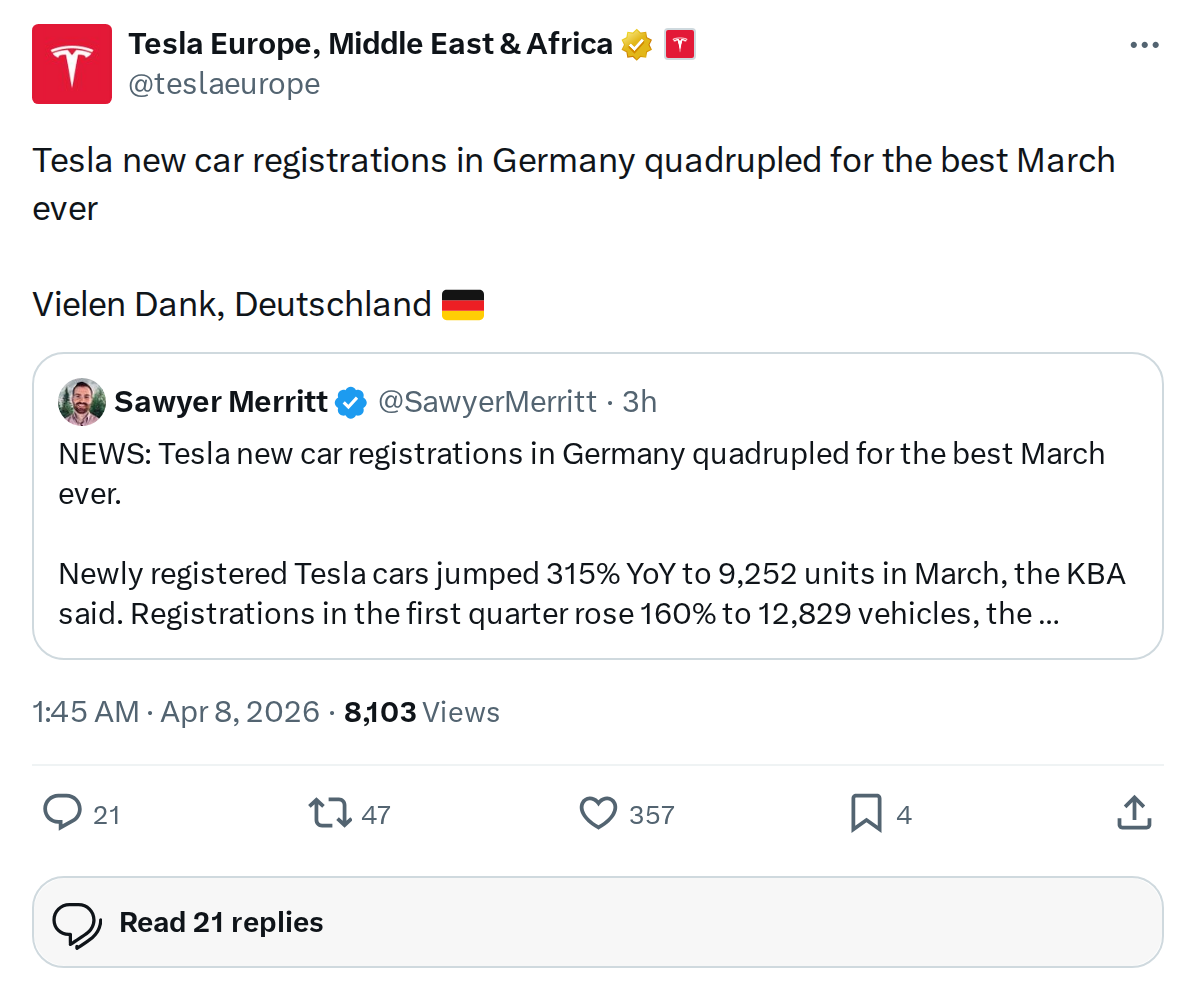
The News: Tesla's new car registrations in Germany quadrupled year-on-year in March 2026, delivering the company's best-ever March result in the country.
Why It Matters: After a difficult start to 2026 in Europe, this is a significant momentum shift — and it signals that Tesla's European recovery may be gaining real traction in its largest continental market.
Source: @teslaeurope on X
Tesla Germany Registrations Quadruple in March — The Best March Ever
Tesla just posted a landmark result in Germany. According to official data and confirmed by Tesla Europe's own announcement, new car registrations in Germany surged 315.1% year-on-year in March 2026, reaching 9,252 units. That's not just a strong month — it's the best March Tesla has ever recorded in Germany, and the strongest monthly registration figure the company has posted there since December 2022.

Tesla Europe's official account marked the occasion with a simple but telling message: "Vielen Dank, Deutschland" — Thank you, Germany. For a brand that has faced persistent headwinds in Europe over the past year, the tone felt earned.
📊 Key Figures
| Metric | Value | Context |
|---|---|---|
| March 2026 Registrations | 9,252 units | Best March ever |
| Year-on-Year Growth | +315.1% | vs. March 2025 |
| Q1 2026 Total Registrations | 12,829 units | +160% vs. Q1 2025 |
| March Share of Q1 | ~75% | Heavy end-of-quarter push |
| Tesla Market Share (March) | 3.1% | Of all new German registrations |
| German BEV Market (March) | 70,663 units | +66.2% YoY |
| BEV Share of German Market | 24% | Of all new car registrations |
| Previous Monthly Peak | December 2022 | Last time Tesla hit this level |
A Market That Was Supposed to Be Difficult
Germany is not an easy market for Tesla. It's the home turf of Volkswagen, BMW, and Mercedes-Benz — brands with century-long relationships with German buyers and dealer networks in every city. Skepticism toward Tesla has historically run higher here than in markets like Norway or the Netherlands. And yet, March 2026 delivered a result that none of those headwinds could prevent.
The broader German EV market also had a strong month — BEV registrations rose 66.2% year-on-year to 70,663 units, representing 24% of all new car sales in Germany. Tesla's 315% surge outpaced the overall BEV market growth by a factor of nearly five, meaning Tesla didn't just ride a rising tide. It captured a significantly larger slice of it.
The Quarter-End Effect — And Why It's Still Meaningful
One pattern worth noting: March accounted for approximately 75% of Tesla's entire Q1 2026 registrations in Germany. That end-of-quarter concentration is a well-documented Tesla pattern globally — deliveries and registrations cluster at the end of each quarter as Tesla pushes to fulfill orders and hit targets. Critics will point to this as a structural quirk rather than organic demand.
But the absolute numbers are hard to dismiss. 9,252 registrations in a single month is a genuine milestone for Tesla in Germany — the strongest result since December 2022, a month that itself benefited from year-end demand. The Q1 total of 12,829 units, up 160% from Q1 2025, suggests that even accounting for the March surge, the underlying trajectory has improved substantially.
🔭 The BASENOR Take
Timeline: March 2026 result — announced April 7, 2026
Impact Level: 🟠 High — significant positive signal for Tesla's European momentum
Confidence: ✅ High — figures corroborated by multiple market data sources
Three things stand out here:
1. The magnitude of the rebound. A 315% year-on-year jump is not a rounding error. Even adjusting for a weak March 2025 baseline, this is a genuine volume surge. It suggests pent-up demand, improved delivery logistics, or both.
2. Germany as a bellwether. If Tesla can post record months in its most skeptical major European market, it raises the question of what Q2 looks like across the continent — particularly in markets where Tesla has historically performed better.
3. The BEV market context matters. Germany's overall EV market is accelerating. A 24% BEV share of new car sales is a structural shift, not a blip. Tesla is well-positioned to benefit as that share continues to grow — provided it can maintain competitive pricing and delivery consistency through the rest of 2026.
📰 Deep Dive
The December 2022 comparison is worth dwelling on. That month represented Tesla's previous high-water mark in Germany — a period when the company was still riding the wave of Model Y's initial European rollout and benefiting from strong order backlogs. The fact that March 2026 has now matched or exceeded that level, after a period of significant market turbulence and increased competition from domestic German manufacturers, is a meaningful data point about Tesla's resilience in the region.
Germany's EV market dynamics have also shifted in Tesla's favor in one important way: the overall BEV adoption rate is climbing sharply. At 24% of new registrations in March 2026, Germany is no longer a laggard in European EV adoption. That expanding pie creates more room for Tesla to grow in absolute terms, even if its market share percentage fluctuates. The 3.1% market share Tesla held in March — across all powertrains, not just EVs — is a number that would have seemed ambitious two years ago.
What happens in April and May will be telling. If registrations hold anywhere near the 3,000-4,000 unit monthly range that would represent a normalized Q2 pace, it would confirm that the Q1 surge wasn't purely a delivery-timing artifact. Tesla's European team will be watching those numbers closely — and so will the rest of the industry.
Related Gear
Gear up your Tesla with tested, custom-fit BASENOR accessories — shop Tesla accessories →
Sources & reporting notes
The links below identify the material source records used for this report.
- @teslaeurope on X (2026-04-07T17:45:18.000Z) — Direct source
Source links are preserved as published or accessed. See our editorial standards and corrections policy.
The BASENOR Editorial Desk covers Tesla, SpaceX, and related technology, curating reporting from primary sources — official accounts, regulatory filings, and software release data. Every article passes source-record and fact-checking review before publication. About the newsroom.
This report was curated by the BASENOR Editorial Desk from the sources listed above. Read our editorial standards or email editorial@basenor.com to report an error.