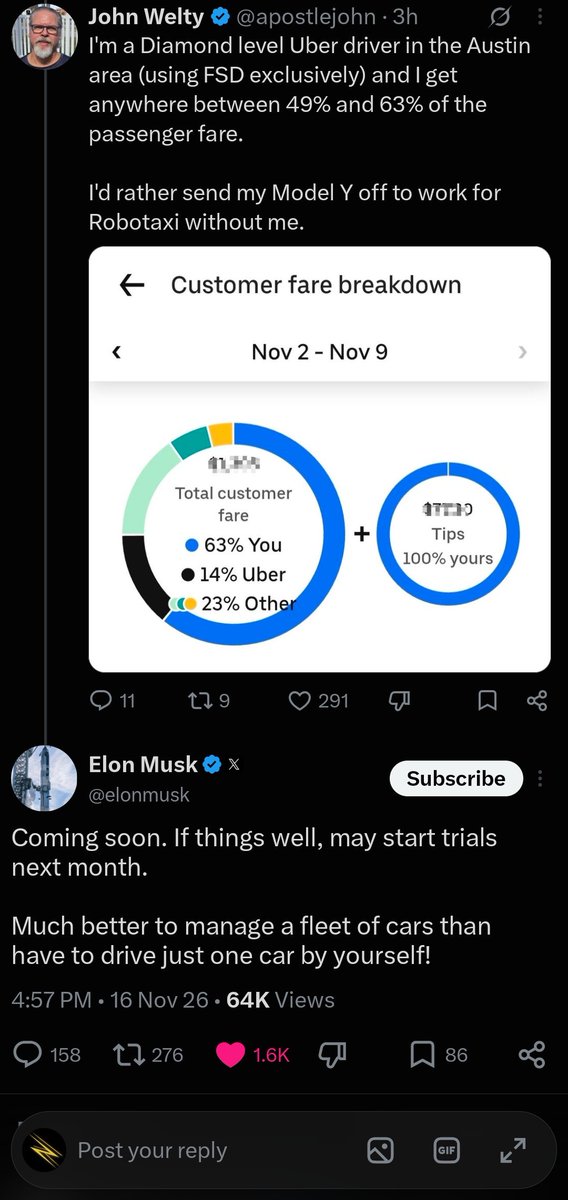
Tesla is preparing to cross one of the most anticipated thresholds in its autonomy roadmap: letting private owners put their own cars on the Robotaxi network. On November 16, 2026, CEO Elon Musk indicated that initial trials with select Model Y owners in Austin could begin as soon as next month — December 2026 — if current testing goes well. The comment came in reply to an Austin Uber driver who asked when he could send his Model Y out to earn fares autonomously.
This would mark Tesla's first real-world step toward the owner-fleet economics Musk has pitched for years: cars that generate income while their owners sleep or work. The details, however, remain thin — and the timing suggests a very small, hand-picked trial rather than an open enrollment.
What Musk Actually Said
Musk's statement was specific on two points and vague on everything else. Initial trials would involve select Model Y owners in Austin, and they could begin as early as next month. He did not specify how participants will be chosen, how fares will be split between Tesla and the owner, what insurance structure applies, or whether vehicles will need specific hardware or software versions to qualify.
The Austin geofence is consistent with Tesla's existing Robotaxi service area, which launched there in mid-2025 using a company-owned Model Y fleet with safety monitors. Expanding from Tesla-owned cars to customer-owned cars is a materially different operational step — it introduces vehicle maintenance variance, owner behavior, and consumer liability questions that an internal fleet doesn't face.
How This Fits the Broader Timeline
Musk's December trial window sits inside a longer rollout plan already sketched by Tesla leadership. According to prior statements from Tesla VP of Autonomous Driving Ashok Elluswamy, broader owner integration into the Robotaxi fleet is targeted for the second quarter of 2027. That framing implies the December activity is best understood as a pilot — a small group of vetted owners used to stress-test the enrollment flow, revenue-sharing mechanics, and remote fleet management before anything scales.
Whole Mars Catalog, a widely followed FSD commentator, speculated the trial could coincide with Tesla's planned December Cybercab deliveries in Austin, which would give the company a single high-visibility moment to demonstrate both the purpose-built robotaxi and the owner-fleet concept in parallel.
Key Facts So Far
| Item | Detail |
|---|---|
| Trial start | Potentially December 2026, pending testing |
| Vehicle | Model Y (select owners only) |
| Location | Austin, Texas |
| Broader fleet access | Targeted for Q2 2027 (per Ashok Elluswamy) |
| Revenue split | Not disclosed |
| Participant selection | Not disclosed |
What It Means for Owners
For Model Y owners in Austin, the practical read is this: nothing to sign up for yet. Tesla has not published an enrollment process, eligibility criteria, or an application form. If a December pilot does launch, it will almost certainly be invitation-only and heavily limited — the kind of trial where Tesla picks owners it can closely monitor rather than opens a waitlist.
For owners outside Austin, the timeline that matters is Q2 2027 — the window Elluswamy pointed to for broader fleet integration. That's still the earliest realistic point at which owners elsewhere could expect access, and it assumes regulatory approval in each market Tesla wants to operate in. State-level autonomous vehicle rules vary widely, and the regulatory path outside Texas is considerably less permissive.
The bigger open question is economics. Musk has historically floated figures suggesting owners could earn meaningful income from an idle vehicle, but no official revenue-share percentage, utilization estimate, or wear-and-tear accounting has been published. Until Tesla discloses those numbers, treat any projected earnings as speculation. Depreciation, tire costs, cleaning, insurance adjustments, and charging consumption all cut into the gross fare before anything reaches the owner.
What to Watch Next
- Austin December activity — Any Tesla announcement pairing Cybercab deliveries with owner-fleet enrollment would confirm Whole Mars Catalog's read.
- Revenue-split disclosure — The single most important number Tesla has not yet released. This determines whether the program is economically meaningful or a branding exercise.
- Insurance structure — Whether Tesla's own insurance product is a prerequisite, and how liability is handled during autonomous ride-hailing periods.
- FSD version requirement — Whether participating cars need a specific FSD build or hardware revision (HW4 is the likely floor).
- Q2 2027 expansion — Elluswamy's stated timeline for opening the program to broader fleet owners, likely outside Austin.
Mini-FAQ
Can I sign up right now?
No. Tesla has not opened any enrollment process. Musk's statement describes a potential trial with hand-picked Model Y owners in Austin that may start in December 2026. There is no application form or waitlist.
Will my Model S or Model X be eligible?
Not for the initial trial. Musk specifically referenced Model Y. Tesla ended Model S and Model X production earlier in 2026, and the initial pilot is scoped to Model Y vehicles in Austin only.
How much could owners earn?
Tesla has not disclosed the revenue split between the company and participating owners, and has not published utilization estimates. Any earnings figure circulating publicly is speculation until Tesla releases actual terms.
Will this expand beyond Austin?
According to Ashok Elluswamy, Tesla's VP for Autonomous Driving, broader owner integration into the Robotaxi fleet is targeted for the second quarter of 2027. Expansion beyond Texas will depend on state-level regulatory approvals, which vary significantly.
Does my car need FSD to participate?
Tesla has not confirmed the exact software or hardware requirement, but the Robotaxi service runs on Tesla's autonomous stack, so some version of FSD on current-generation hardware is the expected floor. Specifics have not been announced.
The December window is less a product launch than a signal — a signal that Tesla believes the owner-fleet economics are close enough to real that it can put a very small number of customer cars on the network and see what breaks. The important disclosures haven't landed yet. When they do, revenue split and insurance structure will tell us whether this is the start of a genuine side-income economy for Tesla owners or a tightly controlled proof-of-concept that stays small for a long time.
🚕 Following the Robotaxi rollout? See every operating city, launch date and announced market in our Tesla Robotaxi Tracker.
Related Gear
Gear up your Model Y with tested, custom-fit BASENOR accessories — shop Model Y accessories →
Sources & reporting notes
The links below identify the material source records used for this report.
- @SawyerMerritt on X (2026-11-16T22:16:30.000Z) — Direct source
- @wholemars on X (2026-11-16T22:24:30.000Z) — Direct source
- @DirtyTesLa on X (2026-11-16T22:35:58.000Z) — Direct source
- @TeslaNewswire on X (2026-11-16T22:38:21.000Z) — Direct source
Source links are preserved as published or accessed. See our editorial standards and corrections policy.
The BASENOR Editorial Desk covers Tesla, SpaceX, and related technology, curating reporting from primary sources — official accounts, regulatory filings, and software release data. Every article passes source-record and fact-checking review before publication. About the newsroom.
This report was curated by the BASENOR Editorial Desk from the sources listed above. Read our editorial standards or email editorial@basenor.com to report an error.