Before his resignation, Nvidia CEO Jensen Huang reportedly told a room of customers that he could hand over Nvidia's entire AI chip capacity to Elon Musk's companies — and that Musk would take it. The offhand remark, now circulating widely, lands in the middle of a genuinely complicated moment for the Nvidia-Musk relationship, and it says something important about the scale of AI infrastructure demand coming from Tesla, xAI, and SpaceX.

The Quote in Context
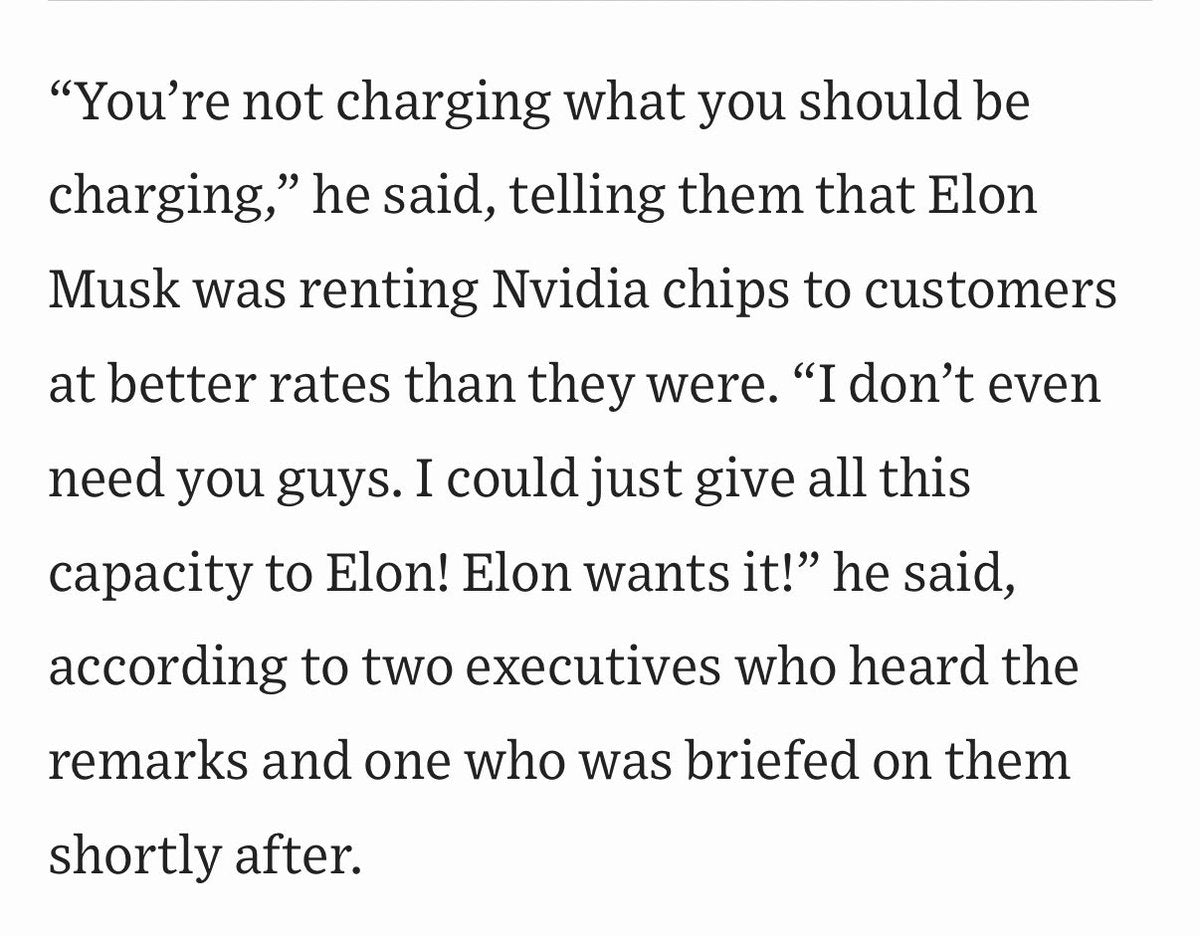
"I don't even need you guys. I could just give all this capacity to Elon! Elon wants it!" — that's Jensen Huang, according to the post above. The remark was apparently directed at existing Nvidia customers, framing Musk's companies as an alternative demand sink so large that Nvidia could theoretically walk away from other buyers entirely.
It reads as bravado — the kind of negotiating theater that Huang was known for. But strip away the theatrics and the underlying point is real: Tesla, xAI, and SpaceX collectively represent one of the largest single pools of AI compute demand on the planet, and Nvidia has been the primary supplier feeding it.
The Numbers Behind the Demand
The scale Huang was gesturing at isn't hypothetical. According to verified reporting, SpaceX alone is targeting up to 3 gigawatts of computing capacity by the end of 2026, with plans to add an incremental 10 gigawatts in 2027. Musk has publicly stated that SpaceX is building exclusively on Nvidia, calling the Vera Rubin architecture "the best" available. Analysts have estimated that SpaceX's planned compute expansion could translate to over $400 billion in Nvidia revenue in 2027 alone.
xAI's Colossus 2 cluster is also expected to more than double its current Nvidia chip count before year-end, according to previous reports. And Tesla's own AI infrastructure — spanning FSD training, Dojo, and Optimus development — adds further demand on top of that.
For context on the supply side: Nvidia's written supply and capacity commitments with its own suppliers grew from $28.9 billion in October 2024 to $279 billion by July 2026, driven primarily by memory and advanced packaging. The company has also announced a 2.5x substrate capacity expansion over the next three years. The Musk ecosystem is a meaningful reason those numbers look the way they do.
A Relationship Now Under Strain
The complication is that Jensen Huang resigned as Nvidia's CEO on November 12, 2026, following reports of extramarital affairs. CFO Colette Kress is serving as interim CEO. That transition matters here because, just two days after Huang's departure, Musk posted on X that many of Nvidia's critical supply arrangements with his companies were "a handshake with Jensen, not a written contract" — raising the pointed question of whether those deals survive the leadership change.
Huang's quote about redirecting all capacity to Musk now reads differently in that light. It was almost certainly made before his resignation, and it captures the personal nature of the relationship he's describing — one built on direct trust between two individuals rather than purely institutional contracts. Whether Nvidia's new leadership can maintain that relationship at the same depth is an open question.
The Longer Play: Terafab
What's also worth noting is that Musk's companies are not purely dependent on Nvidia for the long term. Tesla, SpaceX, and xAI are co-investors in Terafab, a joint semiconductor manufacturing project that brought in Intel as a partner in April 2026. The project uses Intel's 14A fabrication technology, targets 1 terawatt of AI compute produced annually, and is expected to deliver its first experimental chips in 2027, with high-volume production in late 2028.
That timeline means Nvidia remains the critical near-term supplier for at least the next two years. Which is precisely why Huang's comment — even if delivered as a boast — reflects a real dynamic: right now, Musk needs Nvidia's chips, and Nvidia has every incentive to keep that relationship intact regardless of who sits in the CEO chair.
Whether interim CEO Colette Kress moves quickly to formalize the arrangements Huang apparently kept on a handshake basis will be one of the more consequential early tests of Nvidia's post-Huang leadership.
Related Gear
Gear up your Tesla with tested, custom-fit BASENOR accessories — shop Tesla accessories →
Sources & reporting notes
The links below identify the material source records used for this report.
- @wholemars on X (2026-11-16T19:20:21.000Z) — Direct source
Source links are preserved as published or accessed. See our editorial standards and corrections policy.
The BASENOR Editorial Desk covers Tesla, SpaceX, and related technology, curating reporting from primary sources — official accounts, regulatory filings, and software release data. Every article passes source-record and fact-checking review before publication. About the newsroom.
This report was curated by the BASENOR Editorial Desk from the sources listed above. Read our editorial standards or email editorial@basenor.com to report an error.