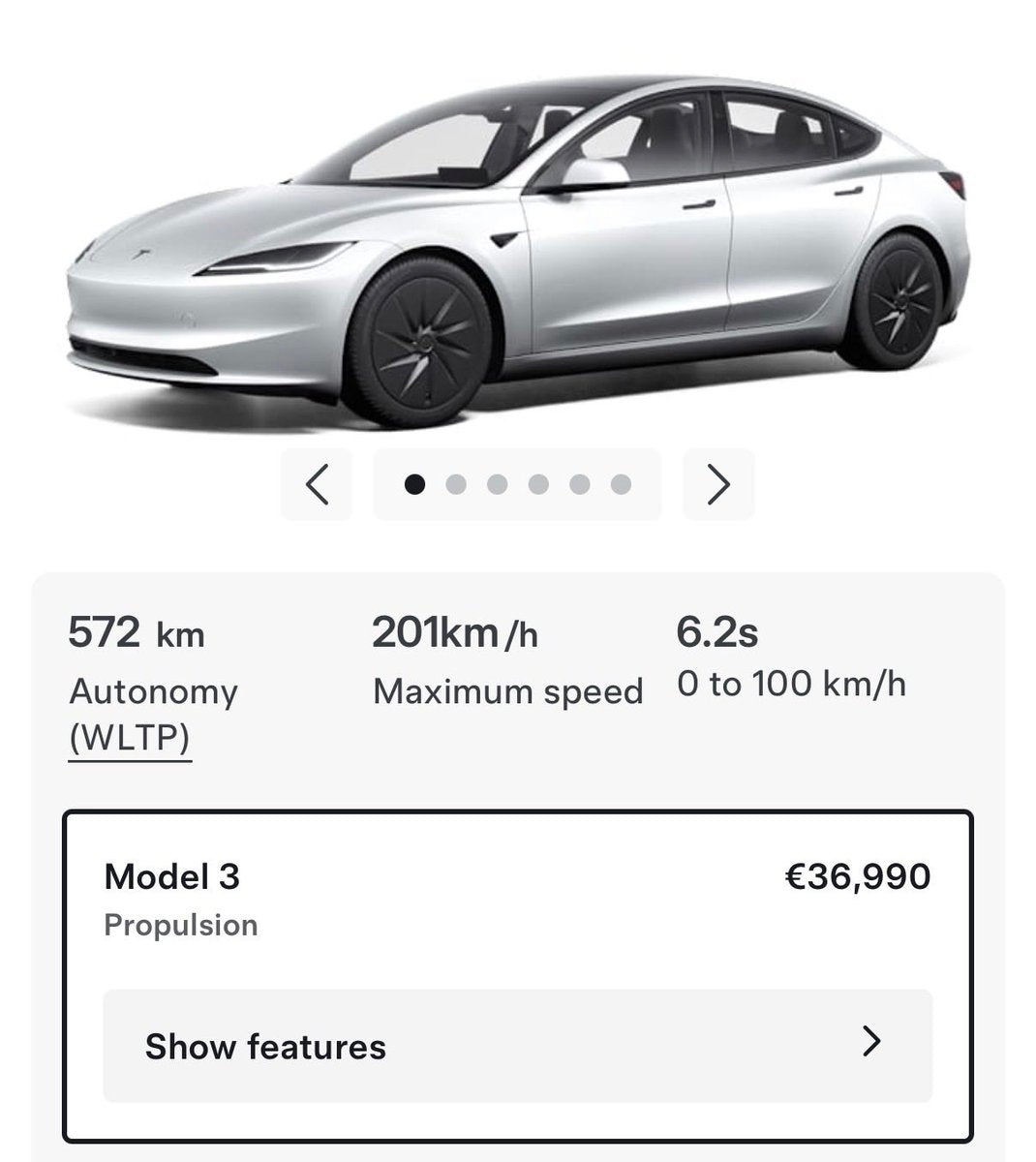
Tesla has quietly boosted the WLTP range of the Model 3 Rear-Wheel Drive in Europe by 38 km (24 miles), pushing the entry-level sedan's official rating to 572 km (356 miles) — up from 534 km (332 miles). The 7.1% improvement comes without any battery hardware change or mechanical revision. According to @TeslaNewswire, the gain is attributable to a new tire supplier: Giti.

What Changed
The updated Model 3 RWD configurator figures reflect three connected improvements — range, energy consumption, and, by extension, real-world efficiency. Tesla's European product pages, as verified against Tesla.com listings, now show the following:
| Metric | Previous | Updated | Change |
|---|---|---|---|
| WLTP Range | 534 km / 332 mi | 572 km / 356 mi | +38 km (+7.1%) |
| Energy Consumption | 13.0 kWh/100 km | 12.2 kWh/100 km | −0.8 kWh/100 km |
| Tire Supplier (RWD trim) | Previous OEM tires | Giti | New supplier |
To put the efficiency delta in context: a 0.8 kWh/100 km reduction on a car with a roughly 60 kWh usable pack means the same battery now covers meaningfully more kilometers between charges. That's the entire mechanism behind the range gain — Tesla isn't adding cells, it's losing fewer of them to rolling resistance.
Why New Tires Move the Needle
Rolling resistance is one of the three dominant energy sinks in EV driving, alongside aerodynamic drag and auxiliary loads. On a mixed WLTP cycle — which weights lower speeds and urban stop-and-go more heavily than highway cruising — rolling resistance has an outsized influence on the final range figure. A tire optimized for low rolling resistance coefficient (RRC) can shift WLTP numbers by 20 to 40 km on a car of this size, which lines up almost exactly with what Tesla has reported.
Giti, headquartered in Singapore, has expanded aggressively into European OEM supply over the past several years. The company has been increasing its footprint in the low-rolling-resistance EV segment, competing against incumbents like Michelin, Hankook, and Continental for entry-level and mid-tier trims. Tesla's willingness to switch tire suppliers at the RWD level — historically the volume trim for European Model 3 sales — suggests either a cost advantage, a supply arrangement, or a measurable efficiency improvement that justified the change. Given the WLTP delta, it may be all three.
Where This Fits in Tesla's European Strategy
The timing matters. European EV buyers have become increasingly sensitive to headline range figures as competitors like the BYD Seal, Hyundai Ioniq 6, and Polestar 2 crowd the mid-size segment. The Model 3 RWD previously listed 534 km WLTP put it behind several rivals on paper — a psychological hurdle for European shoppers who use the WLTP number as a primary comparison point, even though real-world driving typically comes in 15–25% below WLTP figures for all manufacturers.
Pushing the entry Model 3 past 570 km WLTP puts it back in the upper tier of its segment for spec-sheet comparisons, without Tesla having to touch pricing, battery chemistry, or motor tuning. It's the cheapest range increase Tesla can deploy: swap a component, revalidate the WLTP test, update the configurator. That's the entire story.
What It Means for Owners
For existing Model 3 RWD owners in Europe, this update does not retroactively improve range — the change applies to newly built vehicles equipped with the Giti tires. However, owners of earlier Model 3 RWDs who eventually replace their factory tires will have data points to consider: switching to a low-RRC tire (whether Giti or a competitor with comparable specs) can recover a meaningful fraction of that efficiency delta, though real-world results depend on driving style, climate, and terrain.
For prospective buyers, the practical takeaway is that the sticker range now more accurately reflects a modestly more efficient car. Expect real-world highway range in the neighborhood of 430–470 km at moderate speeds in temperate conditions, with proportional gains over the previous configuration.
What to Watch Next
A few open questions remain. First, whether this tire change will propagate to other Model 3 trims — the Long Range AWD and Performance variants use different wheel and tire configurations, and Tesla has not indicated a corresponding WLTP update for those trims yet. Second, whether the Model Y, which shares significant platform DNA with the Model 3, will see a similar tire-driven efficiency bump in Europe. And third, whether North American Model 3 RWD specifications will follow, given that EPA testing methodology differs and tire sourcing can vary by region.
The bigger picture: Tesla is squeezing efficiency gains from component-level changes rather than platform revisions. That's consistent with the company's late-cycle Model 3 strategy — no new sheet metal, no new battery pack, but a steady drip of small optimizations that keep the spec sheet competitive. A 7.1% range increase from a tire swap is exactly the kind of low-cost, high-visibility update that keeps the Model 3 relevant in a market that has otherwise moved on to newer competitor launches.
Related Gear
Gear up your Model 3 with tested, custom-fit BASENOR accessories — shop Model 3 accessories →
Sources & reporting notes
The links below identify the material source records used for this report.
- @TeslaNewswire on X (2026-08-28T18:37:43.000Z) — Direct source
Source links are preserved as published or accessed. See our editorial standards and corrections policy.
The BASENOR Editorial Desk covers Tesla, SpaceX, and related technology, curating reporting from primary sources — official accounts, regulatory filings, and software release data. Every article passes source-record and fact-checking review before publication. About the newsroom.
This report was curated by the BASENOR Editorial Desk from the sources listed above. Read our editorial standards or email editorial@basenor.com to report an error.