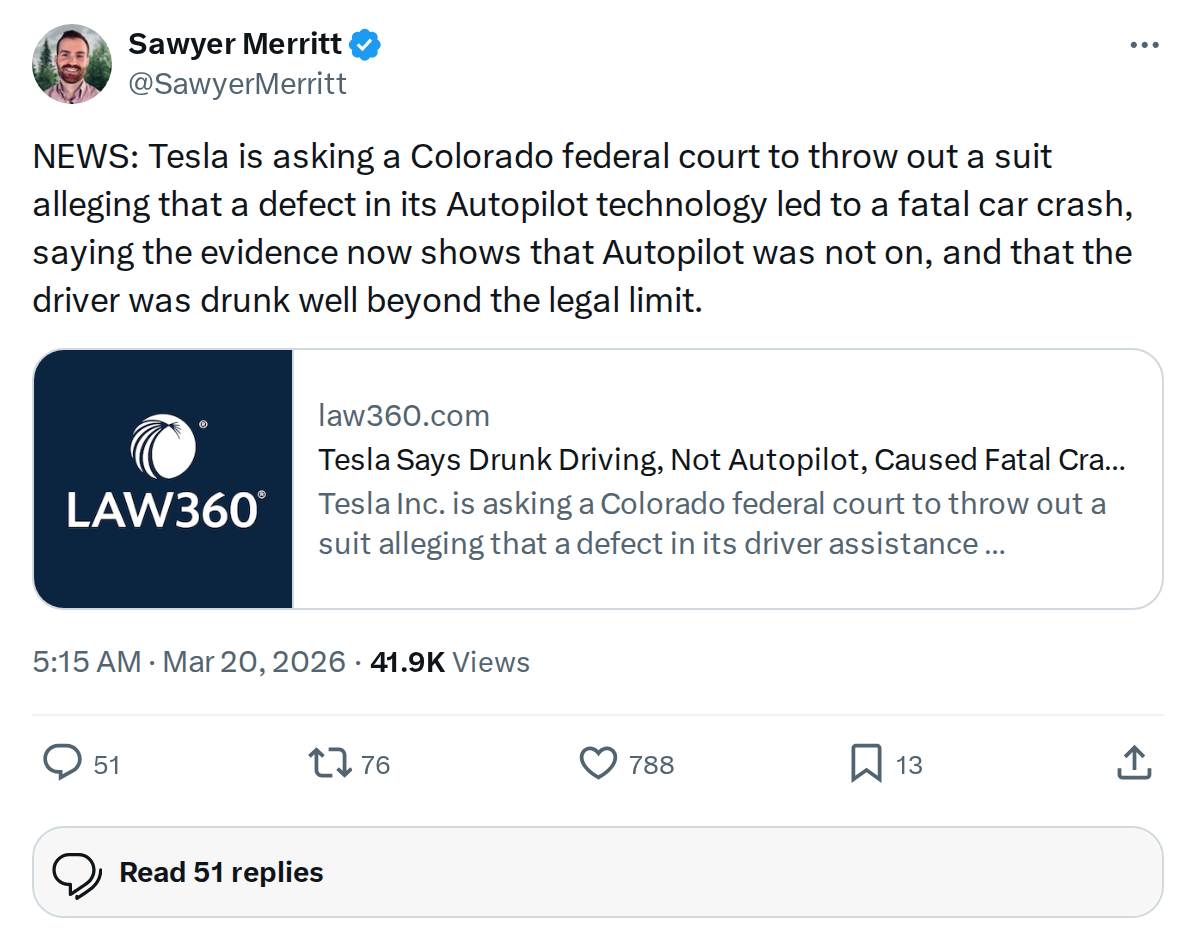
The News: Tesla has petitioned a Colorado federal court to dismiss a lawsuit claiming an Autopilot defect caused a fatal crash — arguing the system was never active and the driver was significantly over the legal alcohol limit.
Why It Matters: This case cuts to the heart of how Autopilot liability is determined — and the outcome could set a precedent for how courts weigh driver impairment against alleged system defects.
Source: @SawyerMerritt on X
Tesla Moves to Dismiss Autopilot Lawsuit: Driver Was Drunk, System Was Off
A high-stakes Autopilot lawsuit in Colorado federal court is facing a dismissal bid from Tesla — and the company's argument is straightforward: the crash had nothing to do with Autopilot because Autopilot wasn't on. According to Tesla's filing, newly surfaced evidence shows the system was not engaged at the time of the fatal collision, and the driver was found to be well above the legal blood-alcohol limit.

📊 Key Figures
| Metric | Detail |
|---|---|
| Autopilot Status at Time of Crash | Not engaged (per Tesla's evidence) |
| Driver Condition | Well above legal alcohol limit |
| Court | Colorado Federal Court |
| Tesla's Action | Motion to dismiss the lawsuit |
What Tesla Is Arguing
Tesla's dismissal motion rests on two pillars. First, the company says the evidence now shows Autopilot was simply not active when the crash occurred — meaning the core premise of the lawsuit, that an Autopilot defect caused the fatality, collapses on its own. Second, Tesla is pointing to the driver's blood-alcohol level, which was reportedly well beyond the legal limit, as a significant contributing factor to the crash.
This is a meaningful legal distinction. Autopilot lawsuits typically hinge on proving the system was engaged and behaved in a way that caused or contributed to the incident. If Tesla can demonstrate the system was off, the plaintiff's burden becomes substantially harder to meet. Add an impaired driver to that equation, and the liability picture shifts dramatically.
For context, Tesla vehicles log detailed data — including whether driver-assistance features are active — that can be retrieved and presented as evidence in litigation. This kind of vehicle data has been central to multiple Autopilot-related cases, and Tesla has increasingly leaned on it to challenge claims that the system was responsible for crashes.
Why This Case Matters Beyond Colorado
Autopilot litigation has been a persistent legal battleground for Tesla. The company faces ongoing scrutiny from regulators and plaintiffs alike over how its driver-assistance technology performs — and how clearly it communicates its limitations to drivers. Each case that reaches a federal court has the potential to shape how future claims are evaluated.
A successful dismissal here would reinforce a pattern Tesla has been building: that its vehicle data is reliable enough to definitively establish whether Autopilot was active, and that driver behavior — particularly impairment — is a legitimate defense when the system wasn't engaged. That's a significant precedent if it holds.
Conversely, if the court declines to dismiss and the case proceeds, it could open the door to broader discovery into Autopilot's design and safety record, which plaintiffs in similar cases would likely cite. Follow our FSD coverage for ongoing updates on Autopilot-related legal and regulatory developments.
🔭 The BASENOR Take
Timeline: Motion filed, awaiting court ruling
Impact Level: Medium — significant for Autopilot litigation landscape, limited immediate effect on owners
Confidence: High — sourced directly from court filing reporting by @SawyerMerritt
For Tesla owners, the practical takeaway here isn't about Autopilot's safety record in isolation — it's about understanding what the technology actually is and isn't. Autopilot is a driver-assistance system. It requires an attentive, sober driver behind the wheel. Tesla's terms of service, in-car warnings, and onboarding materials make this explicit.
The broader legal pattern worth watching: as Tesla's vehicle data logging becomes more sophisticated and more admissible in court, the evidentiary bar for Autopilot-related lawsuits gets higher. That's arguably good for owners — it means false or exaggerated claims are harder to sustain — but it also puts pressure on Tesla to ensure its data retrieval and presentation are airtight.
The Colorado court's decision on this dismissal motion will be worth tracking. If granted, it adds to a body of case law that treats driver impairment as a superseding cause in Autopilot incidents. If denied, expect a discovery process that could surface new details about how Autopilot behaves in the seconds before a crash — details that will matter well beyond this one case.
Related Gear
Gear up your Tesla with tested, custom-fit BASENOR accessories — shop Tesla accessories →
Sources & reporting notes
The links below identify the material source records used for this report.
- @SawyerMerritt on X (2026-03-19T21:15:40.000Z) — Direct source
Source links are preserved as published or accessed. See our editorial standards and corrections policy.
The BASENOR Editorial Desk covers Tesla, SpaceX, and related technology, curating reporting from primary sources — official accounts, regulatory filings, and software release data. Every article passes source-record and fact-checking review before publication. About the newsroom.
This report was curated by the BASENOR Editorial Desk from the sources listed above. Read our editorial standards or email editorial@basenor.com to report an error.