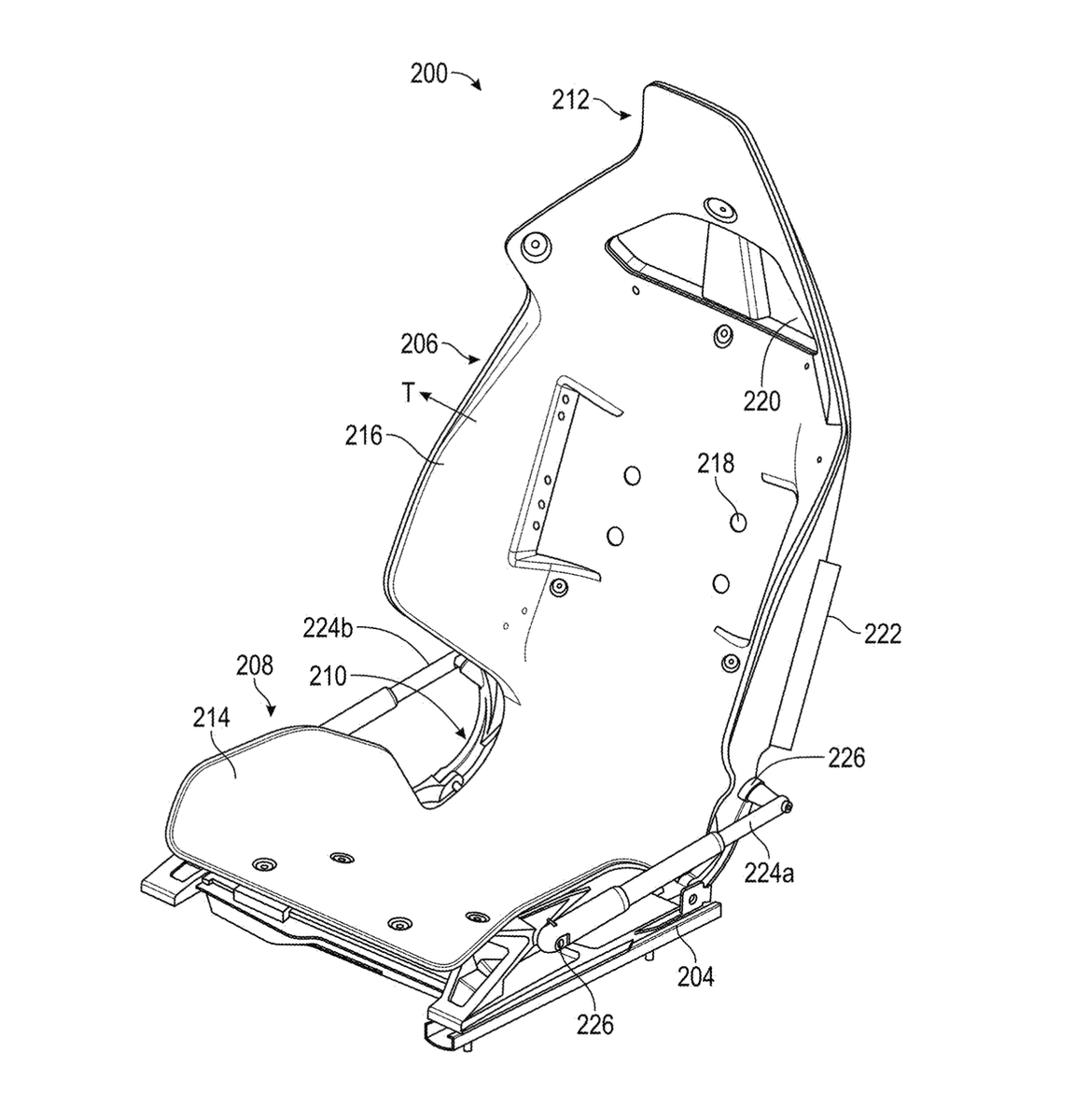
The News: Tesla has been granted a patent for a new seat design — a single continuous frame with aggressive bolstering and a flexible hinge — widely believed to be intended for the upcoming next-generation Roadster.
Why It Matters: This is the most detailed hardware glimpse yet at what could be inside the Roadster, signaling a purpose-built performance interior unlike anything in Tesla's current lineup.
Source: @SawyerMerritt on X

A Seat Patent That Says a Lot
Tesla patents come and go — most never make it into production. But this one is different. The newly granted patent describes a seat built around a single continuous frame, departing sharply from the multi-piece seat structures found in every current Tesla model. Paired with what's described as aggressive bolstering — the side supports that hold you in place during hard cornering — and a flexible hinge mechanism, the design reads less like a comfort-first commuter seat and more like something you'd find in a track-day machine.
That profile fits exactly one vehicle in Tesla's pipeline: the next-generation Roadster.
Why This Design Makes Sense for the Roadster
The Roadster has been promised as the fastest production car Tesla has ever built. With a claimed 0–60 mph time of 1.9 seconds — and Elon Musk having suggested a sub-1.0 second figure with an optional SpaceX cold-gas thruster package — lateral forces on occupants will be extreme by road-car standards. A seat with deep, aggressive bolstering isn't an aesthetic choice at those performance levels; it's a functional requirement.
The single continuous frame construction also suggests a weight and rigidity priority. Fewer joints and separate components typically means a stiffer, lighter structure — exactly what an engineering team obsessed with performance would spec. The flexible hinge element likely addresses ingress and egress in what is expected to be a very low-slung, open-top body.
This patent doesn't exist in isolation. Tesla has been building a paper trail around the next-gen Roadster for months. In August 2025, a patent for an adaptive aerodynamics system — designed to generate significant downforce without external wings — was published. In February 2026, Tesla filed two trademark applications with the USPTO: a new stylized wordmark for 'ROADSTER' and a logo depicting the car's side profile through three flowing curved lines. A curved portrait-style touchscreen patent for the Roadster's interior surfaced as far back as March 2024. The seat patent is the latest piece of what is becoming a recognizable picture.
📋 Roadster Patent & Filing Timeline
| Date | Filing / Patent |
|---|---|
| March 2024 | Curved portrait touchscreen patent published |
| August 2025 | Adaptive aerodynamics / downforce system patent (US 12,377,920 B1) |
| February 2026 | ROADSTER wordmark + side-profile logo trademark filings |
| March 2026 | Single-frame performance seat patent granted |
The Reveal Is Weeks Away
Elon Musk confirmed on Tesla's Q4 2025 earnings call that the company is targeting April 1, 2026 for the Roadster's updated reveal event. That's less than four weeks from today. The timing of this patent grant — and its public disclosure — is unlikely to be coincidental. Tesla's IP filings tend to surface close to production-intent milestones, and the trademark activity in February already signaled that the marketing machine was warming up.
If the April 1 reveal holds, production is expected to follow approximately 12 to 18 months later, placing first deliveries in mid-to-late 2027.
🔭 The BASENOR Take
Timeline: Reveal targeted April 1, 2026 · Production expected mid-to-late 2027
Impact Level: 🟡 Medium — hardware detail, not a delivery date
Confidence: High that this is Roadster-related · Medium that this exact design reaches production unchanged
Patents are engineering intent, not production guarantees. Tesla has filed patents that never shipped and shipped products that were never patented. That caveat aside, the specificity of this design — a continuous frame, aggressive bolstering, flexible hinge — is not generic. It's not a comfort seat for a family crossover. It's a performance seat for a car that will pull serious lateral G-forces.
What's notable is the convergence. The aerodynamics patent, the interior display patent, the trademark filings, and now the seat patent are all pointing in the same direction at the same time. Tesla doesn't file trademarks for cars it's shelving. The April 1 reveal date — confirmed by Musk himself — gives all of this a hard deadline to coalesce around.
For prospective Roadster reservation holders, this patent is the most tangible signal yet that the interior will be purpose-built for performance, not adapted from existing Tesla platforms. The seat alone suggests Tesla is treating the Roadster as a genuine sports car — not a fast Tesla with a different body.
📰 Deep Dive
The language in the Sawyer Merritt report — 'single continuous frame' and 'flexible hinge' — points to a seat architecture that prioritizes structural integrity and driver containment over the adjustable, multi-component designs found in the Model S and Model X. In high-performance vehicles, a rigid seat shell transfers lateral loads directly to the car's structure rather than absorbing them through seat mechanism flex, which improves driver feedback and reduces unwanted movement under hard cornering.
The 'aggressive bolstering' descriptor is equally telling. Current Tesla seats are designed for the broadest possible range of body types and long-distance comfort — reasonable for a daily driver, but not optimized for a car that may pull over 1G in corners. Deep bolsters physically hold the driver in the optimal seating position without relying on a harness, which matters enormously when the car is doing the kind of acceleration and cornering the Roadster's specs imply.
The flexible hinge is the most intriguing element. In a low-slung roadster with a fixed roof or removable panel, getting in and out requires the seat back to articulate in ways that a standard recliner mechanism doesn't accommodate well. A flexible hinge — likely a living hinge or a composite flex point built into the continuous frame — would allow the seat back to fold forward for entry without requiring a separate mechanical pivot assembly. It's an elegant engineering solution to a packaging problem that every sports car manufacturer faces.
Taken together, these three design elements — continuous frame, aggressive bolstering, flexible hinge — describe a seat that is lighter, stiffer, more driver-focused, and more practical for a low-roofline vehicle than anything currently in Tesla's production lineup. Whether this exact patent translates to the production Roadster seat will become clear on April 1. But right now, it's the clearest window yet into how Tesla is thinking about the car's interior.
Related Gear
Gear up your Tesla with tested, custom-fit BASENOR accessories — shop Tesla accessories →
Sources & reporting notes
The links below identify the material source records used for this report.
- @SawyerMerritt on X (2026-03-05T16:36:32.000Z) — Direct source
Source links are preserved as published or accessed. See our editorial standards and corrections policy.
The BASENOR Editorial Desk covers Tesla, SpaceX, and related technology, curating reporting from primary sources — official accounts, regulatory filings, and software release data. Every article passes source-record and fact-checking review before publication. About the newsroom.
This report was curated by the BASENOR Editorial Desk from the sources listed above. Read our editorial standards or email editorial@basenor.com to report an error.