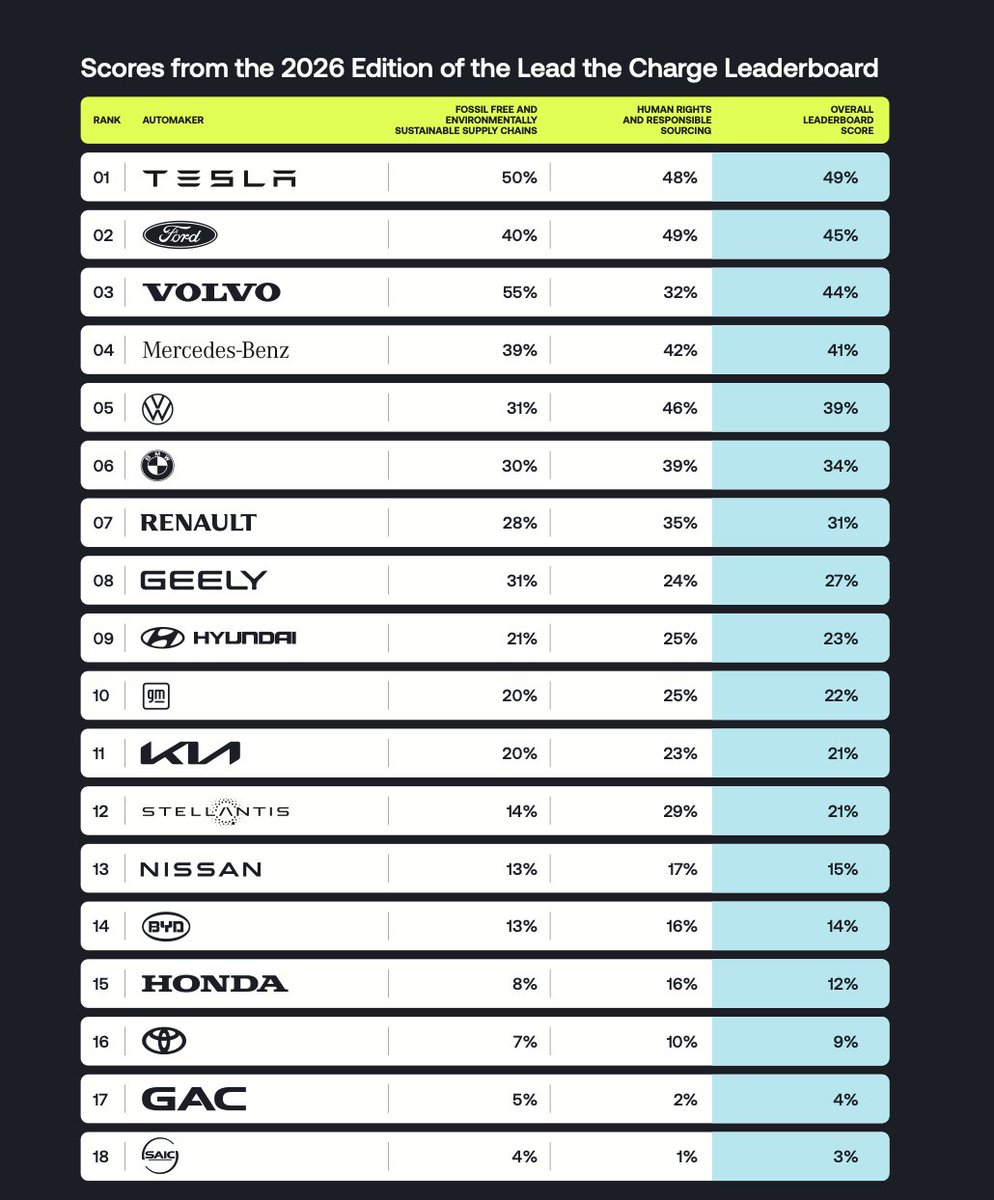
The News: Tesla has been ranked #1 overall on the 2026 Lead the Charge Auto Supply Chain Leaderboard for the second consecutive year, increasing its score by 6 percentage points to 49%.
Why It Matters: Supply chain sustainability is increasingly a factor in how regulators, investors, and consumers evaluate automakers. Tesla holding the top spot — while the industry average sits at just 25% — signals a structural advantage that goes beyond the vehicles themselves.
Source: @SawyerMerritt on X

📊 Key Figures
| Metric | Value | Context |
|---|---|---|
| Tesla Overall Score | 49% | #1 overall |
| Year-over-Year Score Increase | +6 pts | Continued improvement |
| Industry Average Score | 25% | Across 18 automakers |
| Automakers Evaluated | 18 | Global leading brands |
| Leaderboard Edition | 4th (2026) | Tesla #1 for 2nd consecutive year |
| Highest Score Achieved (any automaker) | <50% | No company has crossed 50% |
What Is the Lead the Charge Leaderboard?
The Lead the Charge Auto Supply Chain Leaderboard is an independent annual assessment that evaluates the world's largest automakers on how aggressively they are cleaning up their supply chains. The scorecard covers three main dimensions: eliminating greenhouse gas emissions, reducing environmental harm, and addressing human rights violations — all within the upstream supply chain, not just the vehicles themselves.
The 2026 edition is the fourth installment and evaluated 18 global automakers. According to the report, no company has yet crossed the 50% threshold — meaning the entire industry still has significant ground to cover, even at the top.

Where Tesla Leads — and Where It Doesn't
Tesla's 49% overall score puts it nearly double the industry average of 25%. But the picture is more nuanced when you break it down by category. According to the report, Volvo leads specifically in supply chain decarbonization, while Ford tops the responsible sourcing category. Tesla's dominance is in the overall composite score — meaning it performs consistently across all dimensions rather than excelling in just one.
The report also highlights a two-tier dynamic within the industry. A core group of five automakers — Ford, Mercedes, Tesla, Volvo Cars, and Volkswagen — have improved at roughly double the pace of the remaining 13 companies since the first edition of the Leaderboard. This suggests a widening gap between sustainability leaders and the rest of the field.
🏆 2026 Category Leaders
Source: Lead the Charge 2026 Auto Supply Chain Leaderboard
🔭 The BASENOR Take
Timeline: 2nd consecutive year at #1 (2025 and 2026 editions)
Impact Level: Medium — reputational and regulatory tailwind
Confidence: High — independently verified by Lead the Charge report
A 6-point score increase in a single year is meaningful. It signals that Tesla isn't just defending a position — it's actively building on it. With the industry average stuck at 25% and no automaker yet cracking 50%, Tesla's near-ceiling score puts it in a category of its own on this particular metric.
For Tesla owners, this matters in ways that go beyond bragging rights. Supply chain sustainability is increasingly tied to regulatory compliance in the EU and other major markets, and it's a factor that institutional investors weigh heavily. A cleaner supply chain also tends to correlate with fewer sourcing disruptions — which ultimately affects production stability and delivery timelines.
The caveat worth noting: even at 49%, Tesla hasn't solved the problem. The report's framing — that no automaker has crossed 50% — is a reminder that the entire auto industry, including Tesla, is still in the early stages of genuinely sustainable supply chain management. The gap between Tesla and the average is real, but the absolute score leaves room for continued improvement.
What the two-year streak does confirm is that Tesla's supply chain investments are compounding. That's the kind of structural advantage that's hard to replicate quickly — and it's one more data point in the broader argument that Tesla's lead in the EV space isn't purely about the product on your driveway.
Related Gear
Gear up your Tesla with tested, custom-fit BASENOR accessories — shop Tesla accessories →
Sources & reporting notes
The links below identify the material source records used for this report.
- @SawyerMerritt on X (2026-03-04T16:22:49.000Z) — Direct source
- @SawyerMerritt on X (2026-03-04T16:22:50.000Z) — Direct source
Source links are preserved as published or accessed. See our editorial standards and corrections policy.
The BASENOR Editorial Desk covers Tesla, SpaceX, and related technology, curating reporting from primary sources — official accounts, regulatory filings, and software release data. Every article passes source-record and fact-checking review before publication. About the newsroom.
This report was curated by the BASENOR Editorial Desk from the sources listed above. Read our editorial standards or email editorial@basenor.com to report an error.