📌 UPDATE — August 4, 2026
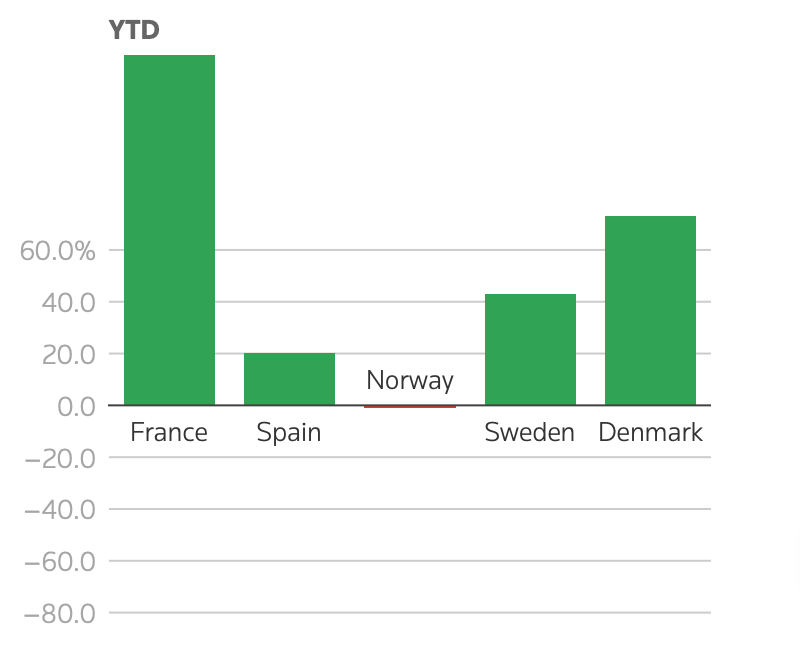
Official July 2026 delivery figures for France are now confirmed: Tesla delivered 2,429 vehicles in the month, marking an 86% year-over-year increase and the second-best July on record for the market. More notably, year-to-date deliveries through July have reached 31,123 units — a 135% increase compared to the same period in 2025 — underscoring that France's momentum is not just a one-month spike but a sustained H1 trend carrying into the second half of the year. The YTD figure suggests Tesla is on pace for a record annual total in France, adding weight to the broader European recovery narrative outlined below.
📊 @TeslaNewswire (Aug 2, 2026): "Tesla deliveries were strong in France in July 2026: ✅ 2,429 vehicles delivered ✅ +86% YoY ✅ Second best July ever ✅ 31,123 vehicles delivered since January ✅ +135% YTD"
Tesla's July 2026 registration data out of Europe tells two very different stories at once. In France and Denmark, the numbers are striking — up 86% and 52% year-on-year respectively. In Norway, Spain, and Italy, they're deeply negative. The divergence isn't random. It points to a deliberate strategic posture that could define Tesla's European performance for the rest of the year.

The Numbers Behind the Headlines
France registered 2,429 Tesla vehicles in July, according to data from the French car body PFA — the second-best July the market has ever recorded for the brand. Denmark logged 508 registrations, up 52% from July 2025, per bilstatistik.dk. Both markets share a common thread: active government incentive programs that make EV purchases meaningfully cheaper for buyers right now.
The contrast with other European markets is hard to ignore. Norway — historically Tesla's most reliable stronghold on the continent — saw registrations fall 97% year-on-year in July. Sweden dropped 60%. Italy fell 77%, Spain 81%, Portugal 69%. These aren't rounding errors. They reflect a pattern consistent with Tesla managing delivery timing and inventory allocation toward markets where incentive windows are open and volume can be maximized.
| Market | July 2026 YoY Change | Context |
|---|---|---|
| France | +86% | 2,429 units — 2nd-best July ever; active EV incentives |
| Denmark | +52% | 508 units; strong BEV adoption trend |
| Norway | -97% | Historically Tesla's strongest European market |
| Sweden | -60% | — |
| Italy | -77% | — |
| Spain | -81% | — |
| Portugal | -69% | — |
The Incentive-Routing Strategy
Tesla has been here before. The company has a well-documented history of concentrating deliveries in markets where government subsidies are most accessible, then pulling back once incentive windows close or taper. What's notable about the current setup is the scale of the planned production increase backing it.
According to previous reporting, Gigafactory Berlin's Model Y output was targeted to increase by 20% starting July 2026, pushing toward 5,000 vehicles per week. A further 20% ramp is planned from October, with a target of 7,500 weekly units. Tesla's German subsidiary has reportedly projected a "significant increase in production volume" and capacity utilization for 2026. That kind of supply expansion needs somewhere to go — and France and Germany, with their current incentive structures, are the obvious destinations.
Germany's July registration data hasn't been released yet as of this writing, but it's one of the two numbers that will complete the picture. Britain's figures are also expected later this week. Both are large markets, and Germany in particular sits at the center of Tesla's European manufacturing footprint. If the German numbers mirror France's trajectory, the H2 thesis gets considerably stronger.
Broader European EV Context
Tesla's selective surge is happening against a generally improving EV backdrop. According to the European Automobile Manufacturers' Association, registrations of new battery-electric cars across Europe rose 51% in June 2026 — the month prior. That's a rising tide, but Tesla's market-specific swings are far more dramatic than the category average, which reinforces the view that allocation decisions, not just demand, are driving the numbers.
Tesla also reported record second-quarter deliveries last month, with European recovery cited as a contributing factor. The Q2 beat set expectations for H2 — and the July data from France and Denmark suggests the company is moving to validate that optimism with concrete volume, at least in the markets where the incentive math works in their favor.
The full picture won't be clear until Germany and Britain report. But the directional signal from France and Denmark is unambiguous: Tesla is leaning into incentive-driven demand with real supply to back it up, and the second half of 2026 in Europe is shaping up to be a meaningful test of whether that strategy can move the needle at scale.
Related Gear
Gear up your Tesla with tested, custom-fit BASENOR accessories — shop Tesla accessories →
Sources & reporting notes
The links below identify the material source records used for this report.
- @SawyerMerritt on X (2026-08-03T15:49:52.000Z) — Direct source
Source links are preserved as published or accessed. See our editorial standards and corrections policy.
The BASENOR Editorial Desk covers Tesla, SpaceX, and related technology, curating reporting from primary sources — official accounts, regulatory filings, and software release data. Every article passes source-record and fact-checking review before publication. About the newsroom.
This report was curated by the BASENOR Editorial Desk from the sources listed above. Read our editorial standards or email editorial@basenor.com to report an error.