
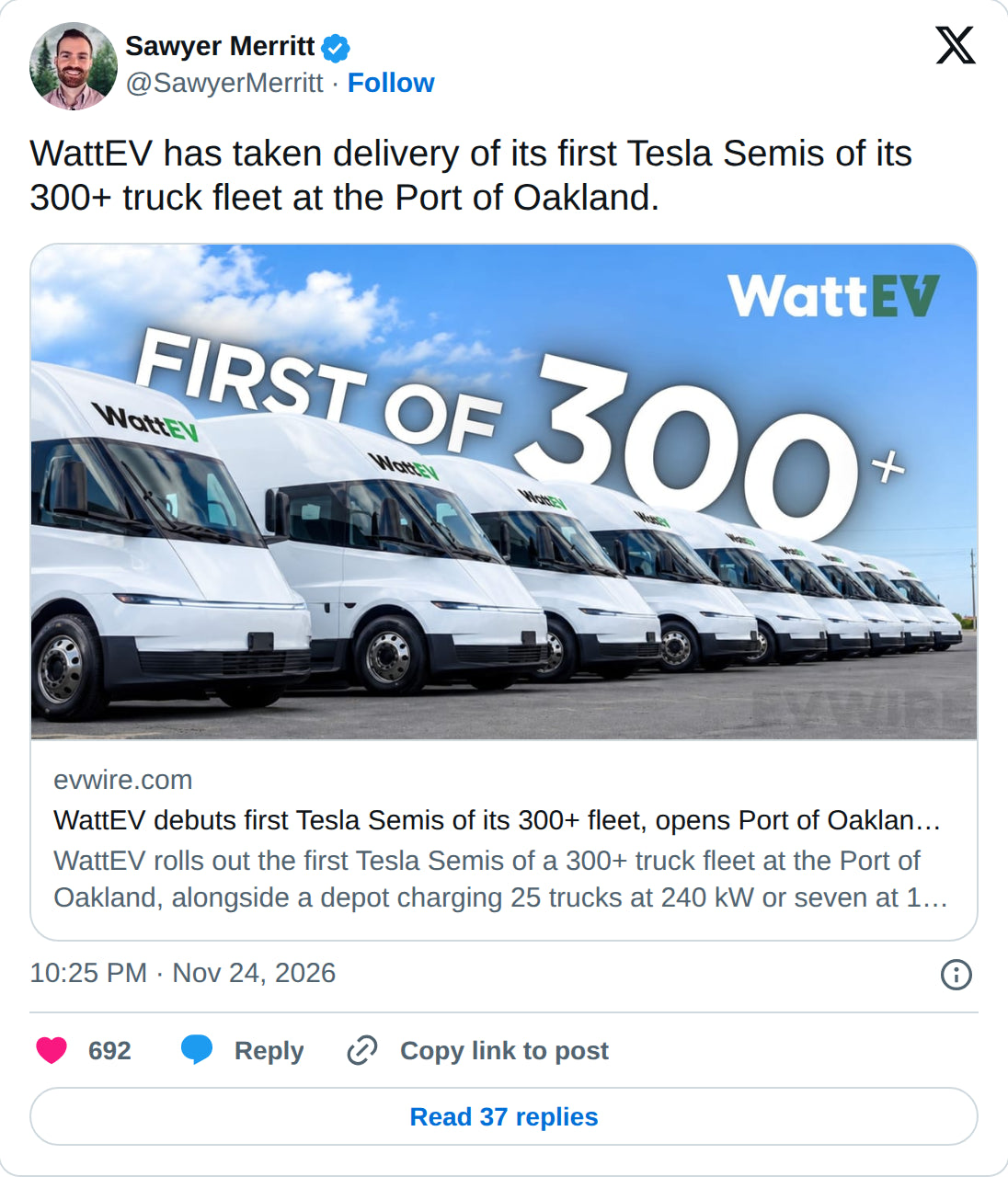
WattEV officially received its first Tesla Semis at the Port of Oakland on November 24, 2026, opening a new chapter in the commercial rollout of Tesla's Class 8 electric truck. The delivery kicks off what is billed as the largest single electric truck deployment in California — a 370-unit order that will put Tesla Semis to work on one of the busiest freight corridors on the West Coast.

The Scale of the Deal
WattEV's order stands at 370 Tesla Semi Class 8 trucks, with more than 300 of those units earmarked for a joint deployment program with the Port of Oakland. The first 50 units were scheduled to begin arriving in 2026, with the full fleet expected to be operational by the end of 2027. November 24 also marked the opening of WattEV's first Bay Area charging depot, built directly at the port to support the incoming trucks.
The Port of Oakland handles roughly 99 percent of Northern California's containerized goods — putting Tesla Semis at the center of a supply chain that touches virtually every product category moving through the region. For Tesla's commercial vehicle ambitions, this is a meaningful proof point: not a pilot program, but a phased deployment with a defined endpoint and an operator that has built the charging infrastructure to match.
| Metric | Detail |
|---|---|
| Total order size | 370 Tesla Semi Class 8 trucks |
| Port of Oakland deployment | 300+ units under joint program |
| First deliveries | 50 units, 2026 |
| Full fleet operational target | End of 2027 |
| Standard Range | ~325 miles at 82,000 lb GCW |
| Long Range | ~500 miles at 82,000 lb GCW |
| Peak charging speed (MCS 3.2) | 1.2 MW — up to 60% range in 30 min |
| Energy consumption | 1.7 kWh per mile (both variants) |
Where Semi Production Stands
Tesla announced the first Semi rolled off its high-volume Nevada production line on April 29, 2026, with volume production reportedly ramping through September 2026 and a stated annual target of 50,000 trucks. The WattEV delivery cadence — 50 trucks in 2026, the remainder through 2027 — maps reasonably well against that production ramp. It also follows a separate deployment at the Port of Long Beach, which BASENOR covered earlier this month when Tesla Semi arrived at that facility with its own set of operational details worth knowing.
The charging infrastructure piece is worth noting separately. WattEV's depot at Oakland uses Tesla's Megawatt Charging System, which supports peak speeds of 1.2 MW and can recover up to 60 percent of range in 30 minutes. For port drayage — short, repetitive hauls between terminal and distribution center — that turnaround time is workable. The trucks don't need 500-mile range; they need reliable charge cycles that keep them moving through a shift.
What This Signals for Tesla's Commercial Push
Two major California ports now have Tesla Semis actively operating, and the operator in both cases has committed to triple-digit fleet sizes rather than token pilots. That pattern matters. Fleet operators absorb the operational risk of early-generation commercial EVs — charging reliability, uptime, driver adaptation — and their willingness to scale up is a more honest signal of product readiness than any spec sheet.
WattEV's model is also distinct: it operates as a charging-as-a-service provider, meaning it owns the trucks and leases them to carriers rather than selling directly to fleets. That structure lowers the barrier for smaller drayage operators to access electric trucks without taking on the infrastructure investment themselves. If the Port of Oakland deployment performs, it becomes a replicable template for other West Coast ports — and a meaningful volume driver for Tesla's Nevada Semi plant as it works toward that 50,000-unit annual target.
Related Gear
Gear up your Tesla with tested, custom-fit BASENOR accessories — shop Tesla accessories →
Sources & reporting notes
The links below identify the material source records used for this report.
- @SawyerMerritt on X (2026-11-24T14:25:56.000Z) — Direct source
Source links are preserved as published or accessed. See our editorial standards and corrections policy.
The BASENOR Editorial Desk covers Tesla, SpaceX, and related technology, curating reporting from primary sources — official accounts, regulatory filings, and software release data. Every article passes source-record and fact-checking review before publication. About the newsroom.
This report was curated by the BASENOR Editorial Desk from the sources listed above. Read our editorial standards or email editorial@basenor.com to report an error.