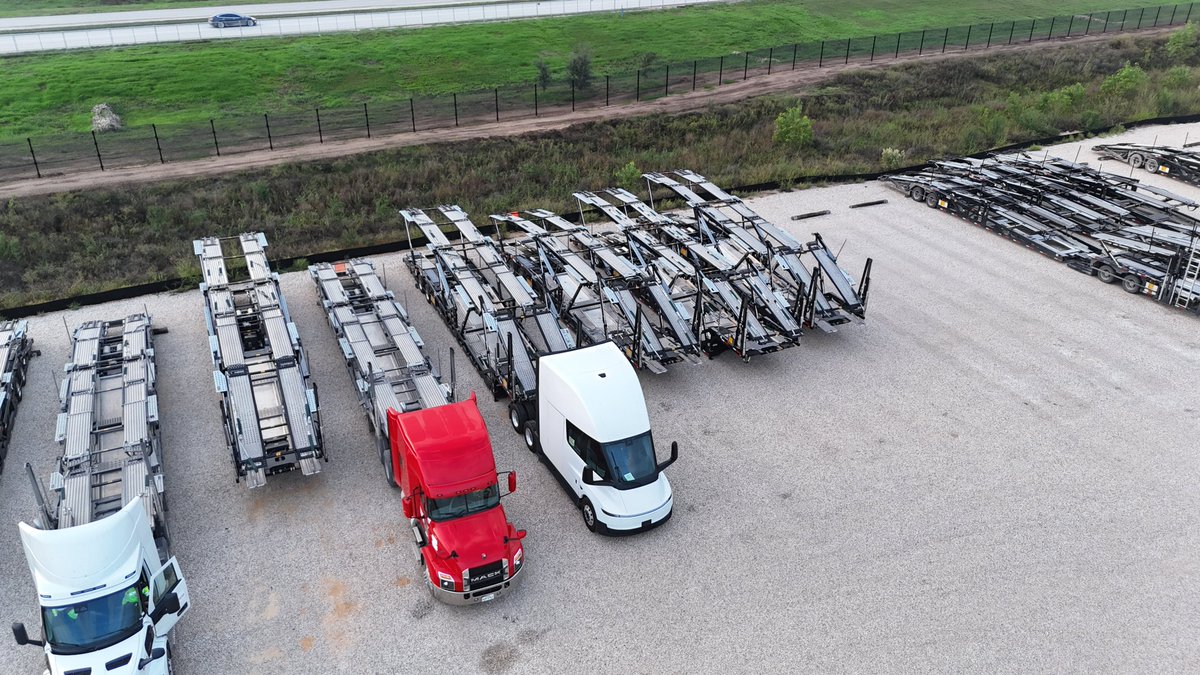
Three refreshed Tesla Semi trucks were spotted actively working at Giga Texas on November 11, pulling vehicle transport trailers — a meaningful step beyond the engineering evaluation sightings from earlier this year. Observer Joe Tegtmeyer, who regularly documents activity at the Austin facility, noted at least three units on site and flagged it as a potential sign that Tesla is beginning to build out a full internal logistics fleet using its own trucks.

Here's what the Giga Texas deployment tells us about where the Semi program actually stands.
1. This Is Operational Work, Not a Demo
Earlier this year, a refreshed Semi was spotted at Giga Texas in March 2026 — but that visit was widely interpreted as an engineering evaluation. What Tegtmeyer documented today is different: trucks hooked to vehicle transport trailers, actively moving product. That's a logistics operation, not a photo op. Tesla has confirmed its intent to integrate Semis into its own freight network, and this appears to be that plan executing in real time at one of its highest-output factories.
2. The Refreshed Semi Is a Substantially Different Truck
The unit seen at Giga Texas is the redesigned Semi, not the original prototype-era version. According to verified specifications, the refresh incorporates a drivetrain with technology carried over from the Cybertruck, 4680 battery cells, and a next-generation heat pump managing both HVAC and powertrain thermals. The cab features acoustic glass and stand-up headroom — details aimed squarely at driver retention in commercial fleets. Software handles pre-trip inspection automation and electronic logging. High-volume production of this version began at the dedicated Nevada factory in April 2026, with customer deliveries starting in September.
3. The Range Numbers Are Commercially Viable
The Semi ships in two configurations. The Standard Range variant carries a 548 kWh pack rated for over 500 km (roughly 310 miles). The Long Range version steps up to an 822 kWh pack with over 800 km (approximately 500 miles) of range under a 37-tonne load. For the Giga Texas use case — shuttling vehicles between the factory and the nearby Tesla delivery hub in Taylor — even the Standard Range spec is more than sufficient. The route is short enough that charging logistics are essentially a non-issue for this particular application.
4. Megacharger Infrastructure at Giga Texas Is Already Expanding
Range alone doesn't make a fleet viable — charging does. Giga Texas has been actively expanding its Megacharger infrastructure through 2026, and Tesla deployed its first public Semi Megacharger station in July 2026. The Semi supports up to 1.2 MW charging, capable of recovering roughly 60% of driving range in 30 minutes. With on-site Megacharger capacity growing at the Austin facility, the infrastructure side of a full internal fleet is increasingly in place. Tesla has also reported year-to-date Semi uptime exceeding 98% in 2026 — a figure that matters enormously when you're building a logistics dependency on a single truck platform.
5. External Orders Signal This Isn't Just an Internal Experiment
The Giga Texas deployment carries more weight when viewed against the broader commercial picture. Third-party logistics firm Einride has a confirmed order for 500 Tesla Semis to be deployed across North America — including Texas — beginning in September 2026, serving customers that include Amazon. The ZET SCALE shipper alliance named Tesla as primary manufacturer for an initial 2,500-truck Class 8 order, with Texas freight hubs in Houston, Dallas, and San Antonio all listed as deployment locations. IMC Logistics has also ordered 50 units. The Nevada factory is designed for up to 50,000 trucks annually. Tesla using its own trucks internally at Giga Texas is both a logistics decision and a live proof-of-concept for every fleet operator watching.
Whether today's three-truck sighting grows into a full factory fleet in the coming months will be worth tracking. Tegtmeyer's observation that he hopes it's "the beginning of a whole fleet" moving vehicles from the factory to the Taylor delivery hub reflects the logical endpoint — Tesla's highest-volume factory, served by Tesla's own electric trucks, charged by Tesla's own Megachargers. The pieces are in place; the question now is pace.
Related Gear
Gear up your Tesla with tested, custom-fit BASENOR accessories — shop Tesla accessories →
Sources & reporting notes
The links below identify the material source records used for this report.
- @JoeTegtmeyer on X (2026-11-11T16:46:24.000Z) — Direct source
Source links are preserved as published or accessed. See our editorial standards and corrections policy.
The BASENOR Editorial Desk covers Tesla, SpaceX, and related technology, curating reporting from primary sources — official accounts, regulatory filings, and software release data. Every article passes source-record and fact-checking review before publication. About the newsroom.
This report was curated by the BASENOR Editorial Desk from the sources listed above. Read our editorial standards or email editorial@basenor.com to report an error.