30-Second Brief
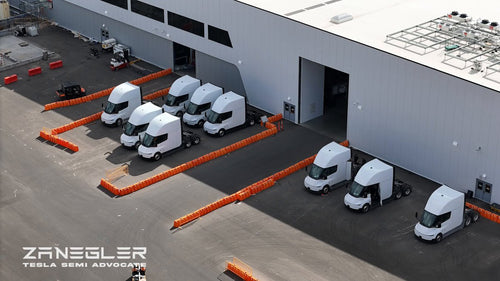
The News: Tesla Semi frames are actively moving through the company's new dedicated factory in Nevada, marking the beginning of mass production with a target capacity of 50,000 trucks per year.
Why It Matters: This is the moment Tesla's long-haul electric trucking ambition shifts from pilot program to industrial-scale reality — a potential turning point for the entire freight industry.
Source: @SawyerMerritt on X
Tesla Semi Factory in Nevada Begins Mass Production — 50,000 Trucks Per Year in Sight
After years of delays, limited pilot deliveries, and anticipation, Tesla's dedicated Semi manufacturing facility in Nevada is now operational. Frames are moving through the production line — and the scale Tesla is targeting is nothing short of transformational for electric freight.

📊 Key Figures
| Metric | Value | Context |
|---|---|---|
| Annual Production Target | 50,000 units | At full ramp |
| Full Ramp Timeline | H2 2026 | Mass production started March 2026 |
| Long Range Version Price | $290,000 | 500-mile range variant |
| Standard Range | ~325 miles | Loaded at 81,000 lbs GVW |
| Long Range | 500 miles | Loaded at 81,000 lbs GVW |
| Peak Power Output | 1,070 hp (800 kW) | 3 independent rear motors |
| MCS Charging Speed | Up to 1.2 MW | 70% charge in ~30 min |
| Pilot Deliveries (Pre-Production) | ~200 trucks | PepsiCo, DHL, Hight Logistics |
| Battery Cell Type | 4680 cells | Domestically sourced, reengineered pack |
| MCS Network (Planned Sites) | ~46 sites | Nationwide expansion underway |
From Construction Site to Assembly Line
The video captured by @corememory and shared by @SawyerMerritt is the clearest confirmation yet that Tesla's Nevada Semi facility has crossed a critical threshold. What was a construction site just months ago is now an operational factory with Semi frames — the structural backbone of each truck — actively progressing through the assembly sequence.
The dedicated facility sits adjacent to Gigafactory Nevada, Tesla's existing battery and drivetrain hub. That proximity is no accident: the Semi's reengineered battery pack uses domestically sourced 4680 cells, and having production co-located with cell manufacturing is a direct supply chain advantage. Tesla is building the Semi ecosystem — factory, cells, and Megawatt Charging System (MCS) infrastructure — as an integrated whole.
The 50,000-Unit Target: What It Actually Means
Fifty thousand Semi trucks per year is a number worth sitting with. For context, the entire Class 8 heavy-duty truck market in the United States sells roughly 250,000–300,000 units annually. At full ramp, Tesla would be targeting approximately 15–20% of that market with a single product from a single factory.
The ramp itself is phased. Mass production officially began in March 2026, with initial assembly concentrated in the first half of the year. Full production capacity is expected to be reached in the second half of 2026. Tesla's track record with factory ramps — from Model 3 in Fremont to Cybertruck in Texas — suggests the path from 'frames moving' to full output will involve iterations, but the infrastructure is clearly in place.
The redesigned Semi is also still undergoing cold-weather validation testing in Alaska, indicating Tesla is running final pre-production checks in parallel with the factory ramp — a sign of confidence that volume deliveries are imminent rather than speculative.
🔭 The BASENOR Take
Timeline: Factory operational March 2026 → Full ramp H2 2026
Impact Level: 🔴 High — First purpose-built electric semi factory at this scale globally
Confidence: ✅ High — Video evidence of active production + corroborated by multiple verified sources
This is a genuine inflection point, not a press release milestone. The gap between 'pilot deliveries' and 'mass production' in the EV trucking space has tripped up nearly every company that has attempted it. Tesla is now visibly on the other side of that gap.
For fleet operators and logistics companies, the calculus is shifting. With the long-range Semi priced at $290,000 and capable of 500 miles on a single charge at full 81,000-lb gross weight, the total cost of ownership argument against diesel becomes increasingly hard to ignore — especially as Tesla expands its MCS charging network toward the planned ~46 nationwide sites. A 70% charge in roughly 30 minutes at 1.2 megawatts is a fundamentally different proposition than early EV charging infrastructure.
The broader signal here is also about Tesla's manufacturing ambitions beyond passenger cars. The Semi factory represents Tesla's first serious foray into commercial vehicle production at scale. If the ramp executes as planned, it validates that the same manufacturing philosophy that brought Model Y to become one of the world's best-selling vehicles can be applied to an entirely different vehicle category — one with even higher per-unit revenue and a customer base (commercial fleets) that makes purchasing decisions on hard economics rather than lifestyle preference.
Watch the delivery numbers in Q3 and Q4 2026. That's when this story gets its next major data point.
Related Gear
Gear up your Tesla with tested, custom-fit BASENOR accessories — shop Tesla accessories →
Sources & reporting notes
The links below identify the material source records used for this report.
- @SawyerMerritt on X (2026-03-08T15:46:49.000Z) — Direct source
Source links are preserved as published or accessed. See our editorial standards and corrections policy.
The BASENOR Editorial Desk covers Tesla, SpaceX, and related technology, curating reporting from primary sources — official accounts, regulatory filings, and software release data. Every article passes source-record and fact-checking review before publication. About the newsroom.
This report was curated by the BASENOR Editorial Desk from the sources listed above. Read our editorial standards or email editorial@basenor.com to report an error.