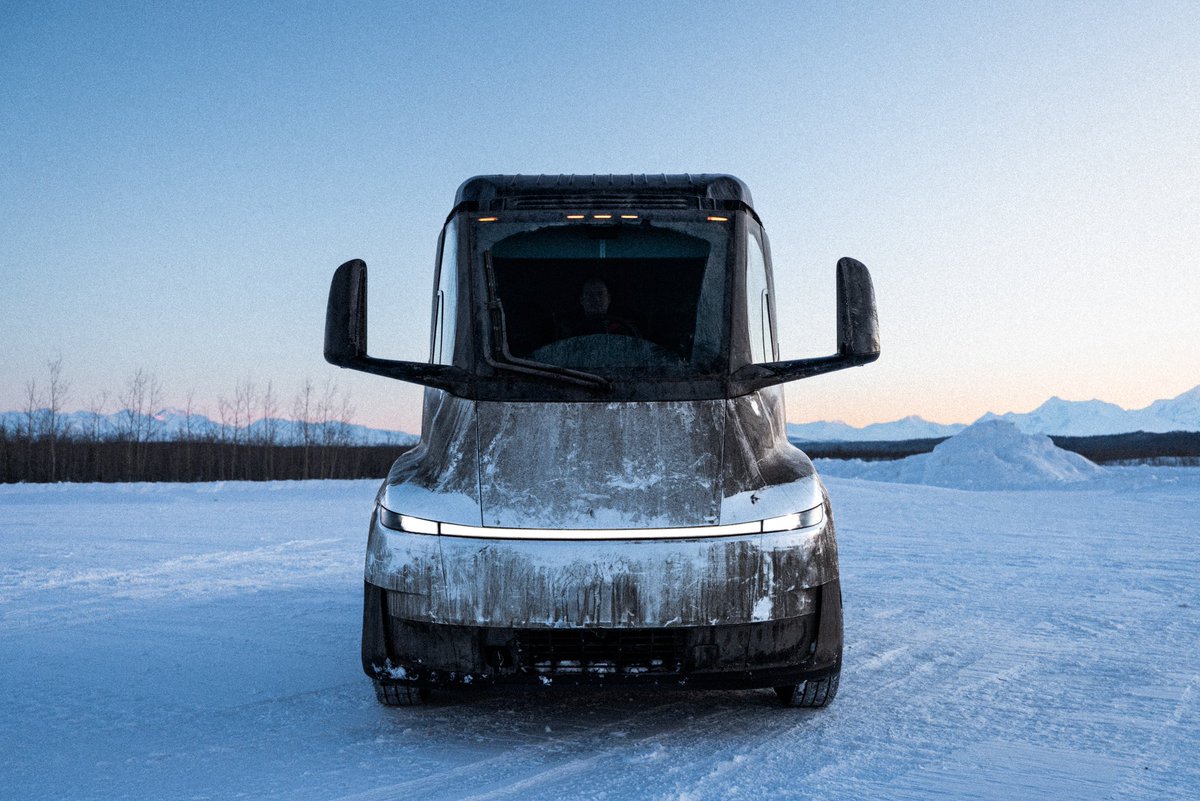
The News: Tesla has shared three new images of the refreshed Semi electric truck undergoing winter testing in Alaska.
Why It Matters: Alaska testing signals Tesla is in the final validation phase for cold-weather performance — a critical milestone before high-volume production begins in 2026.
Source: @TeslaNewswire on X
Tesla's Refreshed Semi Is Being Pushed to Its Limits in Alaska — Here's What It Means
Tesla has released new images of the refreshed Semi undergoing winter testing in Alaska — one of the harshest proving grounds on earth for any electric vehicle. The photos, shared by Tesla and picked up by The Tesla Newswire, show the updated truck operating in extreme cold conditions. For a vehicle targeting high-volume production in 2026, this kind of validation testing is exactly what fleet operators and industry watchers need to see.

📊 Key Figures: Refreshed Tesla Semi at a Glance
| Metric | Standard Range | Long Range |
|---|---|---|
| Range (at 82,000 lbs GCW) | ~325 miles | ~500 miles |
| Energy Consumption | 1.7 kWh/mile | 1.7 kWh/mile |
| Curb Weight | <20,000 lbs | ~23,000 lbs |
| Drive Power | Up to 800 kW (1,072 hp) | |
| Peak Charging Speed (LR) | — | 1.2 MW (MCS 3.2) |
| Charge to 60% SoC | ~30 minutes | |
| Battery Cells | 4680 | |
| Production Target (H2 2026) | 50,000 units/year | |
Why Alaska? The Logic Behind Extreme Cold Testing
Alaska isn't a random backdrop. It's a deliberate engineering gauntlet. Temperatures in interior Alaska regularly drop below -30°F (-34°C) in winter, which creates conditions that stress-test every system an electric truck depends on: battery thermal management, regenerative braking behavior, motor efficiency, HVAC load, and charging performance under cold soak.
For a commercial vehicle like the Semi — where fleet operators are making multi-year purchasing decisions worth millions of dollars — cold-weather range and reliability data isn't a nice-to-have. It's a contract requirement. Seeing Tesla voluntarily share images of this testing is a deliberate signal to those operators: we're doing the work.
It's worth noting that earlier winter testing in Canada showed the Semi holding approximately 400 miles of range with preconditioning active. Alaska testing will push that envelope further, validating performance in conditions that exceed what most North American fleets will ever encounter in regular operation.
The Refreshed Design: What Changed in November 2025
The truck being tested in Alaska is the updated Semi that debuted with a design refresh in November 2025. The facelift brought a new headlight bar, a redesigned chassis, and improved aerodynamics — changes that aren't cosmetic. Better aerodynamics directly translate to improved real-world range, which matters most on long-haul routes where every mile of efficiency compounds over the course of a year.
The powertrain remains three independent rear-axle motors producing up to 800 kW, and the Long Range variant still targets approximately 500 miles at full 82,000 lb gross combination weight. What the Alaska testing is now validating is how that performance holds up when ambient temperatures are working against the battery chemistry.
🔭 The BASENOR Take
Timeline: Design refresh November 2025 → Alaska winter testing March 2026 → High-volume production target H2 2026 (50,000 units/year)
Impact Level: 🟡 Medium-High — Primarily relevant to fleet operators and commercial logistics. Passenger car owners: this validates Tesla's engineering depth across its entire lineup.
Confidence: High — Images are official Tesla releases. Production timeline confirmed by Elon Musk in February 2026 and reflected on Tesla's website.
Analysis: The timing of these Alaska images is deliberate. With high-volume production targeting the second half of 2026 at the Nevada facility, Tesla is now in the window where fleet customers are finalizing purchase decisions. Sharing winter testing imagery — rather than keeping it internal — is a sales and confidence-building move as much as it is an engineering milestone. The fact that Tesla chose Alaska, rather than a more moderate cold-weather environment, also speaks to how seriously they're taking the commercial trucking market's durability expectations.
📰 Deep Dive
What makes this moment significant isn't just the images themselves — it's where they sit in the Semi's development arc. Tesla has been through a long road with this vehicle. The original Semi reveal was in 2017, early deliveries to PepsiCo began in late 2022, and the refreshed design only landed in November 2025. Alaska winter testing in early 2026, ahead of a targeted mass production ramp in the second half of the year, represents the kind of compressed final-validation timeline that Tesla has become known for executing under pressure.
For fleet operators evaluating the Semi, cold-weather performance is one of the last major question marks. The Long Range model's 500-mile range figure is rated at full load under standard conditions. Real-world winter performance — particularly in northern US states, Canada, and Scandinavia — will be the number that actually drives purchasing decisions. If Tesla can demonstrate that range holds to, say, 400+ miles with preconditioning in sub-zero conditions (consistent with earlier Canadian test data), that removes a significant objection from procurement teams.
The Semi's Megawatt Charging System compatibility (MCS 3.2, up to 1.2 MW on the Long Range) is also a factor that becomes more relevant in cold climates, where faster charging reduces the time trucks spend stationary in freezing conditions. A 30-minute charge to 60% state of charge is competitive with diesel refueling stops when you factor in driver rest requirements under HOS regulations.
The broader picture: Tesla is methodically checking every box that commercial fleet operators need checked before they commit. Alaska winter testing, shared publicly, is one of those boxes. The next milestone to watch is the Nevada facility production ramp — when the first high-volume Semi units roll off the line, the commercial EV trucking market will have its clearest signal yet that the transition is real.
Related Gear
Gear up your Tesla with tested, custom-fit BASENOR accessories — shop Tesla accessories →
Sources & reporting notes
The links below identify the material source records used for this report.
- @TeslaNewswire on X (2026-03-07T07:19:42.000Z) — Direct source
Source links are preserved as published or accessed. See our editorial standards and corrections policy.
The BASENOR Editorial Desk covers Tesla, SpaceX, and related technology, curating reporting from primary sources — official accounts, regulatory filings, and software release data. Every article passes source-record and fact-checking review before publication. About the newsroom.
This report was curated by the BASENOR Editorial Desk from the sources listed above. Read our editorial standards or email editorial@basenor.com to report an error.