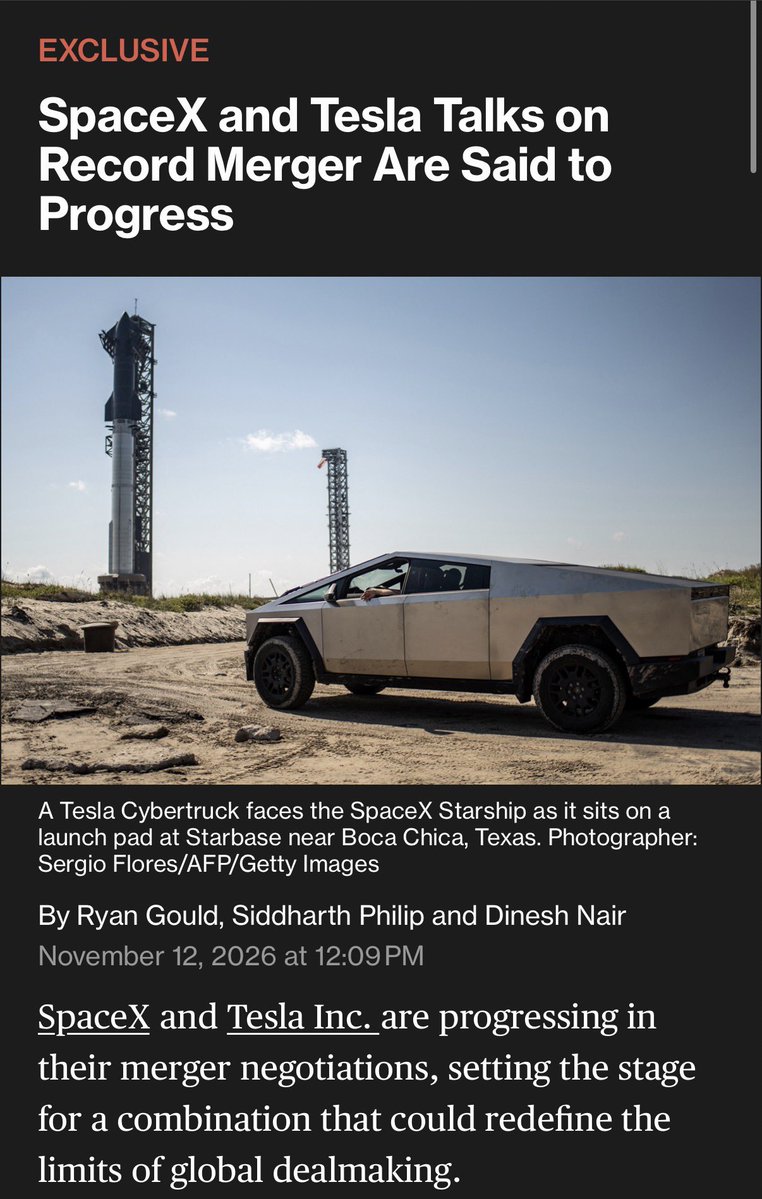
Bloomberg News is reporting that a merger between Tesla and SpaceX could be announced as soon as December, potentially timed to Tesla's annual shareholder meeting on December 3. The report, surfaced Wednesday by Whole Mars Catalog on X, cites sources familiar with the discussions and marks the most concrete timeline yet for a tie-up that would combine Elon Musk's two most valuable companies into a single entity worth an estimated $3.5 trillion.
Neither Tesla nor SpaceX immediately responded to Bloomberg's request for comment, according to the report. Terms have not been finalized, and sources told Bloomberg a slip into early 2027 remains possible.

How We Got Here
The Bloomberg timeline is the next step in a process Musk publicly confirmed last month. On October 20, 2026, Musk said both Tesla and SpaceX had formed special committees of independent directors to evaluate a possible combination, according to Teslarati and Electrek. Because Musk holds controlling stakes in both companies and sits on both boards, he recused himself from the committee discussions to manage the obvious conflict of interest.
At the time, Musk framed the logic around synergies between the two businesses: shared AI software, chip design, robotics, mass-to-orbit launch capacity, and Starlink connectivity for Tesla vehicles. He also cautioned that nothing was guaranteed, noting that a Tesla shareholder vote would require support from 50% of all outstanding shares — a threshold he himself called “quite high.”
The two companies are already commercially entangled. Tesla's SEC filings disclose a $2 billion equity investment in SpaceX and $405 million in Megapack revenue from SpaceX purchases during the first half of 2026. Tesla, SpaceX, and xAI are also co-investors in the Terafab semiconductor project, which is targeting test chip production in May-June 2027 and volume output by Q3 2028.
The Numbers Behind a Combined Entity
A Barclays analysis cited in multiple outlets pegged the combined market value based on October 14, 2026 valuations at roughly $3.5 trillion to $3.6 trillion. For context on scale:
| Entity | Estimated Valuation | Source |
|---|---|---|
| Tesla | ~$1.45–1.5 trillion | Public market, Oct 14 |
| SpaceX | ~$1.9–2.1 trillion | Private valuation |
| Combined | ~$3.5–3.6 trillion | Barclays analysis |
The December 3 shareholder meeting looks like a natural announcement window because it lands during Tesla's most-watched annual investor event. Musk has historically used that stage for major strategic reveals.
Why This Matters for Tesla Owners
For current Tesla owners, a merger would not immediately change the cars in the driveway — but it would reshape the roadmap behind them. Three practical implications are worth tracking:
1. Starlink connectivity: A combined entity removes the commercial negotiation between two separate public/private companies for integrating Starlink into Tesla vehicles. That could accelerate direct-to-vehicle connectivity features that Musk has hinted at for years.
2. Chip and AI consolidation: The Terafab partnership already links Tesla, SpaceX, and xAI on semiconductor development. A merger would fold two of those three parties into one balance sheet, potentially speeding custom chip deployment for FSD, Optimus, and Dojo-successor compute.
3. Capital allocation: SpaceX's cash flow profile is fundamentally different from Tesla's — heavier infrastructure costs offset by Starlink's recurring revenue. Combining them changes how capital gets deployed across robotaxi expansion, Optimus production, and new vehicle programs.
What's Still Uncertain
Several significant unknowns remain before anyone should treat December as a lock:
- Terms have not been agreed. As of Musk's October 20 statement, the special committees had not finalized valuation or exchange ratio.
- Shareholder approval is not guaranteed. Tesla needs 50% of outstanding shares — not just votes cast — to approve the deal.
- Regulatory review. A $3.5 trillion combination would draw scrutiny from the SEC, FTC, and potentially international regulators, given SpaceX's defense contracts and Starlink's global footprint.
- SpaceX private-shareholder dynamics. SpaceX's cap table includes institutional investors, employees, and Musk himself. A merger exchanges their private shares for public Tesla stock — a structural change many may welcome, but one with its own tax and lockup complications.
What to Watch Next
The next three signals that will tell us whether December is realistic:
- Formal 8-K filing from Tesla disclosing a definitive agreement, which would need to land before or during the December 3 shareholder meeting.
- Proxy materials outlining the proposed exchange ratio and committee recommendations — these would typically appear 2-4 weeks ahead of a shareholder vote.
- SpaceX investor communications about how private shares convert. Any leak from that process would effectively confirm the deal structure.
If none of those surface by late November, the “early 2027” scenario Bloomberg also mentioned becomes the more likely outcome. Either way, the question is no longer whether Musk's two biggest companies will combine — it's whether the paperwork gets done before the holidays.
Related Gear
Gear up your Tesla with tested, custom-fit BASENOR accessories — shop Tesla accessories →
Sources & reporting notes
The links below identify the material source records used for this report.
- @wholemars on X (2026-11-12T20:29:40.000Z) — Direct source
Source links are preserved as published or accessed. See our editorial standards and corrections policy.
The BASENOR Editorial Desk covers Tesla, SpaceX, and related technology, curating reporting from primary sources — official accounts, regulatory filings, and software release data. Every article passes source-record and fact-checking review before publication. About the newsroom.
This report was curated by the BASENOR Editorial Desk from the sources listed above. Read our editorial standards or email editorial@basenor.com to report an error.