📌 UPDATE — August 14, 2026
Drone footage of the Terafab site in Grimes County, TX has surfaced for the first time, courtesy of aerial photographer Joe Tegtmeyer (@JoeTegtmeyer). The video reveals a heavily forested, rural landscape dotted with ponds, streams, and cattle — a stark contrast to the industrial scale of what's being built there. Tegtmeyer describes it as a site for "the most advanced chip" manufacturing, confirming earlier reporting that the joint SpaceX-Tesla facility is targeting in-house semiconductor production. This is the first publicly available drone flyover of the active construction site.
@JoeTegtmeyer · Aug 14, 2026
"First drone flight and full video of the new SpaceX and Tesla Terafab located in Grimes County, Texas! The land is rugged, forested & with many ponds, streams, cattle and more … quite the inauspicious location for the most advanced chip [manufacturing facility]"
📌 UPDATE — August 13, 2026
Construction of Terafab in Grimes County, Texas has officially begun. The joint Tesla and SpaceXAI project is targeting production of over 1 terawatt (TW) of compute per year — confirming it will be the largest chip manufacturing facility ever built. The facility's ~100 million sq ft footprint makes it roughly 10× the size of Giga Texas, consistent with earlier reporting. Ground-level construction footage has now emerged showing active site work underway.
The 1 TW/year compute target underscores Terafab's central role in scaling AI infrastructure — not just for Tesla's autonomous systems and Optimus, but for SpaceXAI's broader compute ambitions. No production timeline or phased capacity milestones have been officially disclosed yet.
@TeslaNewswire · Aug 13, 2026
🔥 Tesla and SpaceXAI have started construction of Terafab in Grimes County, Texas! ✅ Largest chip manufacturing facility ever built ✅ Targeting production of over 1 TW of compute per year ✅ Roughly 10× larger than Giga Texas (~100 million sq ft).


The numbers surrounding the Tesla and SpaceX Terafab facility in Grimes County, Texas keep getting harder to contextualize — until you map them onto something familiar. According to Sawyer Merritt, the combined facility is projected to exceed 100 million square feet upon completion, roughly 3.6 square miles. That footprint would cover an area equal to 10% of all the land in the city of Miami.

What Terafab Actually Is
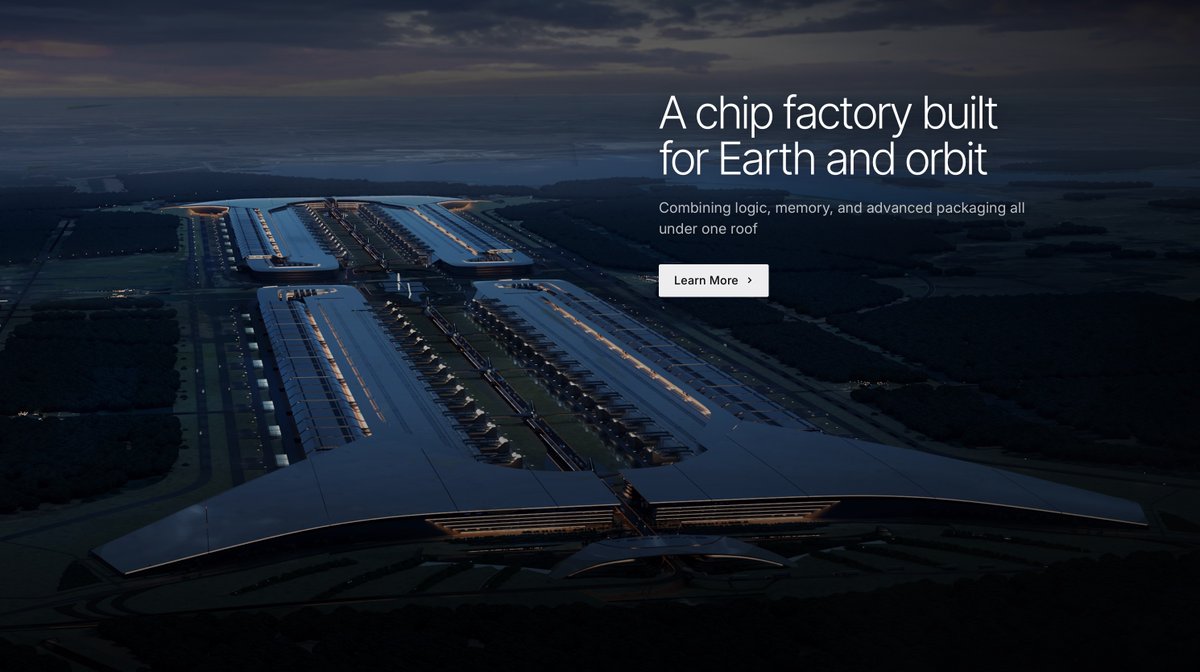
Terafab is not a traditional factory. It is a vertically integrated semiconductor megafactory — designed to combine logic chip fabrication, memory production, advanced packaging, and testing under a single roof. The stated output goal is over 1 terawatt of compute per year, feeding AI chips into Tesla's Optimus robots and Cybercabs, as well as SpaceX's space-based data center infrastructure.
Elon Musk has described the scale as "the right order of magnitude" and called it "the largest and most valuable building on Earth by far" once complete. Intel has been named as a partner, committing its advanced 14A process node to the project.
Tesla and SpaceX officially confirmed the location and the initial investment figure on August 6, 2026 — the day before Merritt's post. A precursor research fab at Giga Texas had already broken ground in April.
The Numbers Behind the Scale
| Metric | Figure |
|---|---|
| Total projected floor space | 100M+ sq ft (3.6 sq miles) |
| Phase 1 capital investment | $16.8 billion |
| Total potential investment (all phases) | Up to $119 billion |
| Target compute output | 1+ terawatt/year |
| Phase 1 jobs created | At least 3,000 |
| Texas Enterprise Fund grant | $30 million |
| Location | Grimes County, TX (~1 hr NW of Houston) |
Why the Footprint Matters Beyond the Headline
A 100-million-square-foot facility is not just a record for bragging rights. The sheer physical scale reflects a strategic bet on vertical integration at a level the semiconductor industry has never attempted. Most chip fabs are purpose-built for a single process — TSMC's most advanced fabs, for comparison, run in the range of a few million square feet each. Terafab's ambition is to collapse the entire supply chain — from raw wafer processing to final packaged chip — into one contiguous campus.
For Tesla specifically, the dependency on third-party chip suppliers has been a recurring constraint. The Dojo supercomputer program was an early signal that Tesla wanted to control its own silicon destiny. Terafab is the industrial-scale answer to that ambition, with Optimus robot production and Cybercab autonomy both contingent on a steady, high-volume supply of custom AI accelerators that no external foundry is currently positioned to deliver at the required cost and volume.
The investment trajectory is also worth noting. The confirmed Phase 1 figure of $16.8 billion is a significant step down from earlier estimates that ran as high as $55 billion for initial investment. Whether that reflects a more conservative Phase 1 scope, revised construction economics, or a phased commitment strategy tied to production milestones remains an open question — but the total potential investment of $119 billion across all phases suggests the long-term ambition hasn't shrunk.
Texas as the Anchor
Grimes County's approval of tax abatements, combined with the state's $30 million Texas Enterprise Fund grant and JETI program qualification, reflects a competitive incentive package — though $30 million is a relatively modest public contribution against a $16.8 billion private commitment. The site's proximity to College Station and the existing Giga Texas footprint near Austin gives Tesla and SpaceX access to engineering talent pipelines from Texas A&M while keeping logistics within a manageable corridor.
Water sourcing was flagged early as a potential friction point for a facility of this scale. SpaceX has stated it will draw from the Gibbons Creek Reservoir rather than local groundwater — a detail that will matter increasingly as the facility scales toward full capacity.
The precursor research fab at Giga Texas, which broke ground in April, is the immediate near-term indicator to watch. How quickly that facility reaches operational status will signal whether the broader Terafab timeline is tracking to plan or facing the construction and permitting delays that have historically shadowed projects of this ambition.
Related Gear
Gear up your Tesla with tested, custom-fit BASENOR accessories — shop Tesla accessories →
Sources & reporting notes
The links below identify the material source records used for this report.
- @SawyerMerritt on X (2026-08-07T01:02:10.000Z) — Direct source
Source links are preserved as published or accessed. See our editorial standards and corrections policy.
The BASENOR Editorial Desk covers Tesla, SpaceX, and related technology, curating reporting from primary sources — official accounts, regulatory filings, and software release data. Every article passes source-record and fact-checking review before publication. About the newsroom.
This report was curated by the BASENOR Editorial Desk from the sources listed above. Read our editorial standards or email editorial@basenor.com to report an error.