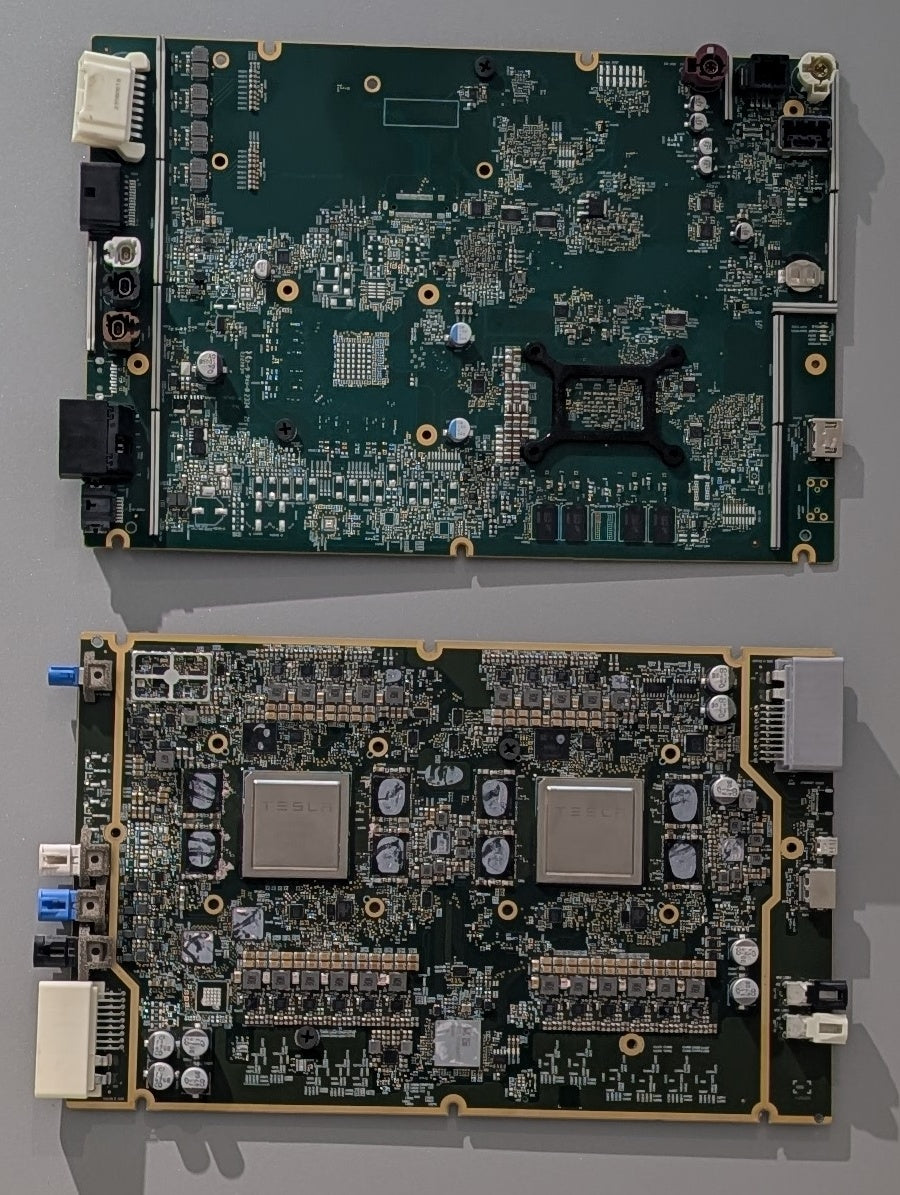
The News: Tesla stores are now openly displaying Hardware 4.0 (HW4) car computers — hardware that was previously kept strictly out of public view.
Why It Matters: This is a quiet but meaningful signal that Tesla is shifting from secrecy to transparency around its most advanced onboard computing platform — and may be setting the stage for HW4.5 visibility soon.
Source: @greentheonly on X
Tesla's HW4.0 Goes from Classified to Showroom Floor
For years, Tesla's Hardware 4.0 car computers were treated almost like classified hardware — integrated into vehicles but never put on display for curious visitors at Tesla's retail locations. That's changed. Tesla community researcher and well-known hardware insider @greentheonly spotted HW4.0 units openly on display during a recent visit to a Tesla store, marking what appears to be a deliberate shift in how Tesla presents its underlying technology to the public.

One detail @greentheonly flagged is worth noting: the infotainment board featuring the AMD CPU was positioned facing the wall — whether intentional or accidental, it's a curious choice that suggests Tesla may still be selective about exactly which components get full visibility.
📊 Key Figures
| Metric | HW3 | HW4 |
|---|---|---|
| CPU Cores | 12 | 20 |
| Neural Network Performance | 36 TOPS | 50 TOPS |
| RAM | 8 GB | 16 GB |
| Storage | 64 GB | 256 GB |
| Camera Interfaces | 9 | 12 |
| Processing Speed vs HW3 | Baseline | 2–4× faster |
Source: autopilotreview.com, wikipedia.org
What Exactly Is HW4.0?
Tesla's Hardware 4.0 — also referred to internally as FSD Computer 2 — represents the most capable onboard computing platform Tesla has shipped to date. It began rolling out in early 2023, first appearing in refreshed Model S and Model X deliveries, before expanding to Fremont-built Model Y units from May 2023. By February 2024, Giga Shanghai was building all new Model Ys with HW4 as standard. The Cybertruck also launched with HW4 from day one.
The hardware leap over HW3 is substantial: 20 CPU cores (up from 12), 50 TOPS of neural network performance (up from 36), 16 GB of RAM (doubled), and 256 GB of storage (quadrupled). It also reintroduces radar — specifically Tesla's "Phoenix radar" — after the company controversially removed radar from its vehicles in 2021. Front camera resolution jumps to 2896 x 1876, and the system now supports 12 camera interfaces versus the previous 9. The chip itself is manufactured by Samsung on a 7 nm process.
In short: HW4 is not an incremental update. It's a generational shift — and Tesla has been quietly shipping it in new vehicles for over two years. The fact that it's now sitting on a retail shelf for anyone to examine is a notable change in posture.
🔭 The BASENOR Take
Timeline: HW4 in vehicles since early 2023 → Now publicly displayed in Tesla stores (March 2026)
Impact Level: Medium — No immediate change for existing owners, but signals a strategic shift
Confidence: High — Direct observation by a credible hardware researcher
HW4.5 Signal: Speculative — @greentheonly raises the question, but no confirmation yet
Tesla putting HW4 on the showroom floor after years of treating it as proprietary hardware tells you something about where the company's head is at. When hardware is still cutting-edge and competitively sensitive, you keep it hidden. When you're ready to move on — or at least ready for customers to understand what they're buying — you put it under glass.
The timing aligns with growing industry conversation about Tesla's next hardware generation. @greentheonly's offhand question — "Maybe they'll show HW4.5 too?" — is worth taking seriously. If HW4 is now considered mature enough for retail display, it's reasonable to ask whether Tesla is already preparing to position HW4.5 as the new benchmark. Tesla has historically been tight-lipped about hardware roadmaps, but the retail display strategy often follows internal confidence that a successor is already in the pipeline.
For current owners, the practical takeaway is this: if you're driving a vehicle delivered after mid-2023, you almost certainly have HW4 already. The store display doesn't change your car's capabilities today. But it does suggest Tesla is growing more comfortable with public-facing hardware transparency — which could mean clearer upgrade path communication down the road.
One quirky detail worth revisiting: the infotainment board with the AMD CPU was reportedly facing the wall. Whether that's a deliberate choice to obscure the processor branding or simply poor display setup, it's the kind of detail that hardware watchers will notice. AMD's involvement in Tesla's infotainment stack isn't new information, but Tesla has never been particularly eager to spotlight its silicon partnerships publicly.
📰 Deep Dive
Tesla's retail strategy has always been unconventional — no dealerships, direct sales, and showrooms that function more as brand experience centers than traditional car lots. Displaying the actual computing hardware that powers its vehicles fits that mold: it's a way to make the technology tangible for customers who might otherwise have no idea what's running their car's autonomy stack. For the average Tesla buyer, seeing a physical HW4 unit on a shelf makes the "Full Self-Driving" pitch feel more grounded and real.
From a competitive standpoint, this move also makes sense as HW4 becomes table stakes. When every new Tesla ships with HW4 as standard, there's no longer any reason to keep it under wraps. The secrecy served its purpose during the transition period — preventing premature questions about HW3-to-HW4 upgrade timelines and managing customer expectations. Now that the fleet has largely turned over, openness costs Tesla nothing and potentially builds buyer confidence.
The HW4.5 speculation is the more interesting thread to pull. Tesla has a pattern of iterating hardware quietly before announcing it publicly. If stores are already comfortable displaying HW4, and if internal development of HW4.5 is sufficiently advanced, a similar display rollout for the next generation could follow within months of its vehicle integration. Owners and prospective buyers would do well to watch Tesla store displays as an informal leading indicator of what's coming next.
Related Gear
Gear up your Tesla with tested, custom-fit BASENOR accessories — shop Tesla accessories →
Sources & reporting notes
The links below identify the material source records used for this report.
- @greentheonly on X (2026-03-12T03:59:54.000Z) — Direct source
Source links are preserved as published or accessed. See our editorial standards and corrections policy.
The BASENOR Editorial Desk covers Tesla, SpaceX, and related technology, curating reporting from primary sources — official accounts, regulatory filings, and software release data. Every article passes source-record and fact-checking review before publication. About the newsroom.
This report was curated by the BASENOR Editorial Desk from the sources listed above. Read our editorial standards or email editorial@basenor.com to report an error.