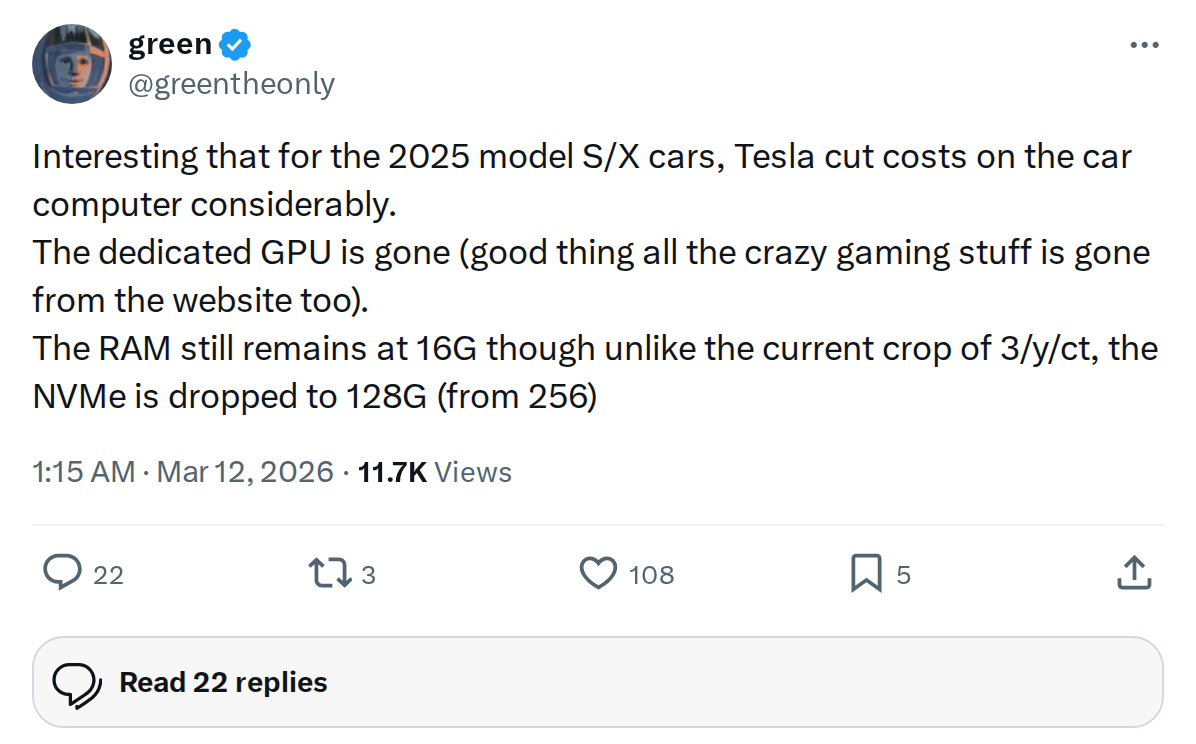
The News: Tesla has significantly cut the computer hardware costs in 2025 Model S and Model X vehicles, removing the dedicated GPU entirely.
Why It Matters: For owners considering a final Model S/X purchase before production ends in Q2 2026, this is a meaningful spec downgrade — particularly for anyone who valued the in-car gaming capability.
Source: @greentheonly on X
Tesla Strips Dedicated GPU from 2025 Model S/X Computer as End-of-Life Approaches
Tesla has quietly downgraded the onboard computer hardware in its 2025 Model S and Model X vehicles, removing the dedicated GPU that previously powered the cars' infotainment and gaming capabilities. The finding, surfaced by well-known Tesla hardware researcher @greentheonly, aligns with Tesla's earlier removal of all gaming-related content from its website — and fits squarely into the broader context of the Model S/X approaching end of production.

📊 Key Figures
| Component | Previous | 2025 Model S/X |
|---|---|---|
| Dedicated GPU | ✅ Present | ❌ Removed |
| RAM | 16 GB | 16 GB (unchanged) |
| In-Car Gaming | Available (Tesla Arcade) | Removed from website |
| Production End | — | Q2 2026 |
What Tesla Actually Changed
The dedicated GPU — which previously handled the graphically intensive workloads of Tesla Arcade games like Cyberpunk 2077 and The Witcher 3 — is no longer present in the 2025 Model S/X computer. According to @greentheonly, who has a long track record of accurately identifying hardware changes inside Tesla vehicles through firmware and component analysis, the cost-cutting measure is substantial.
Notably, the RAM remains at 16 GB, which is actually higher than what Tesla currently ships in the Model 3, Model Y, and Cybertruck. The NVMe storage detail in the original tweet appears to have been cut off, suggesting additional changes may still be forthcoming from the researcher's analysis.
The removal of the dedicated GPU is a logical consequence of Tesla quietly scrubbing all gaming-related features from its website. Tesla Arcade — once a marquee selling point for the Model S and Model X — is effectively dead as a product offering. There is no point maintaining expensive GPU silicon for software features that no longer exist on the platform.
The Bigger Picture: End-of-Life Hardware Rationalization
This hardware change doesn't exist in a vacuum. Tesla officially confirmed during the Q4 2025 Earnings Call that the Model S and Model X will be discontinued, with production ending in Q2 2026. Elon Musk explained that the Fremont Factory floor space currently dedicated to these flagship sedans and SUVs will be repurposed for Optimus humanoid robot assembly and Cybercab production.
With that context, the GPU removal is a textbook end-of-life cost rationalization. Tesla is not investing in the future of a platform it has already scheduled for retirement — it is managing margin on the remaining production run. Removing an expensive discrete GPU component while the software features that justified it have already been eliminated is simply good manufacturing economics.
It is also worth noting that Tesla did introduce a minor refresh to the Model S and Model X in June 2025, adding features like a Frost Blue paint option, improved noise cancellation, updated suspension tuning, new wheel designs, a front fascia camera, dynamic ambient lighting, and additional third-row space in the Model X. That refresh came with a $5,000 price increase across all configurations. The GPU removal appears to be a separate, cost-side adjustment happening concurrently — meaning buyers are paying more while receiving less silicon under the hood.
🔭 The BASENOR Take
Timeline: Hardware change identified March 11, 2026 | Production ends Q2 2026
Impact Level: Medium — affects buyers making a final Model S/X purchase decision
Confidence: High — @greentheonly has a strong track record on hardware findings; the gaming feature removal from Tesla's website independently corroborates the GPU elimination
The real question for prospective buyers: does the GPU removal affect anything beyond gaming? The honest answer is probably not much in day-to-day use. Tesla's FSD and core infotainment functions do not rely on the discrete GPU — they run on dedicated neural processing hardware. The 16 GB of RAM remaining is actually a spec advantage over the current 3/Y/Cybertruck lineup. But if you were holding out for a Model S or Model X specifically because of the premium hardware experience, the calculus has shifted. You are now buying a vehicle on a sunset platform with reduced silicon, at a higher price than a year ago, with fewer software features. That is a combination worth factoring into any purchase decision before Q2 2026.
📰 Deep Dive
The removal of the dedicated GPU from the 2025 Model S/X is a revealing signal about how Tesla manages hardware at the end of a product lifecycle. Rather than continuing to source and install components that serve no active software purpose, Tesla is trimming the bill of materials on its way out. This is not unusual in the auto industry — manufacturers routinely simplify specs on outgoing models — but it is unusually visible in Tesla's case because third-party researchers like @greentheonly can inspect firmware and component signatures directly.
What makes this particularly interesting is the sequencing. Tesla first removed the gaming features from its website (and presumably from the software), then removed the GPU hardware from the cars. That is the correct order of operations from an engineering standpoint — you do not remove hardware that active software still depends on. The fact that both changes have now been confirmed suggests Tesla's internal roadmap for the Model S/X sunset has been executing on schedule.
For the broader Tesla ecosystem, this change is a footnote. The Model S and Model X represent a small fraction of Tesla's current production volume, and their discontinuation has been publicly confirmed. The manufacturing capacity being freed up for Optimus and Cybercab is far more strategically significant to Tesla's future than the final hardware configuration of its outgoing flagship. But for the owners and buyers who have long associated the Model S/X with Tesla's most premium, feature-rich experience, the GPU removal is a meaningful — if symbolic — end to that era.
Related Gear
Gear up your Model S & X with tested, custom-fit BASENOR accessories — shop Model S & X accessories →
Sources & reporting notes
The links below identify the material source records used for this report.
- @greentheonly on X (2026-03-11T17:15:58.000Z) — Direct source
Source links are preserved as published or accessed. See our editorial standards and corrections policy.
The BASENOR Editorial Desk covers Tesla, SpaceX, and related technology, curating reporting from primary sources — official accounts, regulatory filings, and software release data. Every article passes source-record and fact-checking review before publication. About the newsroom.
This report was curated by the BASENOR Editorial Desk from the sources listed above. Read our editorial standards or email editorial@basenor.com to report an error.