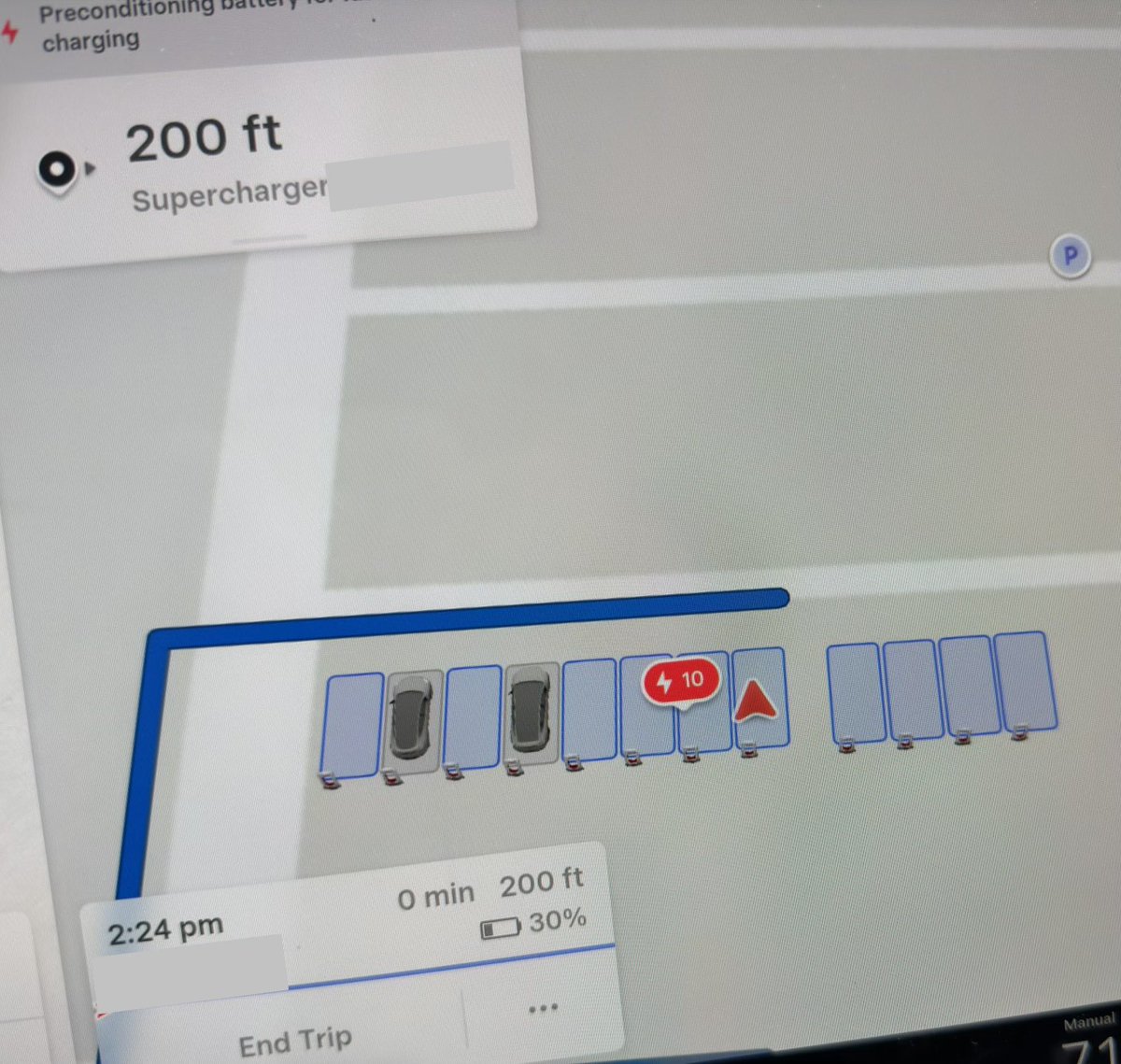
The News: Tesla has deployed a 3D Supercharger site map feature that shows live occupancy status — Available, Occupied, or Down — for every individual stall at supported stations.
Why It Matters: No more pulling into a full station blind. You can see exactly which stalls are open before you arrive — and even scout nearby amenities while you charge.
Source: @SawyerMerritt on X

What Is the Tesla Supercharger 3D Site Map?
Tesla's Supercharger 3D site map is exactly what it sounds like — a real-time, three-dimensional view of a Supercharging station rendered directly in your vehicle's navigation display. Instead of a generic pin on a map, you get a full layout of the station: every stall, its current status, and the surrounding area.
Each stall is color-coded with one of three statuses:
- Available — stall is open and ready
- Occupied — another vehicle is currently charging
- Down — stall is offline or out of service
The map also surfaces nearby businesses and amenities — restaurants, shops, restrooms — so you can plan your downtime before you even park.
📊 What Changed
| Feature | Before | Now |
|---|---|---|
| Station view | Generic map pin with stall count | Full 3D layout of the physical station |
| Stall availability | Total available vs. occupied count only | Per-stall live status (Available / Occupied / Down) |
| Nearby amenities | Not shown in charging view | Highlighted on the 3D map |
| Coverage | Pilot: 18 U.S. sites (Dec 2025) | 300+ sites live, 300+ added per week |
| Geographic reach | U.S. only (initially California + Texas) | Most U.S. states + Europe rollout underway |
How Fast Is This Rolling Out?
The feature launched quietly as part of Tesla's 2025 Holiday Update in early December 2025, initially live at just 18 Supercharger sites across California and Texas. The expansion since then has been aggressive.
🔌 Rollout Timeline
| Dec 2025 | Pilot launch — 18 sites in CA + TX |
| Jan 2026 | Europe rollout begins via 2026.2 software update |
| Feb 10, 2026 | Expanded to most U.S. states |
| Feb 12, 2026 | 300+ sites live; adding 300+ per week (per Tesla Director of Charging North America Max de Zegher) |
At that pace, coverage across the U.S. network — which spans over 75,000 connectors globally — could be largely complete within months.
🚦 Owner's Action Plan
Verdict: Recommended — check compatibility first
Step 1 — Check if your hardware supports the in-car 3D view
The in-car 3D site map display requires an AMD Ryzen-based media unit (the newer infotainment hardware). If your Tesla has an older MCU, you won't see the 3D rendering on-screen — though live stall data may still be accessible via the Tesla app.
- Model 3 Highland, Model Y Juniper, and recent Model S/X refreshes are most likely to have compatible hardware
- Older vehicles (pre-2022 MCU2) may not render the 3D view in-car
- Check: Controls → Software → Additional Vehicle Information to confirm your media unit generation
Step 2 — Access the 3D map at a supported Supercharger
There are two ways to trigger the site map:
- While navigating: Route to a supported Supercharger. When you arrive, the 3D layout and live stall statuses will appear automatically.
- On-demand: At a supported station, tap "View Site Map" in the charging interface.
Step 3 — Use it to pick your stall strategically
This is where the feature earns its keep. Before you even pull in, you can see which stalls are free. At busy stations, this means you can drive directly to an open stall instead of circling. If multiple stalls are available, you can also spot which are "Down" and avoid them entirely.
Step 4 — Don't see it yet? Be patient
If your local Supercharger doesn't show the 3D map, it likely hasn't been added yet. With 300+ sites being added per week, most U.S. owners should see coverage at their regular charging stops within the coming weeks. European owners on software version 2026.2 or later should also start seeing supported sites appear.
What's Coming Next
According to Tesla's Director of Charging North America, the site map feature is explicitly being built with Full Self-Driving and Robotaxi operations in mind. That's a meaningful signal: this isn't just a convenience feature for human drivers — it's infrastructure groundwork for autonomous vehicles that need to navigate charging stations without a human at the wheel.
Expect the maps to get richer over time, potentially adding stall-level power output data, wait time estimates, and tighter integration with FSD routing. For now, though, the live stall view alone is a meaningful upgrade for charging stop planning.
📰 Deep Dive
The Supercharger 3D site map is a deceptively simple feature with real operational impact. The core problem it solves: arriving at a Supercharger station and not knowing where to go. Even with the existing availability count ("6 of 12 available"), you still had to physically scan the lot to find which stalls were open. At large stations with 20, 30, or 40 stalls spread across multiple rows, that's a genuine friction point — especially when you're low on range and every minute counts.
The per-stall live status changes that calculus entirely. You know before you park. You know which row to head to. And if a stall shows as Down, you're not wasting time plugging in only to get an error. It's a small UX improvement that compounds across every charging stop you make.
The hardware requirement is worth flagging for older Tesla owners. The AMD Ryzen media unit — which Tesla began deploying more broadly in 2022 and beyond — is the gating factor for the in-car 3D rendering. Owners on older MCU hardware aren't completely locked out, but the experience will be meaningfully different. Tesla has historically been cautious about backporting visually intensive features to older infotainment systems, so don't expect a retrofit path here.
The FSD and Robotaxi angle mentioned by Tesla's charging leadership is the most forward-looking piece of this story. An autonomous vehicle navigating to a Supercharger needs to know exactly where to park — not just that spots are available, but which specific stall to target. The 3D site map, with its machine-readable stall-level data, is precisely the kind of infrastructure that makes that possible. What looks like a driver convenience feature today is quietly becoming part of Tesla's autonomous operations stack.
📋 Tracking Tesla software? See every firmware, FSD and app version in one place in our Tesla Software Update Tracker.
Related Gear
Gear up your Tesla with tested, custom-fit BASENOR accessories — shop Tesla accessories →
Sources & reporting notes
The links below identify the material source records used for this report.
- @SawyerMerritt on X (2026-03-16T03:10:28.000Z) — Direct source
Source links are preserved as published or accessed. See our editorial standards and corrections policy.
The BASENOR Editorial Desk covers Tesla, SpaceX, and related technology, curating reporting from primary sources — official accounts, regulatory filings, and software release data. Every article passes source-record and fact-checking review before publication. About the newsroom.
This report was curated by the BASENOR Editorial Desk from the sources listed above. Read our editorial standards or email editorial@basenor.com to report an error.