
Tesla's Supercharger pipeline added eight stations to its active tracking list this week, with movement across four countries: Portugal, South Korea, Italy, and France. Three locations entered the planning stage and five are now under active construction, according to supercharge.info, the community-maintained network tracker.
Network Changes This Week
What does "PLAN" vs. "CONSTRUCTION" actually mean?
These are the two earliest stages in Tesla's Supercharger pipeline as tracked by supercharge.info. A PLAN status means the site has been identified and registered — permits may be in progress, but no physical work has started. CONSTRUCTION means groundwork, electrical installation, or equipment placement is actively underway at the location. Neither stage has a guaranteed opening date, but construction sites are typically weeks to a few months from going live, while plan-stage sites can take considerably longer.
Which locations moved to PLAN this week?
All three new plan-stage entries are in Portugal: Valadares, Castro Marim, and Bougado. Portugal has seen steady Supercharger pipeline activity through 2026 — Tesla announced community-voted sites including Abrantes, Portugal as part of its Q3 2026 community-picked rollout, and earlier construction was reported at Caldas da Rainha, Rio Tinto, and Guimarães. These three new plan entries suggest Tesla is continuing to fill coverage gaps along the Portuguese coast and interior.
Which locations are now under construction?
Five stations moved into the construction phase across three countries:
- Incheon, South Korea — a major port city and gateway to Seoul, currently underserved relative to its population density.
- Gokseong Rest Area (Suncheon), South Korea — a highway rest-area site, which fits Tesla's broader push to place Superchargers at high-traffic transit points. South Korea announced plans to add 21 new fast-charging locations at highway rest areas as part of a government program, and this site appears consistent with that initiative.
- Cheongju, South Korea – West — a second site in Cheongju, indicating Tesla is expanding capacity in this central Korean city rather than treating it as a single-site market.
- Siena, Italy – Via delle Province — Siena is a high-tourism destination in Tuscany with limited existing fast-charging infrastructure, making it a logical gap to close for both local owners and road-trippers.
- Avrillé, France — a suburb of Angers in the Loire Valley, extending coverage in a region that sits between major Atlantic coast corridors.
How reliable is this data?
The source is supercharge.info, a community-maintained tracker that aggregates permit filings, construction sightings, and user reports. The site explicitly notes its data is not provided or validated by Tesla directly. Status changes are generally accurate for identifying active pipeline movement, but opening dates and stall counts are not confirmed until Tesla publishes them officially. Treat plan and construction entries as directional signals, not firm commitments.
When can drivers in these regions expect the stations to open?
There are no official opening dates for any of these eight locations. Construction-phase sites — Incheon, Gokseong, Cheongju West, Siena, and Avrillé — are the closest to going live, but timelines vary significantly based on local permitting, grid connection work, and Tesla's deployment schedule. The three Portuguese plan-stage sites (Valadares, Castro Marim, Bougado) are earlier in the process and could be many months away. The best way to track progress is to monitor supercharge.info directly or watch for the sites to appear in Tesla's in-car navigation as they approach opening.
For a broader look at how the network has been evolving, our coverage of the prior week's ten-station update provides useful context on the pace of expansion across different regions. You can also follow all charging news as new stations come online.
Related coverage
Related Gear
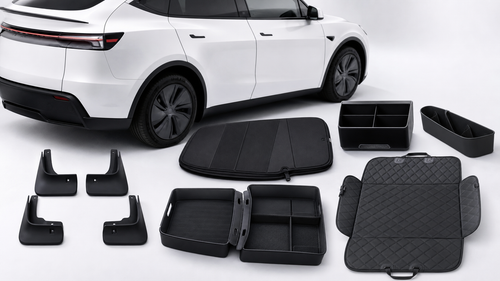
Gear up your Tesla with tested, custom-fit BASENOR accessories — shop Tesla accessories →
Sources & reporting notes
The links below identify the material source records used for this report.
- SUPERCHARGER — Collected source record
Source links are preserved as published or accessed. See our editorial standards and corrections policy.
The BASENOR Editorial Desk covers Tesla, SpaceX, and related technology, curating reporting from primary sources — official accounts, regulatory filings, and software release data. Every article passes source-record and fact-checking review before publication. About the newsroom.
This report was curated by the BASENOR Editorial Desk from the sources listed above. Read our editorial standards or email editorial@basenor.com to report an error.