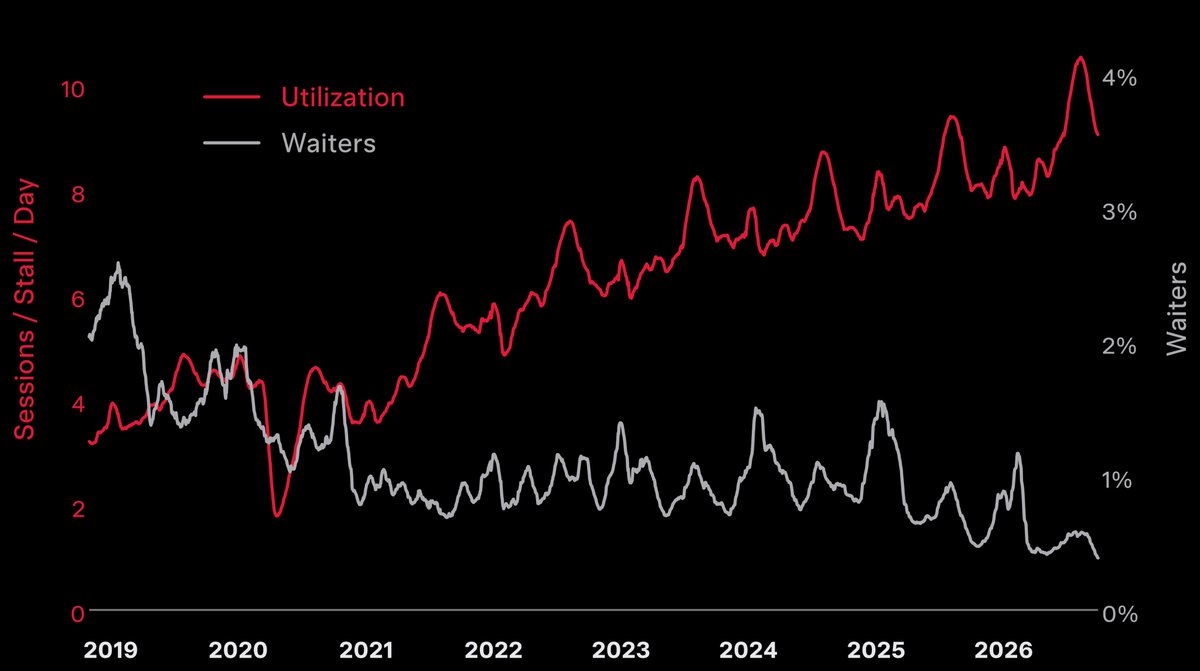
Tesla's Charging team has released fresh data on how the Supercharger network is actually performing — and the numbers tell a story that's easy to miss in a headline. Utilization is at an all-time high, but wait times have simultaneously dropped to record lows. That combination doesn't happen by accident. Here's what the data shows, and what it means if you charge on the road.

1. Utilization Has Hit a New High: ~9–10 Sessions Per Stall Per Day
Tesla's Charging team confirmed that average global utilization has reached approximately 9–10 charging sessions per stall per day — an all-time high for the network. For context, that figure was in the 7–8 range as recently as Q1 2026, according to previous data. Each stall is now being used roughly once every 2.5 hours around the clock. That's a meaningfully busy network, and it's a direct reflection of fleet growth outpacing what most charging infrastructure can handle.
2. Wait Times Are at Their Lowest: Just 0.3–0.4% of Drivers
Despite that record utilization, the share of drivers who actually have to wait for a stall has fallen to approximately 0.3–0.4% — near or at an all-time low. Earlier in 2026, that figure sat around 0.4–0.5%. The continued decline suggests Tesla's stall expansion is staying ahead of demand growth. If you've noticed fewer queues at your regular Supercharger stops this year, this data explains why.

3. The Network Delivered 2.0 TWh in a Single Quarter
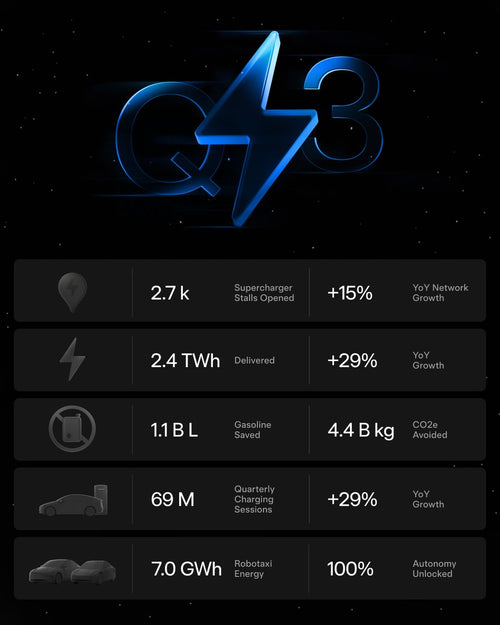
In Q2 2026, the Supercharger network delivered a record 2.0 terawatt-hours of energy — up 30% year-over-year, according to previous reporting. To put that in perspective, Q1 2026 set a record at 1.8 TWh, only for Q2 to break it. The trajectory is steep. Quarterly charging sessions also climbed to 60 million in Q2, a 32% year-over-year increase. Preliminary Q3 2026 data points to 69 million total charging sessions across Superchargers, home Wall Connectors, and third-party NACS-compatible stations — up 29% from the same period last year.
4. Tesla Has Crossed 80,000 Stalls Globally
The global Supercharger network crossed 80,000 stalls as of mid-May 2026. Tesla added approximately 2,500 new stalls in Q1 2026 (up 19% year-over-year) and around 2,700 in Q2 2026 (up 17%). That pace of expansion — roughly 1,000 new stalls per month — is what's keeping wait times suppressed even as utilization climbs. Of those 80,000-plus stalls, over 27,500 are now accessible to non-Tesla EVs, meaning the network's efficiency metrics increasingly reflect a broader charging public, not just Tesla owners.
5. Tesla Launched Automatic Waitlists at High-Traffic Locations
On May 11, 2026, Tesla launched a pilot program for automatic virtual waitlists at five high-traffic Supercharger locations in the US. When all stalls at a participating station are occupied, drivers can join a queue from the car's navigation screen or the Tesla app rather than circling or guessing. The rollout is still limited, but it's a direct operational response to peak-hour congestion at the busiest nodes on the network — and a sign that Tesla is managing demand at the software layer, not just by adding hardware.
What the Data Actually Says
The headline tension here — record utilization, record-low wait times — resolves when you look at the stall addition rate. Tesla has been adding stalls faster than session growth demands, which is the only way to keep both numbers moving in their current directions simultaneously. The automatic waitlist pilot suggests the team is also investing in smarter queue management for the locations where hardware expansion alone isn't enough. For owners, the practical takeaway is straightforward: the network is busier than ever, but it's also better managed than ever. For charging news across the network, see our charging coverage.
Related Gear
Gear up your Tesla with tested, custom-fit BASENOR accessories — shop Tesla accessories →
Sources & reporting notes
The links below identify the material source records used for this report.
- @TeslaNewswire on X (2026-10-01T19:38:23.000Z) — Direct source
Source links are preserved as published or accessed. See our editorial standards and corrections policy.
The BASENOR Editorial Desk covers Tesla, SpaceX, and related technology, curating reporting from primary sources — official accounts, regulatory filings, and software release data. Every article passes source-record and fact-checking review before publication. About the newsroom.
This report was curated by the BASENOR Editorial Desk from the sources listed above. Read our editorial standards or email editorial@basenor.com to report an error.