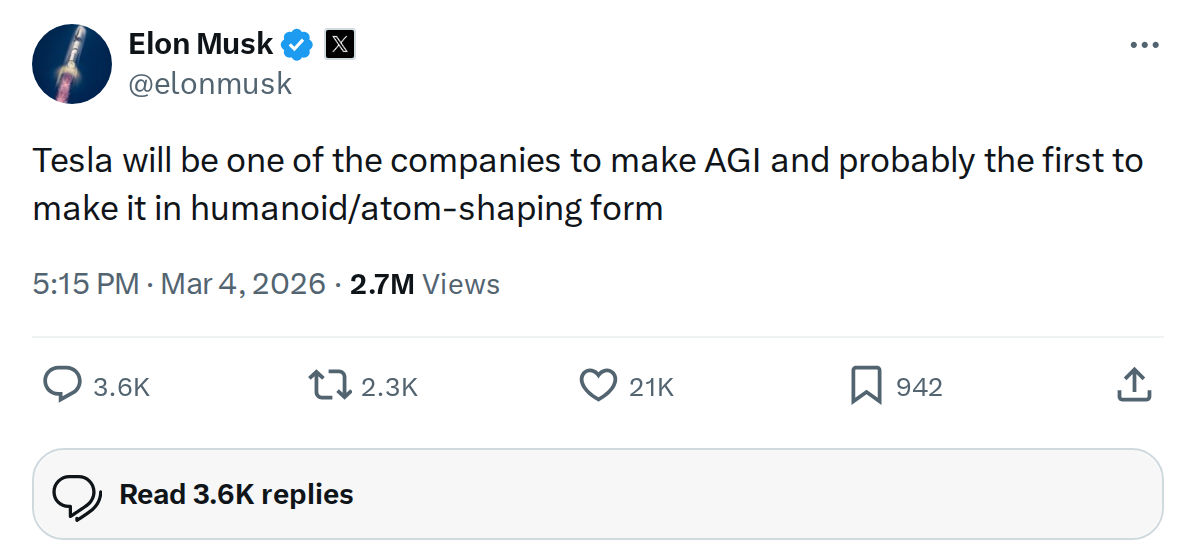
The News: Elon Musk declared that Tesla will be one of the companies to achieve Artificial General Intelligence (AGI) — and likely the first to do it in humanoid, physical form.
Why It Matters: This is the clearest signal yet that Tesla is not just an EV company. Optimus, Tesla's humanoid robot, is the physical embodiment of this AGI ambition — and it changes how owners and investors should think about the company's long-term value.
Source: @elonmusk on X
Tesla Just Redefined Its Own Mission
Most people still think of Tesla as a car company that happens to have good software. Elon Musk wants to correct that assumption — loudly and directly.
In a post that has already surpassed 2.3 million views, Musk stated that Tesla will be among the companies to build Artificial General Intelligence, and specifically that it will likely be the first to achieve AGI in a humanoid or "atom-shaping" form. That phrase — atom-shaping — is deliberate. It signals something beyond software intelligence: an AI that can manipulate the physical world with its own hands.

That physical AI is Optimus — Tesla's humanoid robot project, now years into development and approaching a critical inflection point.
📊 Key Figures
| Metric | Value | Context |
|---|---|---|
| Target Price | ~$20,000 | "Less than a car" — Musk |
| Height | 5'8" (173 cm) | Human-scale form factor |
| Weight | 125 lbs (57 kg) | Lightweight for industrial use |
| Walking Speed | Up to 5 mph (8 km/h) | Demonstrated in public testing |
| Payload Capacity | 20 lbs (9 kg) | Factory and logistics tasks |
| Internal Deployment | 2024 target | Tesla factories first |
| External Sale | 2025 target | Commercial availability |
Why "Atom-Shaping" Is the Key Phrase
The AI race so far has been almost entirely digital — large language models, image generators, reasoning engines. They live in servers. They can write, analyze, and create, but they cannot pick up a box, tighten a bolt, or navigate a factory floor.
Musk's framing of "atom-shaping" AGI draws a sharp line between that digital intelligence and what Tesla is building. Optimus is designed to be the bridge between AI reasoning and physical action. It uses the same neural network architecture and training philosophy behind Tesla's Full Self-Driving system — but instead of navigating roads, it navigates the real world on two legs, with two hands.
That's a fundamentally different kind of intelligence problem. And it's one that Tesla, with its years of real-world AI training data from its vehicle fleet, may be uniquely positioned to solve. For more on how Tesla's AI stack underpins both vehicles and robotics, see our FSD coverage.
🔭 The BASENOR Take
Timeline: Optimus internal factory deployment began in 2024. External commercial sales were targeted for 2025. Musk's statement today signals the AGI framing is now front and center as the program matures.
Impact Level: 🔴 High — This reframes Tesla's entire long-term value proposition.
Confidence: Medium-High — The direction is clear; the timeline for true AGI remains speculative by nature.
There are a few things worth unpacking in Musk's specific word choice: "one of the companies." He's not claiming Tesla will be the only AGI developer — he's placing Tesla in a small, elite group alongside the obvious names in AI. But the qualifier that follows is more aggressive: "probably the first to make it in humanoid/atom-shaping form." That's a direct competitive claim against every robotics company currently in the space.
For Tesla owners, this statement has a dual significance. First, it confirms that the company you've invested in — whether financially or just by buying a vehicle — is playing a much longer game than quarterly delivery numbers suggest. Second, it means the software intelligence improving your car's FSD capabilities and the intelligence being trained into Optimus are part of the same research trajectory. Every mile your Tesla drives is, in a sense, contributing to this larger mission.
What This Means for Tesla's Competitive Position
Tesla's advantage in this race isn't just engineering talent or capital — it's data. The FSD fleet has accumulated billions of real-world driving miles, training neural networks to make split-second decisions in unpredictable environments. Adapting that training pipeline to a bipedal robot performing factory tasks is a significant leap, but the foundational AI infrastructure already exists.
At a target price of around $20,000 — less than many of the vehicles Tesla sells — Optimus is also designed to be commercially scalable in a way that most robotics competitors have not yet demonstrated. If Tesla can hit that price point at volume, the economics of humanoid robotics change dramatically, and the "atom-shaping AGI" Musk describes stops being a vision statement and becomes a product roadmap.
The question for owners and observers isn't whether Tesla is serious about AGI. Today's statement makes that unambiguous. The question is how quickly the gap between current Optimus demonstrations — sorting objects, walking at 5 mph, performing fine motor tasks — and genuine general intelligence can be closed. That's a question no one in the industry has answered yet. But Tesla has now publicly staked its claim to be first.
🤖 Tracking Tesla's humanoid robot? See every Optimus production milestone and appearance in our Tesla Optimus Tracker.
Related Gear
Gear up your Tesla with tested, custom-fit BASENOR accessories — shop Tesla accessories →
Sources & reporting notes
The links below identify the material source records used for this report.
- @elonmusk on X (2026-03-04T09:15:38.000Z) — Direct source
Source links are preserved as published or accessed. See our editorial standards and corrections policy.
The BASENOR Editorial Desk covers Tesla, SpaceX, and related technology, curating reporting from primary sources — official accounts, regulatory filings, and software release data. Every article passes source-record and fact-checking review before publication. About the newsroom.
This report was curated by the BASENOR Editorial Desk from the sources listed above. Read our editorial standards or email editorial@basenor.com to report an error.