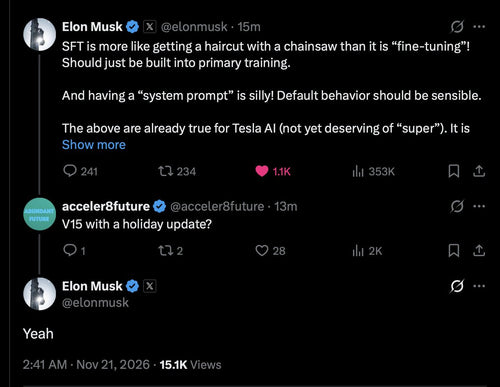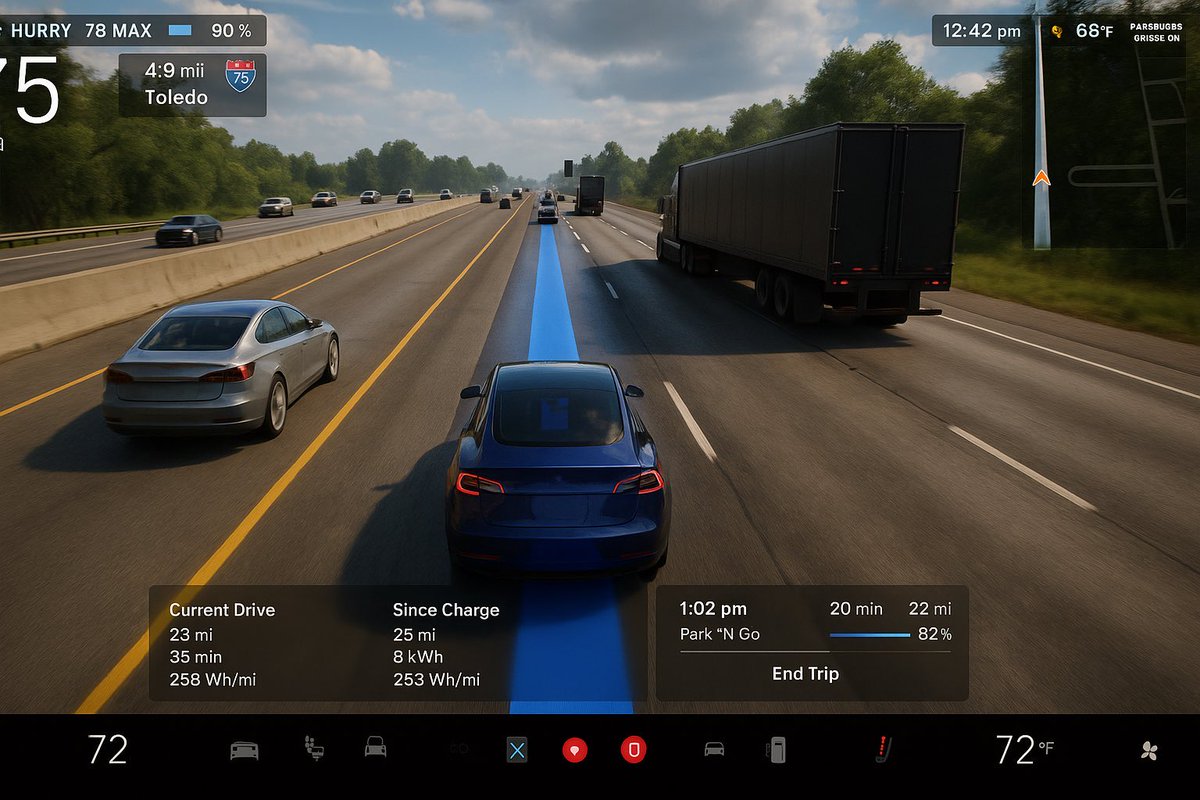
Tesla's Full Self-Driving V15, slated for a December 2026 rollout as part of the annual Holiday Update, isn't just a performance upgrade — it's a complete reimagining of how your car shows you the world. According to @TeslaNewswire, the new interface will "re-render reality in a mind-blowing way," with speculation pointing to Unreal Engine as the rendering backbone. Combined with a 10-billion-parameter AI model and a suite of confirmed capability upgrades, FSD V15 may be the most significant Tesla software release in years.

What's Actually Confirmed for FSD V15
Before getting into the UI speculation, it's worth grounding this in what Tesla has officially stated. According to Elon Musk and Tesla executives, FSD V15 will ship with a meaningful set of confirmed changes:
| Change | Type | Models |
|---|---|---|
| Redesigned UI — "re-renders reality" (likely Unreal Engine) | Official | HW4 confirmed; HW3 TBD |
| ~10 billion parameter AI model (~10× prior version) | Official | HW4 confirmed |
| HOV/carpool lane handling fixed | Official | All compatible |
| Pothole avoidance | Official | All compatible |
| Tesla's own AI-powered mapping system | Official | All compatible |
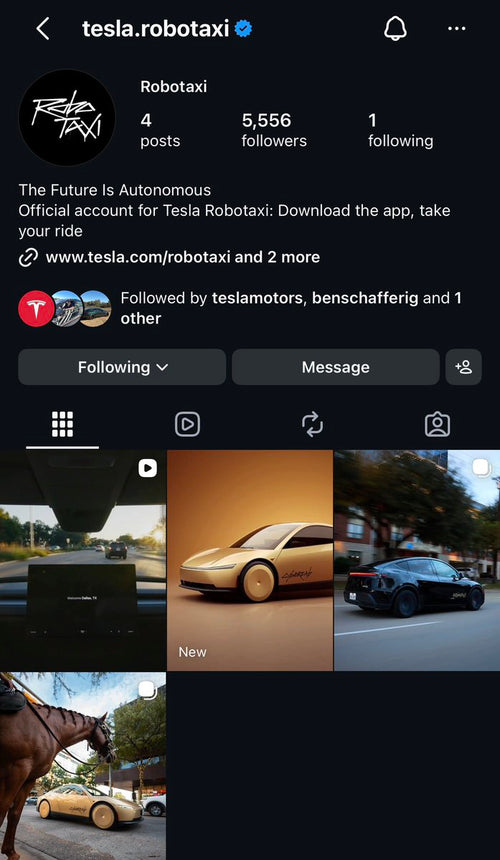
| Robotaxi software parity (Austin Model Y network) | Official | Model Y (Austin) |
The UI: What "Re-Rendering Reality" Actually Means
Tesla's current FSD visualization — the birds-eye view with flat lane lines, generic car silhouettes, and basic obstacle outlines — has been largely unchanged in its fundamental aesthetic for years. The phrase "re-render reality" suggests a shift toward photorealistic or near-photorealistic scene reconstruction: your car's cameras and sensors feeding a real-time 3D engine that draws the world around you as it actually looks, not as a simplified abstraction.
Tesla previously teased this direction with the post "What if we're just driving in a video game" — a nod toward the kind of immersive, game-engine-quality rendering that Unreal Engine is built for. Epic's Unreal Engine 5, in particular, is capable of real-time environments that are visually indistinguishable from film-quality renders. If Tesla has integrated it into the visualization stack, the in-car display could shift from a functional diagram to something closer to a live digital twin of your surroundings.
It's worth being clear: the Unreal Engine connection is informed speculation based on Tesla's prior statements and the capabilities required to deliver what's been described. Tesla hasn't officially named the rendering technology. But the direction is unambiguous — this is a visual overhaul, not a minor refresh.
Your Action Plan Before V15 Arrives
FSD V15 is targeting December 2026. Here's how to make sure you're positioned to receive it — and get the most out of it — from day one.
1. Confirm your hardware generation
FSD V15's confirmed compatibility is Hardware 4 (HW4/AI4). If you're unsure which hardware your car has, go to Controls → Software → Additional Vehicle Information and look for the Autopilot computer entry. HW4 cars will show "AI4" or "Full Self-Driving Computer (AI4)." If you're on HW3, hold off on expectations — Tesla has not confirmed a V15 build for HW3, and the jump to a 10-billion-parameter model may require the additional compute headroom that HW4 provides.
2. Make sure your FSD subscription or purchase is active
FSD V15 is an FSD-tier feature. Check your subscription status under Controls → Upgrades. If your subscription lapsed or you're on Autopilot only, you won't receive the new interface or the AI model upgrade.
3. Enable Software Update Preference to "Advanced"
To get V15 as early as possible after it drops, set your update preference to Controls → Software → Software Update Preference → Advanced. This opts you into the earliest available release channel for your region and hardware tier.
4. Ensure your car is on a strong Wi-Fi connection regularly
A 10-billion-parameter model is a large download. Park your car on home Wi-Fi overnight in the weeks leading up to the December rollout. Updates of this scale can take longer to download over LTE and may be deprioritized on cellular to manage Tesla's network load.
5. Note your current FSD version for comparison
When V15 lands, the UI change will be immediately obvious — but the AI improvements in hazard prediction and reaction time are subtler. Take a mental note of any recurring FSD behaviors that frustrate you today (HOV lane hesitation, pothole reactions, specific intersection types). You'll have a much clearer read on what actually improved if you're comparing against a baseline you remember.
Why This Release Is Different
Most FSD updates improve the model incrementally. V15 is doing something structurally different: it's shipping the same software stack that runs Tesla's commercial Robotaxi fleet in Austin. That means the gap between what your personal vehicle does and what a driverless Cybercab does is narrowing to near-zero on the software side. The UI overhaul is the visible face of that shift — Tesla isn't just upgrading the driving, it's upgrading how the car communicates its understanding of the world to you.
December is close. Get your hardware confirmed, your subscription active, and your Wi-Fi ready — this one is worth being first in line for.
📋 Tracking Tesla software? See every firmware, FSD and app version in one place in our Tesla Software Update Tracker.
🚕 Following the Robotaxi rollout? See every operating city, launch date and announced market in our Tesla Robotaxi Tracker.
Related Gear
Gear up your Tesla with tested, custom-fit BASENOR accessories — shop Tesla accessories →
Sources & reporting notes
The links below identify the material source records used for this report.
- @TeslaNewswire on X (2026-11-21T09:04:43.000Z) — Direct source
Source links are preserved as published or accessed. See our editorial standards and corrections policy.
The BASENOR Editorial Desk covers Tesla, SpaceX, and related technology, curating reporting from primary sources — official accounts, regulatory filings, and software release data. Every article passes source-record and fact-checking review before publication. About the newsroom.
This report was curated by the BASENOR Editorial Desk from the sources listed above. Read our editorial standards or email editorial@basenor.com to report an error.