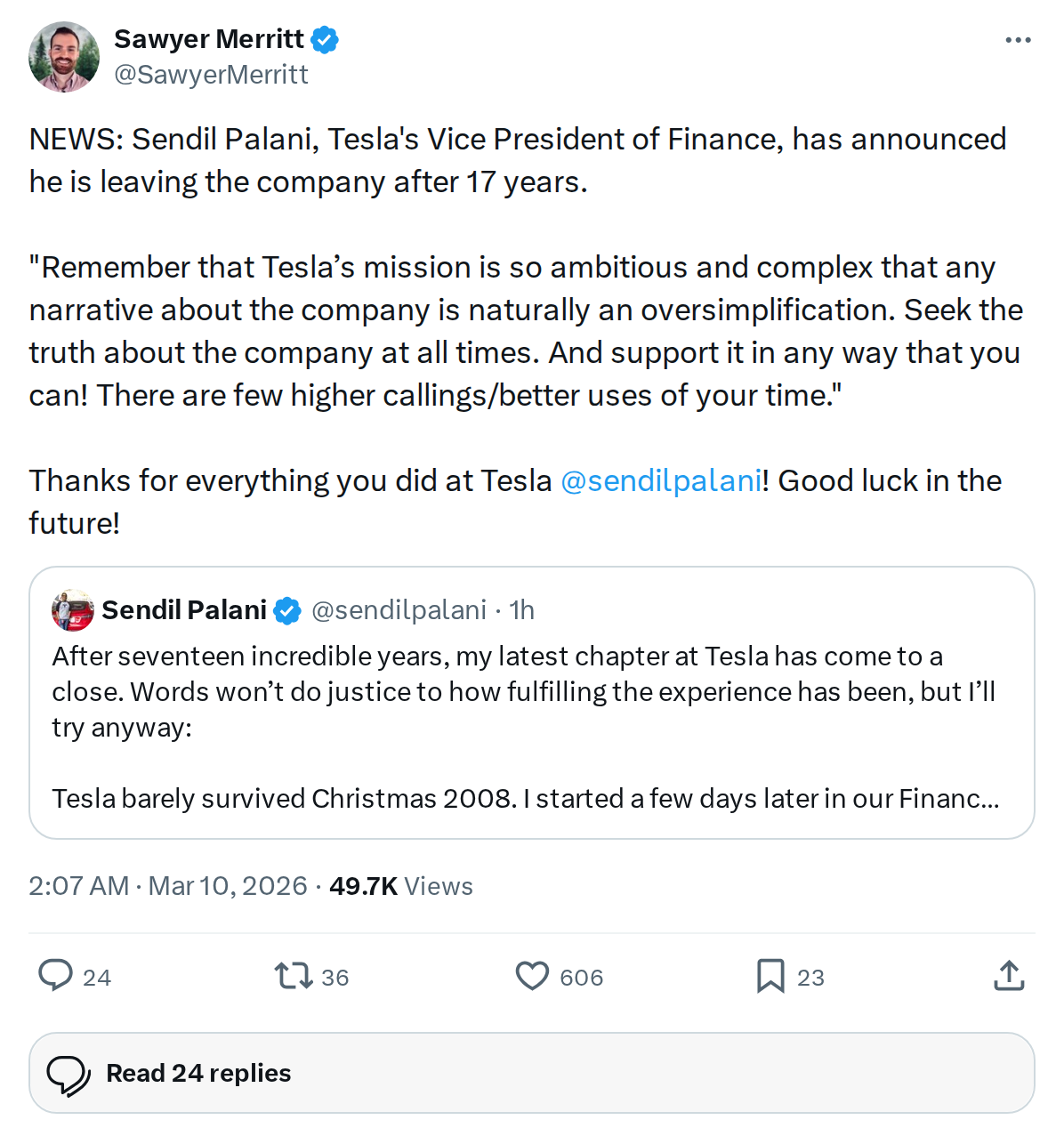
The News: Sendil Palani, Tesla's Vice President of Finance, has announced his departure from the company after a 17-year tenure.
Why It Matters: Palani was one of Tesla's longest-serving finance executives, having guided the company through its 2010 IPO and multiple critical fundraising rounds. His exit marks a significant leadership change in Tesla's finance organization.
Source: @SawyerMerritt on X
A 17-Year Run Comes to an End
Sendil Palani joined Tesla's Finance team in January 2009 — a time when the company was still years away from its IPO and fighting for survival as an EV startup. On March 9, 2026, he announced his departure as Vice President of Finance, closing out one of the longest tenures of any executive at the company.
In his farewell message, Palani offered a characteristically measured send-off, urging followers not to take any single narrative about Tesla at face value:
"Remember that Tesla's mission is so ambitious and complex that any narrative about the company is naturally an oversimplification. Seek the truth about the company."

Elon Musk responded to Palani's post within minutes, writing: "Thanks for an epic contribution over many years!" — a rare public acknowledgment from Musk that underscores just how significant Palani's role was inside the company.
📊 Key Figures
| Metric | Value |
|---|---|
| Tenure at Tesla | 17 years |
| Start Date | January 2009 |
| Departure Date | March 9, 2026 |
| Final Title | Vice President of Finance |
| Key Milestones Covered | Series E, Series F, DOE Loan, 2010 IPO |
Who Was Sendil Palani?
Palani wasn't a recent hire or a high-profile external recruit — he was a builder. He joined Tesla in 2009 when the company had fewer than 1,000 employees and was still proving its Model S concept. Over the following 17 years, he held leadership roles across Engineering Finance, Manufacturing Finance, and Corporate Planning.
Critically, Palani was in the room for some of Tesla's most consequential financial moments: the Series E and Series F fundraising rounds, the Department of Energy loan guarantees that helped fund the Model S program, and Tesla's 2010 IPO — the first American automaker to go public since Ford in 1956. These weren't just resume line items; they were existential events for Tesla, and Palani helped navigate all of them.
🔭 The BASENOR Take
Timeline: Departure announced March 9, 2026. Effective immediately.
Impact Level: 🟡 Medium — Significant institutional knowledge loss, but Tesla's finance structure is deep.
Confidence: ✅ High — Confirmed via Palani's own X post and Musk's direct response.
Seventeen years in a company like Tesla — one that has reinvented itself multiple times, survived near-bankruptcy, scaled to millions of vehicles per year, and entered entirely new product categories — is an extraordinary run. The fact that Palani's farewell message focused not on himself but on Tesla's mission says something about the culture he came from.
His parting words are worth sitting with: any narrative about Tesla is an oversimplification. That's a pointed reminder in a media environment where Tesla is perpetually either the world's most important company or on the verge of collapse, depending on the week. From someone who watched the financial reality up close for 17 years, it reads as a genuine caution against both the hype and the doom.
For Tesla owners, the immediate operational impact is minimal. Tesla's finance organization is large and well-staffed, and VP-level transitions — while notable — don't affect vehicle software, service, or charging infrastructure. What this departure does signal is a natural generational shift. The executives who built Tesla through its scrappy early years are gradually moving on, replaced by a new cohort who inherited a company already at scale.
Whether Palani's exit is part of a broader leadership reshuffling or simply a personal decision after a long career is not yet clear. What is clear is that Tesla loses a significant piece of institutional memory — the kind that only comes from being present for the DOE loan negotiations, the IPO roadshow, and every financial crisis in between.
📰 Deep Dive
Palani's tenure began at a pivotal moment in Tesla's history. January 2009 was less than a year after the global financial crisis, and Tesla was burning cash while trying to bring the original Roadster to market and develop the Model S. The DOE loan guarantee program — which Palani was involved in securing — provided $465 million in low-interest loans that were critical to building the Fremont factory and launching the Model S. Tesla repaid those loans nine years early, in 2013, a moment that became a defining PR milestone for the company.
The 2010 IPO was equally consequential. Tesla raised $226 million in its public offering, and the market's reception validated the company's long-term vision at a time when many analysts were skeptical. Having finance leadership that understood both the internal complexity and the external narrative was essential — and Palani was part of that team.
His farewell message — directing people to Tesla's own investor relations and mission pages rather than media coverage — reflects a finance executive's instinct: go to the primary source, not the interpretation. For Tesla owners who want to understand what's actually happening with the company, that's sound advice regardless of who's delivering it.
Tesla has not yet announced a successor to the VP of Finance role. Given the company's current scale — operating Gigafactories on four continents, managing an energy storage business, and navigating complex international regulatory environments — filling that seat with someone who has comparable institutional depth will be a meaningful task for the executive team.
Related Gear
Gear up your Tesla with tested, custom-fit BASENOR accessories — shop Tesla accessories →
Sources & reporting notes
The links below identify the material source records used for this report.
- @SawyerMerritt on X (2026-03-09T18:07:12.000Z) — Direct source
Source links are preserved as published or accessed. See our editorial standards and corrections policy.
The BASENOR Editorial Desk covers Tesla, SpaceX, and related technology, curating reporting from primary sources — official accounts, regulatory filings, and software release data. Every article passes source-record and fact-checking review before publication. About the newsroom.
This report was curated by the BASENOR Editorial Desk from the sources listed above. Read our editorial standards or email editorial@basenor.com to report an error.