
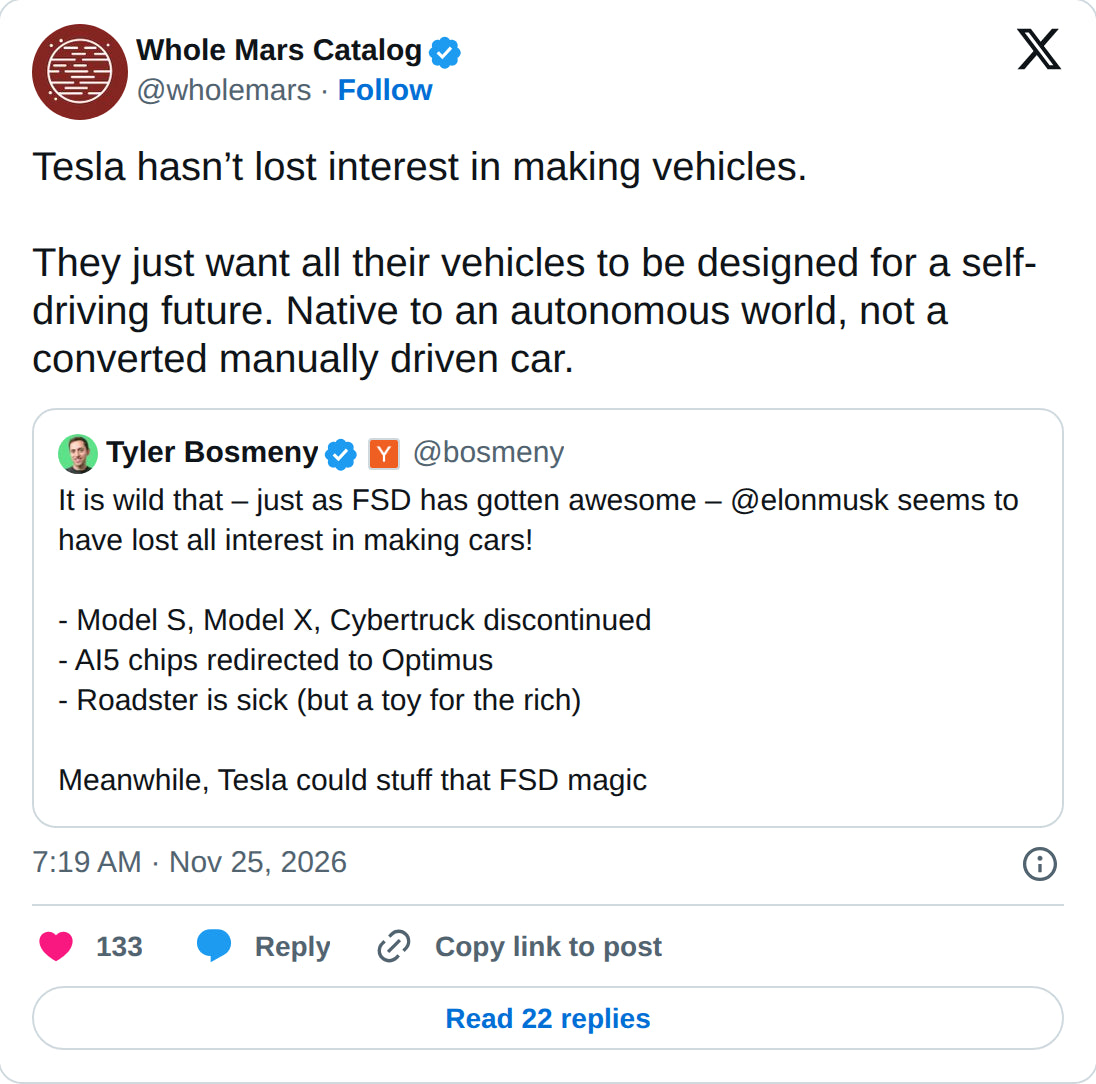
A post from Whole Mars Catalog on November 24 cut through a lot of noise about Tesla's vehicle roadmap: the company hasn't lost interest in making cars. It's just decided that every car it makes from here on should be engineered for a world where the driver is optional — or absent entirely. That distinction is more consequential than it sounds.

Here are five points that explain why Tesla's native-autonomy philosophy matters — and what it means for the vehicles coming next.
1. "Native" autonomous design is fundamentally different from retrofitting
Most vehicles on the road today — including early Tesla models — were designed around a human driver. Steering columns, pedal clusters, sightlines calibrated for seated occupants: all of it assumes someone is in control. Bolting self-driving hardware onto that architecture is an engineering compromise. Tesla's stated direction is to start from a blank sheet where no human input is required, which changes everything from interior packaging to sensor placement to structural load paths.
2. The Cybercab is the clearest proof of concept so far
Tesla unveiled the Cybercab in October 2024 — a two-seat vehicle with no steering wheel and no pedals. It is the most literal expression of the native-autonomy philosophy the company has produced. According to public announcements, it is priced at approximately $30,000, with a $299 monthly subscription for autonomous driving features. A limited robotaxi service launched in September 2026, and customer deliveries are targeted for December 2026. Tesla has also announced Cybercab production at its Berlin Gigafactory from 2029, with a dedicated zone targeting up to one million units annually.
3. The Model Y itself is being rethought along the same lines
On November 19, 2026, Elon Musk stated that Tesla plans to launch an autonomous version of the Model Y — without a steering wheel or pedals — configured to carry six to seven passengers. No launch date or price has been announced. The significance here is that native autonomy is not being reserved for purpose-built robotaxis; it is being applied to Tesla's highest-volume platform. That signals a company-wide architectural shift, not a niche product experiment.
4. This explains recent product decisions that confused some observers
Tesla ended production of the Model S and Model X in May 2026, with the Fremont line being converted to Optimus robot manufacturing. Read alongside the native-autonomy strategy, that decision becomes more legible: continuing to invest in vehicles designed around manual driving controls runs counter to where the company is going. Resources are being redirected toward platforms that don't carry the legacy assumptions of a human-operated car.
5. The competitive moat is in the software, not just the hardware
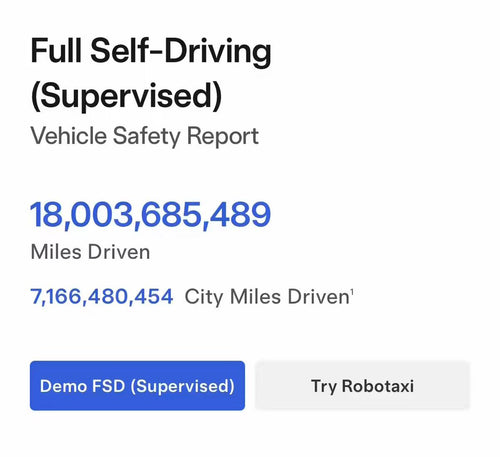
Building a car without a steering wheel is straightforward. Building one that can actually navigate the real world without human backup is the hard part — and it is where Tesla's years of Full Self-Driving development, its fleet data, and its in-house AI infrastructure become structural advantages. A native autonomous vehicle only delivers on its promise if the autonomy stack is reliable enough to remove the manual fallback entirely. Tesla is betting its product roadmap on the belief that it can get there.
Taken together, these five points describe a company that has made a deliberate architectural bet: that the future of personal and commercial transportation does not include a steering wheel, and that the vehicles worth building are the ones designed with that assumption from day one. Whether that bet pays off depends entirely on how quickly — and how reliably — full autonomy can be delivered at scale.
🚕 Following the Robotaxi rollout? See every operating city, launch date and announced market in our Tesla Robotaxi Tracker.
Related Gear
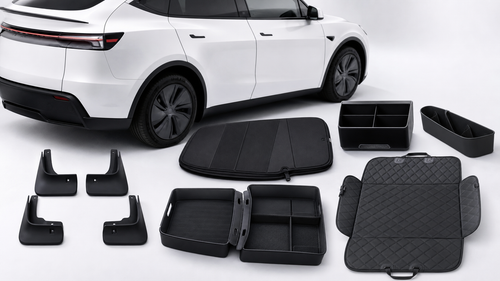
Gear up your Tesla with tested, custom-fit BASENOR accessories — shop Tesla accessories →
Sources & reporting notes
The links below identify the material source records used for this report.
- @wholemars on X (2026-11-24T23:19:52.000Z) — Direct source
Source links are preserved as published or accessed. See our editorial standards and corrections policy.
The BASENOR Editorial Desk covers Tesla, SpaceX, and related technology, curating reporting from primary sources — official accounts, regulatory filings, and software release data. Every article passes source-record and fact-checking review before publication. About the newsroom.
This report was curated by the BASENOR Editorial Desk from the sources listed above. Read our editorial standards or email editorial@basenor.com to report an error.