Tesla published a new engineering blog post on September 1 detailing how it designs vehicle battery packs for safety, durability, and longevity — and the headline number is striking. Across more than 265 billion miles of operation logged by the end of 2025, Tesla says it has no evidence of a single spontaneous battery failure leading to a vehicle fire in Model 3, Model Y, Cybertruck, or Semi vehicles. The post lays out a layered safety philosophy the company calls Passive Propagation Resistance, and it gives owners a clearer picture of what's happening inside the pack under their floorboard.

What Tesla Actually Claimed
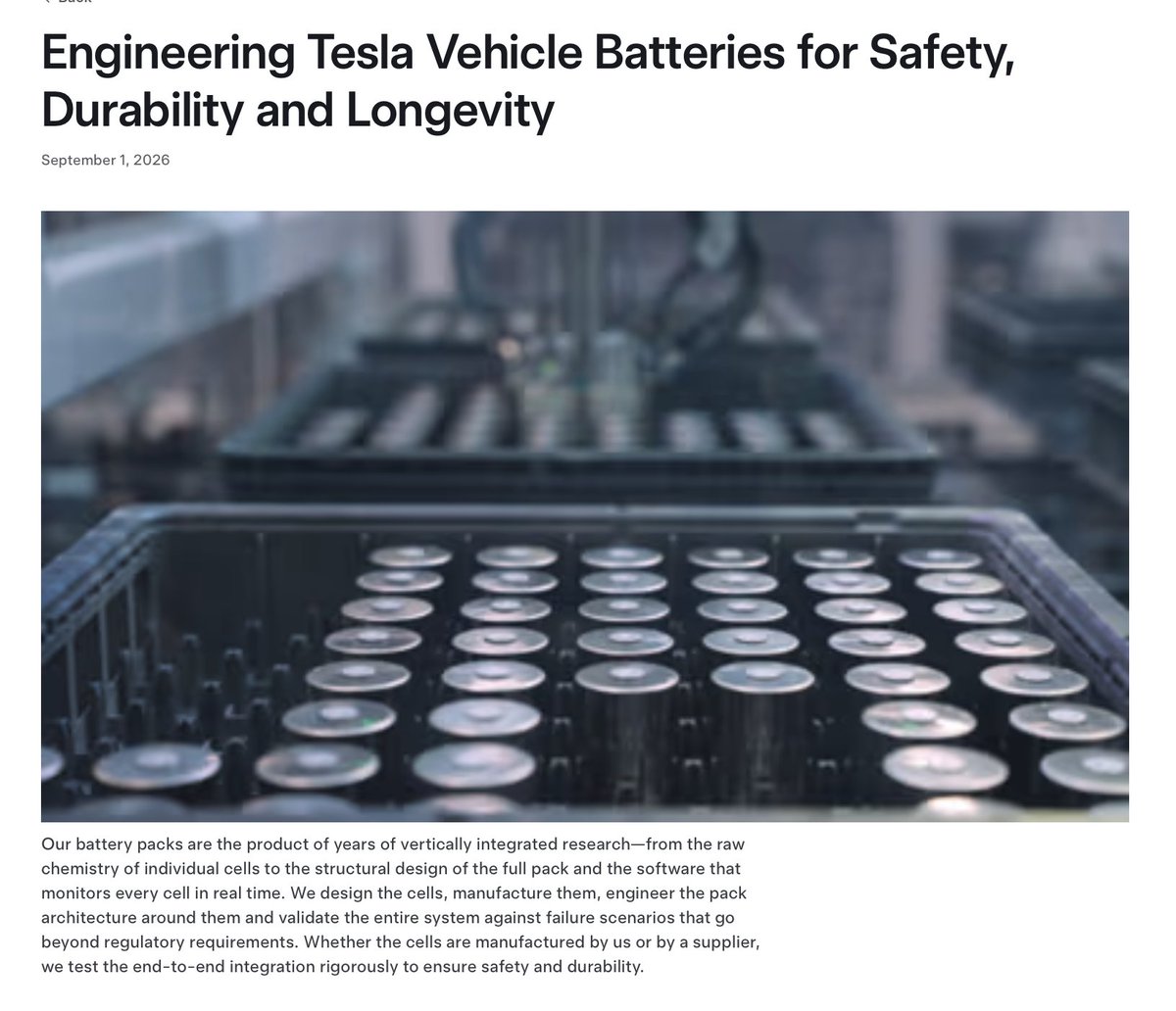
The blog post — titled "Engineering Tesla Vehicle Batteries for Safety, Durability and Longevity" — walks through Tesla's approach at the cell, module, and pack level. According to the post, the design objective is that even if an issue occurs in a single cell and results in a thermal reaction, that reaction is contained to that one cell and does not propagate to neighboring cells or trigger a pack-level event.
A few specifics worth pulling out:
- 265 billion+ miles of cumulative operation logged by the end of 2025.
- Zero spontaneous battery-caused fires reported in Model 3, Model Y, Cybertruck, or Semi according to Tesla's own data.
- Chemistry split: high-nickel layered oxide cathodes (NMC-type) in 4680 cells for energy density, and lithium iron phosphate (LFP) in standard-range vehicles for durability and cost.
- Active thermal management keeps each cell inside an optimal temperature band for both performance and longevity.
- Fleet telemetry — anonymized real-time data on battery health, temperature, charge cycles, and performance — feeds back into engineering.
Notable omission: Model S and Model X are not in the fire-free claim. Tesla ended S/X production earlier this year, and the company's newer chemistries and pack architectures live in the four vehicles it did name.

How to Read the Claim
The key word in Tesla's statement is spontaneous. The company is not saying no Tesla has ever caught fire — high-speed collisions, road-debris punctures, and post-crash fires are a different category, and NHTSA data tracks those separately. What Tesla is claiming is that its packs are not igniting on their own during normal use or charging in the four current-production nameplates.
For context: the U.S. average is roughly one vehicle fire per 19 million miles driven across all fuel types, per NHTSA and NFPA data historically cited by Tesla. Against that baseline, 265 billion miles without a spontaneous pack-caused fire in the named models is a meaningful engineering data point — provided you accept Tesla's internal definition of "spontaneous."
What Owners Should Actually Do
A safety-and-longevity post is only useful if it changes something in your driving routine. Here's the practical read for current owners:
1. Trust the thermal system — don't fight it
Tesla's battery preconditioning runs automatically before Supercharging when you navigate to a station in the car. If you routinely charge at Superchargers without setting the destination in the nav, you're skipping the warm-up cycle that keeps cells inside the optimal temperature band the blog post describes. Set the Supercharger as your navigation destination even if you know the way — the pack will thank you.
2. Charge to 80% daily on NMC/4680 packs, 100% on LFP
The chemistry split matters here. If your car has an LFP pack (most standard-range Model 3 and Model Y builds), Tesla recommends charging to 100% at least weekly to keep the state-of-charge estimation calibrated. If your car has a 4680 or NMC pack (Long Range, Performance, Cybertruck, Semi), the classic 80% daily / 100% only-when-needed rule applies for longevity.
3. Don't disable Sentry Mode over battery-drain worries
A common owner reflex is to blame Sentry Mode for battery wear. The pack architecture Tesla describes is designed for continuous low-load draw. If you want to reduce vampire drain, set "Exclude Home" and "Exclude Work" in the Sentry Mode settings rather than disabling it entirely.
4. Report any thermal warning immediately
Tesla's fleet telemetry only works if the car is talking to the mothership. If you ever see a "Battery needs service" or "Vehicle may not restart" alert, do not clear it and hope — book service the same day through the app. The layered safety design is meant to contain a single-cell issue, but Tesla's own PPR approach depends on catching problems before they compound.
5. Keep the car plugged in when parked long-term
The thermal management system needs power to condition the pack in extreme heat or cold. A car left unplugged in a 100°F parking lot for a week is doing more chemistry damage than one plugged in at 30% SOC. If you're traveling, leave the car on a Level 1 outlet with the charge limit set to 50%.
What to Watch Next
Two things are worth tracking after this post. First, whether Tesla releases the underlying methodology — how it defines "spontaneous," what data-collection window it used, and whether the 265 billion miles figure is audited or self-reported. Second, whether NHTSA's next annual fire-incident summary aligns with Tesla's claim; regulator data usually lags by a year and will provide independent context.
For now, the takeaway for owners is unchanged but reinforced: the fundamentals — precondition before fast charging, respect the chemistry, keep the car connected — are what let the layered safety design actually do its job.
Related Gear
Gear up your Tesla with tested, custom-fit BASENOR accessories — shop Tesla accessories →
Sources & reporting notes
The links below identify the material source records used for this report.
- @SawyerMerritt on X (2026-09-02T02:36:38.000Z) — Direct source
- @SawyerMerritt on X (2026-09-02T02:38:24.000Z) — Direct source
- @wholemars on X (2026-09-02T02:57:23.000Z) — Direct source
Source links are preserved as published or accessed. See our editorial standards and corrections policy.
The BASENOR Editorial Desk covers Tesla, SpaceX, and related technology, curating reporting from primary sources — official accounts, regulatory filings, and software release data. Every article passes source-record and fact-checking review before publication. About the newsroom.
This report was curated by the BASENOR Editorial Desk from the sources listed above. Read our editorial standards or email editorial@basenor.com to report an error.