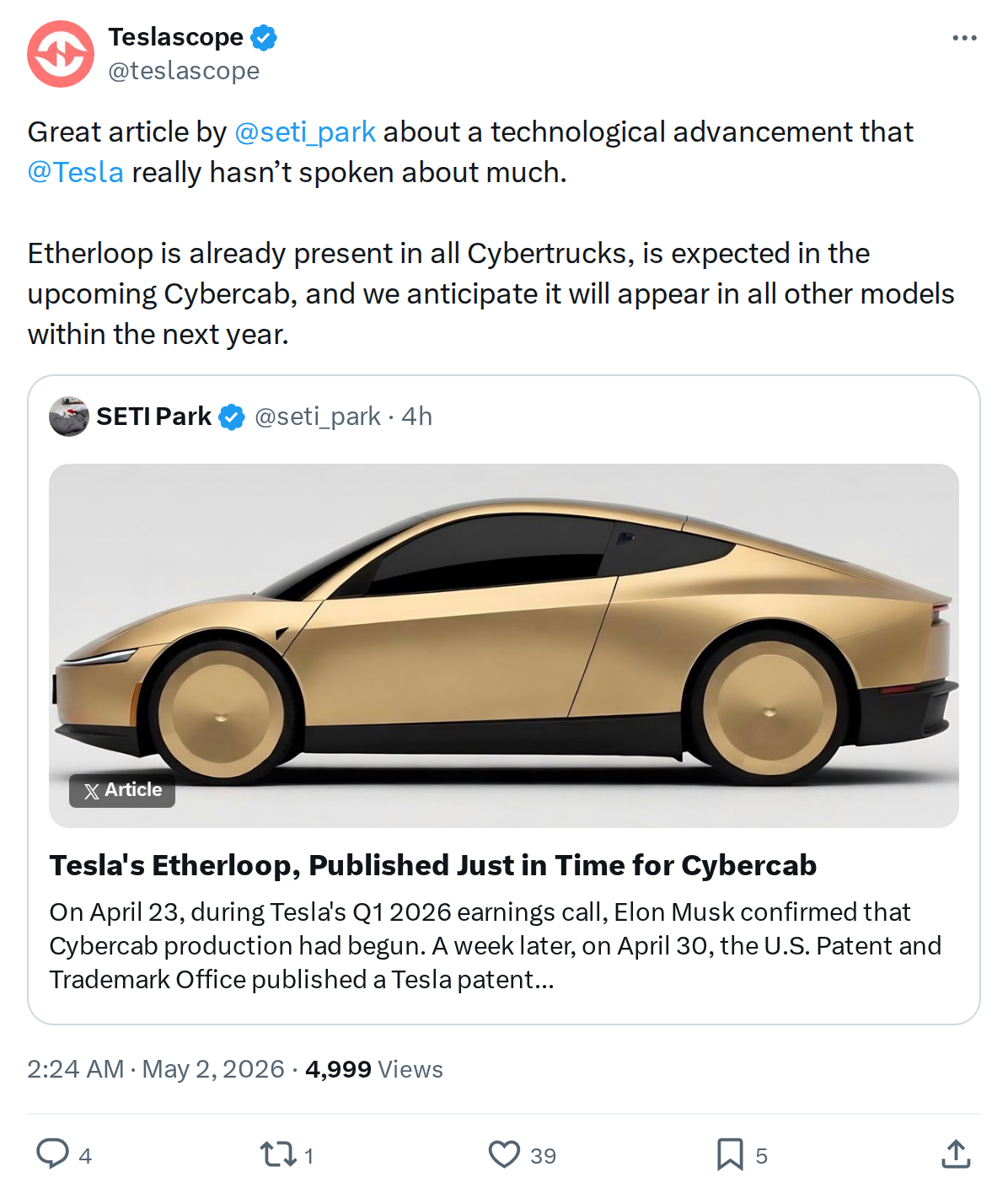
Tesla has been quietly rolling out one of its most consequential hardware changes in years — and most owners have no idea it's there. Etherloop, an Ethernet-based communication architecture already present in every Cybertruck, is expected to arrive in the Cybercab and then spread across Tesla's entire lineup within the next twelve months, according to Teslascope.

The numbers behind the technology are striking. In the Cybertruck, Etherloop reduced the total wire count from 490 (as found in the Model 3) down to 155 — a 68% reduction — even as the number of connection endpoints grew by 35% compared to the Model Y. The high-powered harness alone shed 84% of its mass, and overall wiring weight in the Cybertruck is roughly 50% lighter than a comparable Tesla built on the older architecture. Less wiring means fewer potential failure points, faster assembly on the line, and simpler diagnostics when something does go wrong.

Etherloop isn't just a cost-cutting exercise. The system supports millisecond-scale latency across the vehicle's internal network and enables bandwidths exceeding 100 Gbps through Tesla's open-source TTPoE protocol (Tesla Transport Protocol over Ethernet, licensed under GPLv2). It also integrates with Tesla's 48-volt low-voltage architecture, allowing a single two-wire run to carry both data and power simultaneously. That's what makes active road noise cancellation and the advanced sound system possible — audio data travels to speakers over the same shared infrastructure. The architecture is designed as an intermediate step toward a full Etherloop network in next-generation vehicles, where cross-car wiring could be eliminated entirely to support Tesla's unboxed manufacturing process.
For owners, the practical upside is straightforward: fewer wires means fewer things to fail, and when service is needed, technicians can diagnose problems faster and more precisely. Teslascope notes that while the change isn't something most customers will feel day-to-day, it's the kind of foundational improvement that compounds over a vehicle's lifetime — and one that will likely make future service visits shorter and cheaper.

Marcus covers Tesla's software releases, FSD rollouts, and OTA changes. Background in automotive engineering. Based in Austin.
Sources verified at publish time. Spotted an inaccuracy? Email editorial@basenor.com.