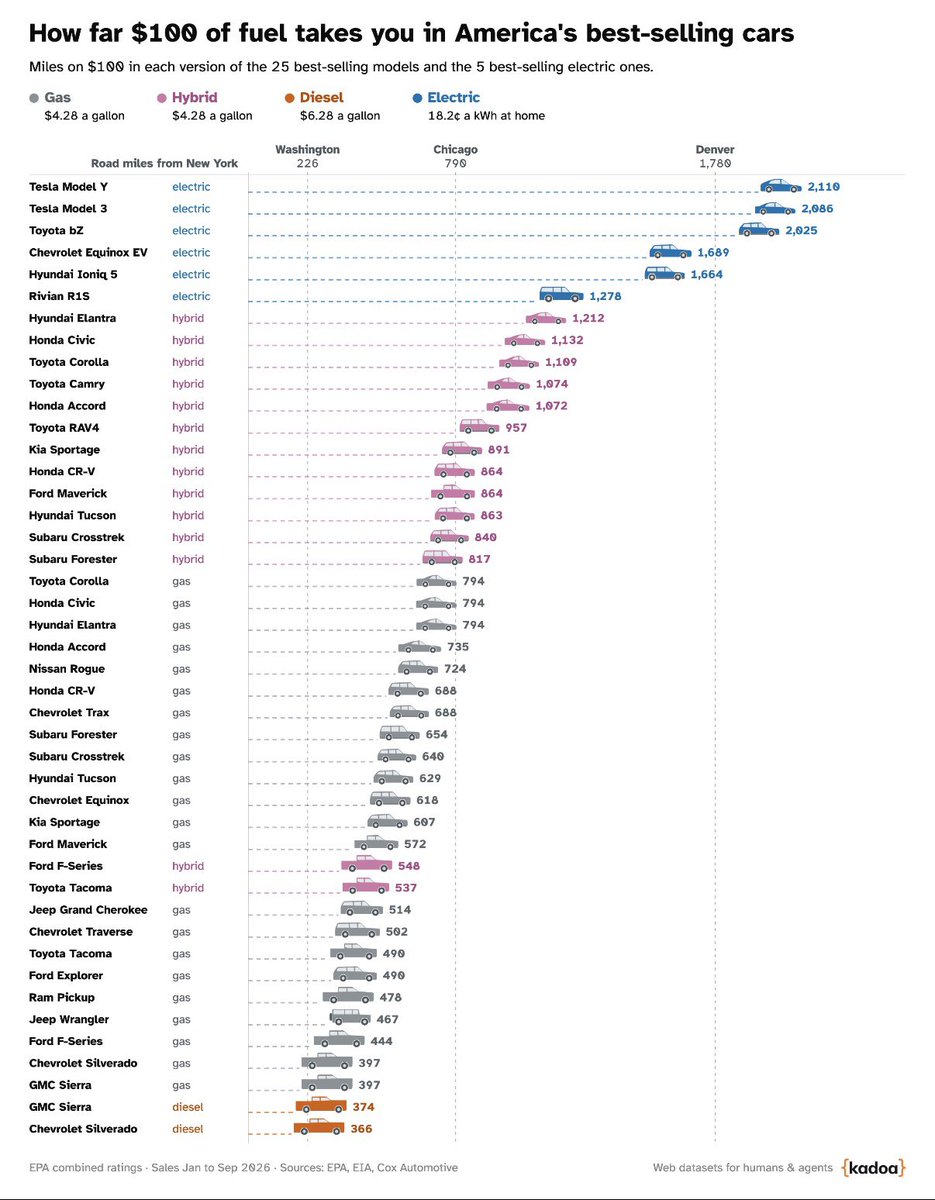
It's a simple claim that holds up under scrutiny: a dollar spent on fuel moves you more miles in a Tesla than in any other vehicle on the market — gas or electric. That's the point @wholemars put plainly this week, and the underlying numbers make a strong case. Here's what's driving that advantage.

1. Tesla's Efficiency Ratings Are Class-Leading
The 2026 Model 3 RWD (18-inch wheels) is rated at 24 kWh per 100 miles — that's 4.2 miles per kWh — and carries an EPA combined rating of 139 MPGe with 321 miles of range, according to cars.com. To put that in perspective, the average new gasoline car achieves roughly 28–30 MPG. At current national average electricity prices near $0.16/kWh and gas around $3.20/gallon, the Model 3 delivers roughly 26 miles per dollar of fuel versus about 9 miles per dollar in a typical gas car. The math is not close.
2. Electricity Is Cheaper Per Unit of Energy Than Gasoline
Even before accounting for efficiency, electricity is a cheaper energy carrier than gasoline on a per-mile basis in most U.S. markets. Home charging — which covers the majority of Tesla owner charging sessions — typically runs between $0.10 and $0.18 per kWh depending on the utility and time of day. Off-peak rates in states like Washington or Texas can drop below $0.08/kWh, compressing the fuel cost per mile even further. Gasoline's energy equivalent (1 gallon ≈ 33.7 kWh) costs several times more per usable mile once drivetrain efficiency losses are factored in.
3. Tesla's Drivetrain Wastes Less Energy Than the Competition
Internal combustion engines convert roughly 20–40% of fuel energy into motion; the rest is lost as heat. Tesla's electric motors operate at over 90% efficiency. That gap is why MPGe ratings — which put both fuel types on a common scale — consistently favor EVs, and why Tesla's ratings sit at the top of the EV category as well. A higher-efficiency motor means every dollar of electricity is doing more actual work moving the car forward, not warming the engine bay.
4. The Advantage Compounds Over Miles Driven
For owners who drive 12,000–15,000 miles per year — close to the U.S. average — the per-mile fuel cost difference between a Model 3 and a comparable gas sedan can add up to $800–$1,400 annually, depending on local energy prices. Over a five-year ownership period, that's a meaningful offset against the vehicle's purchase price. The efficiency advantage doesn't degrade significantly with age, either; unlike combustion engines, electric motors don't lose efficiency as they accumulate miles under normal use.
5. Supercharger Rates Are Higher, But Still Competitive
The one caveat worth noting: Supercharger pricing — typically $0.25–$0.45/kWh in the U.S. — narrows the cost gap compared to home charging. At the high end of Supercharger rates, the per-mile fuel cost approaches that of a very fuel-efficient hybrid. For road-trip-heavy drivers who rely primarily on the Supercharger network rather than home charging, the math is less dramatic, though still generally favorable over gasoline at current prices. The full efficiency advantage is most pronounced for owners who charge at home overnight.
The core point stands regardless of which scenario you model: Tesla's combination of high-efficiency motors, aerodynamic design, and access to low-cost home electricity makes the cost-per-mile calculation difficult for any other vehicle to match. For owners tracking their total cost of ownership, fuel savings remain one of the most concrete and measurable benefits in the ledger.
Related Gear
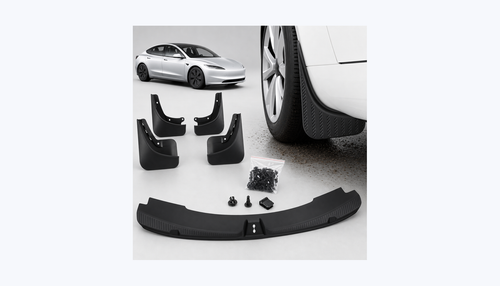
Gear up your Model 3 with tested, custom-fit BASENOR accessories — shop Model 3 accessories →
Sources & reporting notes
The links below identify the material source records used for this report.
- @wholemars on X (2026-10-26T20:18:14.000Z) — Direct source
Source links are preserved as published or accessed. See our editorial standards and corrections policy.
The BASENOR Editorial Desk covers Tesla, SpaceX, and related technology, curating reporting from primary sources — official accounts, regulatory filings, and software release data. Every article passes source-record and fact-checking review before publication. About the newsroom.
This report was curated by the BASENOR Editorial Desk from the sources listed above. Read our editorial standards or email editorial@basenor.com to report an error.