📌 UPDATE — March 24, 2026
Tesla has been confirmed as Nvidia's single largest automotive customer — not because of in-car chips (Tesla builds its own), but because of its enormous data center spending on FSD AI training. Nvidia's VP of Automotive made the disclosure, underscoring just how capital-intensive Tesla's training infrastructure has become. Meanwhile, Elon Musk is now pushing forward with a so-called "terafab" — Tesla's own AI hardware manufacturing facility — which could eventually reduce dependence on Nvidia for training compute and deepen the vertical integration described in this article. The irony: Nvidia's #1 auto customer is actively building the infrastructure to need them less.


30-Second Brief
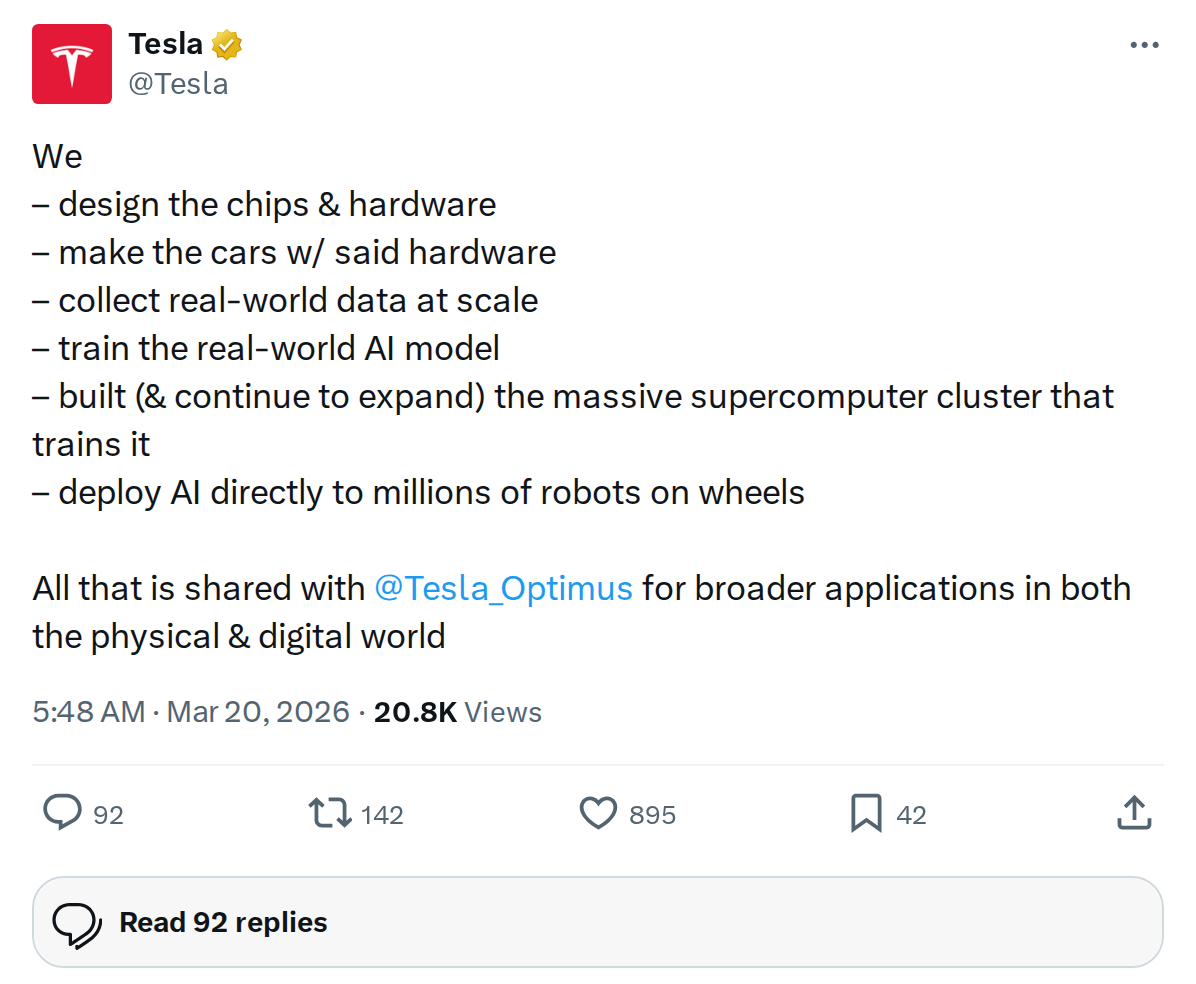
The News: Tesla publicly outlined its complete end-to-end AI and hardware integration strategy — from custom chip design to real-world deployment across millions of vehicles.
Why It Matters: This isn't marketing. It's a description of a competitive moat that virtually no other company can replicate — and every Tesla you own is a direct beneficiary of it.
Source: @Tesla on X
Tesla's Full AI Stack: Why No One Can Copy This Model
Tesla just laid it out plainly. In a single post, the company described something that takes most of its competitors entire ecosystems of partners, suppliers, and contractors to attempt — and even then, they fall short. Tesla designs its own chips, builds its own cars with those chips inside, collects real-world driving data at a scale no one else can match, trains its AI on supercomputer clusters it built itself, and deploys that AI directly to millions of vehicles on the road today. That's not a supply chain. That's a closed-loop intelligence machine.

📊 The Six-Layer Stack
Tesla's post wasn't a product announcement — it was a statement of structural advantage. Let's break down each layer and what it actually means:
| Layer | What Tesla Does | Why It's Different |
|---|---|---|
| Chip Design | Custom FSD silicon (HW3, HW4, and beyond) | Optimized specifically for Tesla's neural nets — not general-purpose |
| Vehicle Manufacturing | Builds the cars that carry the hardware | Hardware and software co-designed from day one |
| Data Collection | Real-world fleet data from millions of vehicles | Diversity and volume of edge cases no simulation can replicate |
| AI Training | Trains end-to-end models on proprietary data | Feedback loop is internal — no data sharing, no latency |
| Supercomputer Cluster | Dojo and NVIDIA-based training infrastructure | Built and operated in-house; continues to scale |
| Deployment | OTA updates to the full active fleet | Improvements reach owners within days, not model years |
The Hardware Foundation: HW3 to HW4 and Beyond
The chip layer is where this story starts. Tesla's Hardware 3 FSD chip, introduced in April 2019, was already a landmark — processing 2,300 frames per second at 144 trillion operations per second (TOPS), fabricated on Samsung's 14nm process. It was purpose-built for Tesla's vision-based neural network approach at a time when most automakers were still sourcing off-the-shelf processors.
Hardware 4, which began shipping in January 2023 with refreshed Model S and Model Y vehicles, pushed that further. Built on Samsung's 7nm process, HW4 doubles the RAM to 16 GB and quadruples storage to 256 GB compared to HW3. Front camera resolution jumped from 1280x960 pixels to 2896x1876 pixels — a massive increase in visual input quality. Elon Musk has stated HW4's computational capabilities are three to eight times more powerful than HW3. Critically, the hardware was redesigned so thoroughly — new cable routing, new cooling systems — that an HW3-to-HW4 retrofit isn't planned. The hardware and the car it lives in are designed together.
That co-design philosophy is the point. When Tesla designs a chip, it's designing it knowing exactly what sensors feed it, what software will run on it, and what vehicle it will be bolted into. No other automaker controls all three of those variables simultaneously.
The Data Flywheel Nobody Else Has
The data layer is arguably the most underappreciated part of this stack. Tesla's fleet represents millions of vehicles driving billions of real-world miles across every climate, road condition, and traffic scenario imaginable. When an unusual situation occurs — a mattress on a highway, an unmarked construction zone, a driver cutting across three lanes — Tesla's system can flag it, collect it, and use it to improve the model. That improvement then ships to every car in the fleet.
This is a compounding advantage. The more cars Tesla sells, the more data it collects. The more data it collects, the better the AI gets. The better the AI gets, the more valuable Tesla vehicles become. Competitors who rely on simulation or limited real-world testing programs are running a fundamentally different — and slower — race.
🔭 The BASENOR Take
Tesla posting this isn't accidental. It's a deliberate signal — to investors, to competitors, and to its own customer base — that the vertical integration strategy is intentional, mature, and accelerating. The phrase 'robots on wheels' at the end of the post is doing real work: it's framing every Tesla vehicle not as a car with software, but as a deployed AI agent that happens to transport people.
For owners, this is meaningful beyond the marketing. Every FSD improvement you receive via OTA is the direct output of this loop running faster. The gap between what Tesla's AI can do today and what it could do 18 months ago is a direct function of this stack operating at scale. And because Tesla controls every layer — from the silicon to the deployment — it can iterate faster than any competitor working through third-party chip vendors, contracted data labelers, or shared cloud infrastructure.
The 'robots on wheels' framing also points toward where this is heading. Tesla's Optimus humanoid robot program runs on the same underlying AI and sensor-fusion principles as its vehicle fleet. The data collected from millions of driving hours informs the same models being trained for bipedal robotics. The supercomputer cluster that trains FSD is the same infrastructure being scaled for general-purpose AI. This isn't six separate initiatives — it's one integrated system getting smarter every day, and your Tesla is both a product of it and a contributor to it.
📰 Deep Dive
What makes Tesla's post worth paying attention to isn't the individual claims — most of these facts have been public for years. What's notable is the framing: Tesla is presenting these six capabilities as a unified system, not a list of features. That's a strategic communication choice. The company is drawing a circle around everything it controls and saying: this is the moat.
For the broader AI industry, this matters because the dominant model for AI development has been disaggregated — one company trains the model, another provides the chips, another handles deployment infrastructure. Tesla is arguing, implicitly, that disaggregation is a liability. When you own the full stack, you can optimize across every layer simultaneously. A chip design decision can be made with full knowledge of the training workload it will run. A data collection strategy can be shaped by the specific failure modes the model is exhibiting. That kind of cross-layer optimization is structurally unavailable to companies that don't control the whole chain.
For Tesla owners specifically, the practical implication is that your vehicle's capabilities are not fixed at the point of purchase in the way a traditional car's are. The AI running on your hardware will continue to improve as long as Tesla's data flywheel keeps spinning and its training clusters keep scaling. The car you bought is, in a real sense, still being built — just in software, and in the supercomputer clusters Tesla continues to expand. That's a fundamentally different ownership proposition than any other vehicle on the market today. For a deeper look at how this AI development translates to real-world capability, see our FSD coverage.
Related Gear
Gear up your Tesla with tested, custom-fit BASENOR accessories — shop Tesla accessories →
Sources & reporting notes
The links below identify the material source records used for this report.
- @Tesla on X (2026-03-19T21:48:12.000Z) — Direct source
- @wholemars on X (2026-03-24T09:32:32.000Z) — Direct source
- @wholemars on X (2026-03-24T09:39:35.000Z) — Direct source
Source links are preserved as published or accessed. See our editorial standards and corrections policy.
The BASENOR Editorial Desk covers Tesla, SpaceX, and related technology, curating reporting from primary sources — official accounts, regulatory filings, and software release data. Every article passes source-record and fact-checking review before publication. About the newsroom.
This report was curated by the BASENOR Editorial Desk from the sources listed above. Read our editorial standards or email editorial@basenor.com to report an error.