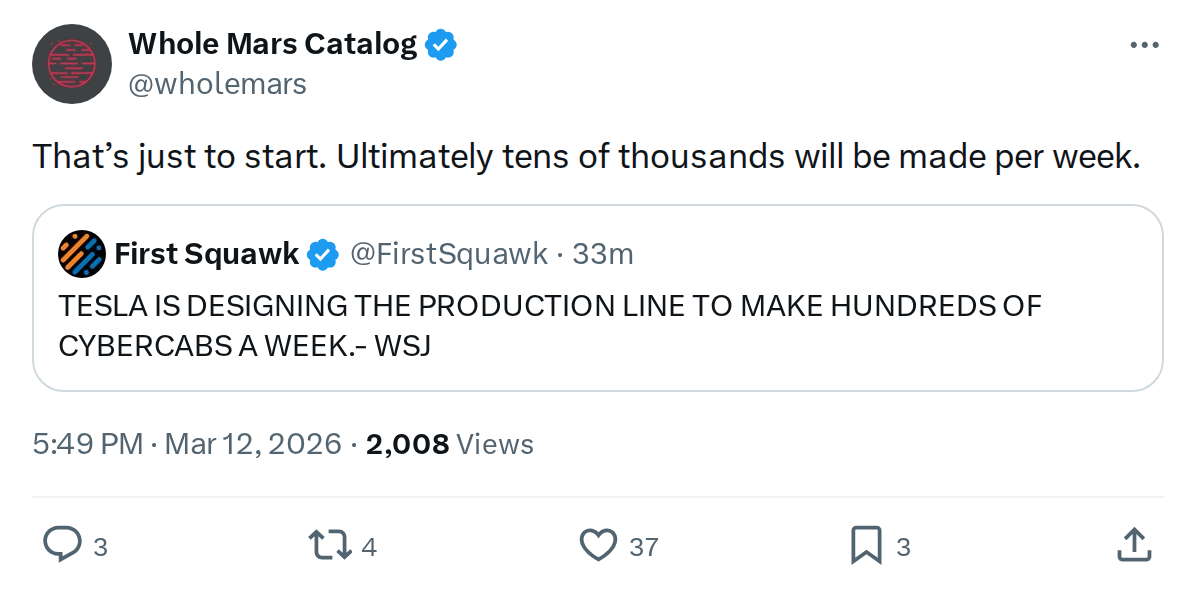
The News: Tesla community account Whole Mars Catalog signals that current production figures for a Tesla product are just the starting point — the ultimate target is "tens of thousands" of units made per week.
Why It Matters: If Tesla hits that ceiling across its next-gen vehicle, Semi, and Optimus lines, it would represent a manufacturing transformation that dwarfs anything the company has achieved to date.
Source: @wholemars on X

Tesla has never been shy about setting production targets that sound outlandish — until they don't. This week, Whole Mars Catalog, one of the more plugged-in voices in the Tesla community, reinforced that the production numbers currently being discussed for Tesla's next major product are just the opening act. The end goal? Tens of thousands of units per week.
To put that in perspective: Tesla's entire global vehicle output across all models currently runs in the range of roughly 20,000–25,000 cars per week. A single product line hitting "tens of thousands" per week would be a seismic shift — and it points squarely at Tesla's most ambitious bets right now.
📊 Key Figures: Where Tesla's Production Targets Stand Today
| Product | Current / Near-Term Target | Long-Term Ceiling |
|---|---|---|
| Next-Gen Vehicle ("Model 2" / Redwood) | 10,000 / week (ramp target) | Tens of thousands / week |
| Tesla Semi | ~960 / week (50K/yr capacity) | Full capacity H2 2026 |
| Cybertruck | ~2,500 / week (end-2024 target) | ~4,800 / week (250K/yr) |
| Optimus (Humanoid Robot) | 50,000 units total in 2026 | 1 million / year (planned capacity) |
Sources: Tesla supplier briefings, Elon Musk statements, verified industry reporting.
Which Product Are We Actually Talking About?
The tweet is brief — Whole Mars Catalog was responding to another post, so context matters. The "tens of thousands per week" framing most plausibly applies to Tesla's next-generation mainstream vehicle, internally referred to as "Redwood" and closely tied to the Cybercab platform. Here's why:
- Tesla has confirmed next-gen vehicle production begins in the second half of 2025 at Gigafactory Austin, with Berlin and the planned Mexico facility following.
- The initial ramp target is 10,000 units per week — already ambitious — but Tesla's stated long-term annual capacity aspirations for this platform are far higher.
- The Cybercab, a driverless variant of the same platform unveiled in October 2024, targets 2026 production and could share manufacturing lines, compounding output.
Optimus is the other candidate. Tesla's design freeze for Optimus Gen3 is targeted for Q1 2026, with mass production within 2026 and a long-term planned annual capacity of 1 million units — which would eventually translate to roughly 19,000+ per week. That's squarely in "tens of thousands" territory.
🔭 The BASENOR Take
Timeline: Next-gen vehicle ramp begins H2 2025 → 10K/week initial target → "tens of thousands" is a multi-year horizon, likely 2027–2029 at realistic scale.
Impact Level: 🔴 High — if achieved, this redefines Tesla's revenue ceiling and changes the EV market's competitive landscape entirely.
Confidence: Medium. The directional ambition is consistent with Tesla's stated plans. The specific timeline for hitting peak throughput remains uncertain.
📰 Deep Dive
Tesla's history with production targets is complicated. The company has repeatedly set aggressive timelines, missed them, and then eventually surpassed them. The Model 3's infamous "production hell" in 2017–2018 is the canonical example — Elon Musk's 5,000/week target slipped by months, but Tesla eventually cleared it and built an entirely new production approach around it. That pattern is worth keeping in mind when evaluating a claim like "tens of thousands per week."
What's different this time is the manufacturing architecture. Tesla's next-gen platform is designed from the ground up for high-volume, low-cost production — unboxed assembly, fewer parts, and a dramatically simplified supply chain. The company has explicitly said this vehicle will be its highest-volume product ever. If the platform works as designed, the ramp from 10,000/week to multiples of that is more a matter of adding capacity than solving fundamental engineering problems.
For existing Tesla owners, this trajectory matters beyond just new-car availability. Higher production volumes historically drive down component costs across the fleet, accelerate software development cycles (more cars on the road means more training data for FSD), and give Tesla the manufacturing leverage to absorb price cuts without margin collapse. A Tesla producing tens of thousands of next-gen vehicles per week is a structurally stronger company — and that benefits everyone already in the ecosystem.
The wildcard is Optimus. If Tesla's humanoid robot hits even a fraction of its 1-million-per-year capacity target, it would represent a manufacturing challenge unlike anything the auto industry has faced. Robots building robots at scale is the kind of compounding advantage that's easy to dismiss until it isn't. Whole Mars Catalog's comment, brief as it is, reflects a genuine belief among Tesla's closest observers that the current numbers are a floor, not a ceiling.
🤖 Tracking Tesla's humanoid robot? See every Optimus production milestone and appearance in our Tesla Optimus Tracker.
Related Gear
Gear up your Tesla with tested, custom-fit BASENOR accessories — shop Tesla accessories →
Sources & reporting notes
The links below identify the material source records used for this report.
- @wholemars on X (2026-03-12T09:49:28.000Z) — Direct source
Source links are preserved as published or accessed. See our editorial standards and corrections policy.
The BASENOR Editorial Desk covers Tesla, SpaceX, and related technology, curating reporting from primary sources — official accounts, regulatory filings, and software release data. Every article passes source-record and fact-checking review before publication. About the newsroom.
This report was curated by the BASENOR Editorial Desk from the sources listed above. Read our editorial standards or email editorial@basenor.com to report an error.