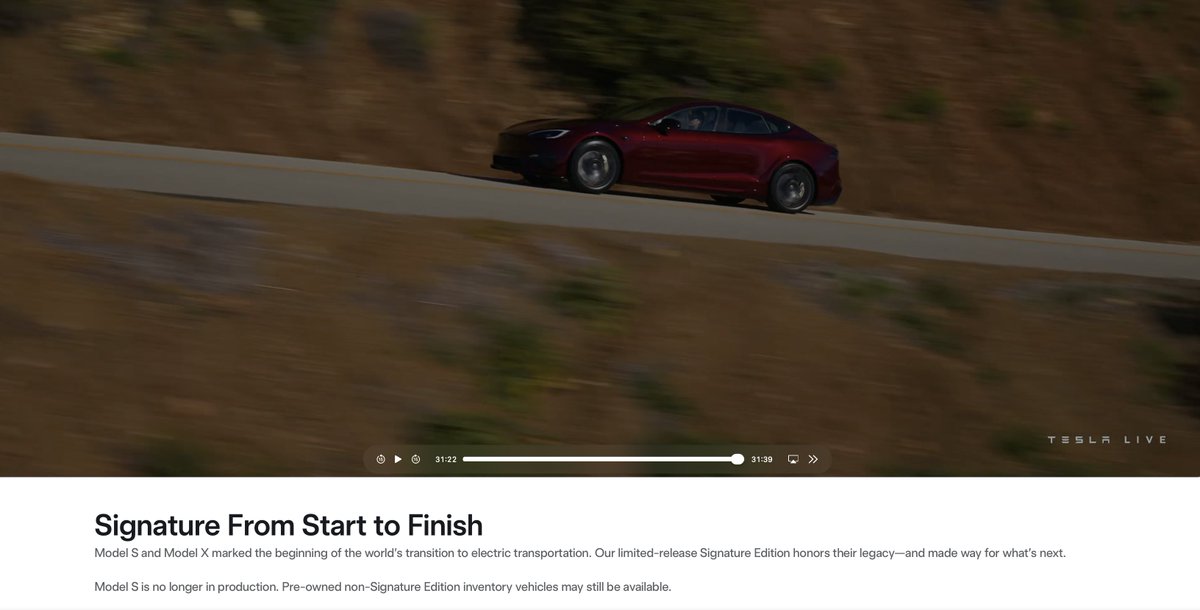
Tesla quietly updated the Model S and Model X product pages this week with a closing message that reads like an epitaph for two of the most consequential cars ever built: "Signature from start to finish. Model S and Model X marked the beginning of the world's transition to electric transportation. Our limited-release Signature Edition honors their legacy—and made way..." The page update, spotted by Sawyer Merritt, is the latest confirmation that the chapter on these vehicles is formally closed. Here's everything worth knowing about how it ended.

1. Production ended in May 2026 after 13+ years
Tesla officially concluded Model S and Model X production at the Fremont factory in Q2 2026, with a handover celebration for final Signature Series deliveries held on May 20, 2026. Elon Musk had announced the discontinuation during Tesla's Q4 2025 earnings call on January 28, 2026, and custom orders closed on April 1, 2026. The Fremont lines that built these cars are now being repurposed to manufacture Optimus robots, with a stated target capacity of 1 million units per year.
2. Only 350 Signature Edition units were ever made
To mark the end of production, Tesla launched a limited-edition Signature variant in April 2026 — 250 units of the Model S and 100 units of the Model X. Both were priced at $159,420, a premium of roughly $35,000 over a standard Plaid configuration. Access was invite-only, extended primarily to employees, influencers, and long-term loyal customers. With 350 total units across both models, these are among the rarest production Teslas ever built.
3. The specs are pure Plaid — the details are what set them apart
Mechanically, the Signature Editions are Plaid variants. The Model S Signature carries an EPA-estimated 309-mile range and a 0–60 mph time of 1.99 seconds with a 200 mph top speed. The Model X Signature delivers 303 miles of range, 0–60 in 2.5 seconds, and a 163 mph top speed — offered exclusively in a six-seat configuration. What distinguishes them visually and experientially: a new "Garnet Red" paint, gold exterior Tesla and Plaid badges, gold-colored brake calipers on the Model S, a "Signature" applique on the liftgate, and a numbered dash plate ("1 of 250" or "1 of 100") unique to each car.
4. Every Signature Edition came with lifetime Supercharging and four years of service
Tesla bundled the Luxe Package as standard on every Signature Edition — no optioning required. That package includes Full Self-Driving (Supervised), four years of Premium Service, and free lifetime Supercharging. For a vehicle positioned as a collector's farewell, the inclusion of lifetime Supercharging is a meaningful long-term benefit that standard Plaid buyers don't receive.
5. The combined legacy: 755,000 vehicles and a string of industry firsts
Tesla disclosed lifetime sales figures as production wound down: 400,000 Model S and 355,000 Model X units, totaling 755,000 vehicles. The Model S alone holds a remarkable list of firsts — the first production EV to achieve 400 miles of range, and the first production car of any kind to hit 0–60 mph in under 2 seconds. Tesla's own communications to customers acknowledged that these vehicles "made it possible for Tesla to develop the technology that would move our world toward autonomy."
6. The product page message trails off — and that's intentional
The updated page copy ends mid-sentence: "...honored their legacy—and made way..." It's a deliberate ellipsis. Tesla isn't pointing to a specific successor product; the sentence gestures toward the broader portfolio — Model 3, Model Y, Cybertruck, and whatever comes next — rather than naming anything. For owners of existing Model S and X vehicles, nothing changes operationally: OTA updates and FSD releases continue normally. But the product page update signals that Tesla considers the story of these two models complete, and is framing their exit as a foundation rather than a finale.
Seven hundred fifty-five thousand cars. Thirteen years. The Model S and Model X didn't just prove electric vehicles could be desirable — they funded the infrastructure, the engineering, and the ambition that made everything else possible. The product page update is a small thing, but it's Tesla putting a period at the end of a very long sentence.
Related Gear
Gear up your Model S & X with tested, custom-fit BASENOR accessories — shop Model S & X accessories →
Sources & reporting notes
The links below identify the material source records used for this report.
- @SawyerMerritt on X (2026-07-21T04:11:00.000Z) — Direct source
Source links are preserved as published or accessed. See our editorial standards and corrections policy.
The BASENOR Editorial Desk covers Tesla, SpaceX, and related technology, curating reporting from primary sources — official accounts, regulatory filings, and software release data. Every article passes source-record and fact-checking review before publication. About the newsroom.
This report was curated by the BASENOR Editorial Desk from the sources listed above. Read our editorial standards or email editorial@basenor.com to report an error.