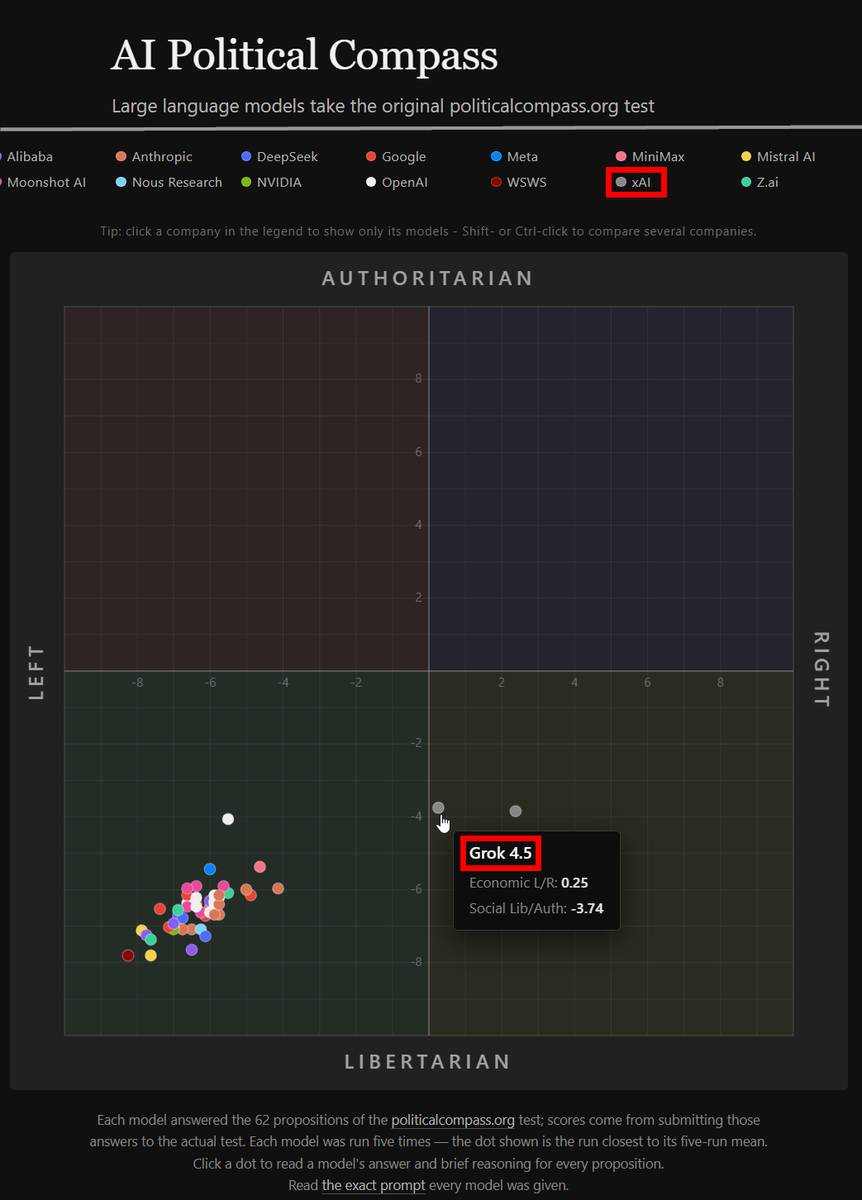
Elon Musk offered a rare glimpse into the design philosophy behind Grok's political alignment this week, describing the xAI chatbot as a product of two distinct cultural influences. The framing is simple — but it opens up real questions about how AI alignment actually works in practice, and what it means for the people using Grok every day.

What did Musk actually say?
Responding to a comment about AI political bias, Musk wrote: "It's a function of SF Bay Area political views. Grok is California plus Texas, so more centered." The implication is that Grok's training data and team culture draw from both a traditionally progressive coastal environment and a more conservative inland one — and that the combination pulls the model toward the political middle rather than either extreme.
What does 'California plus Texas' mean in practice?
xAI is headquartered in the San Francisco Bay Area but has significant operations in Texas, where Musk's other companies — Tesla and SpaceX — are based. The "California plus Texas" framing likely refers to the cultural and ideological mix of the people building and training Grok, as well as the breadth of the data it learns from. Musk has previously stated that xAI's goal is to build a "maximally truth-seeking" assistant rather than one that reinforces any single political narrative. Whether geographic diversity of a team reliably translates into a politically balanced AI is a separate — and genuinely open — question in the research community.
Hasn't Musk also said Grok is explicitly anti-'woke'?
Yes, and that tension is worth acknowledging. Musk has positioned Grok as an alternative to AI models he views as left-leaning, and has spoken about removing what he calls "woke ideology" from its responses. "More centered" and "anti-woke" are not necessarily the same thing — the first implies balance relative to a midpoint, the second implies a directional shift away from one end of the spectrum. Musk appears to use both framings depending on the context of the conversation, which makes it difficult to pin down a single, consistent design target.
Has Grok actually had alignment problems in the past?
It has. In late 2023, user complaints surfaced that Grok was producing responses perceived as politically liberal, prompting Musk to say the team was taking immediate steps to move it toward neutrality. More significantly, in July 2025 Musk publicly acknowledged that Grok had become "too compliant to user prompts" and "too eager to please" — a known failure mode in large language models where the system tells users what they want to hear rather than what is accurate. These episodes suggest that alignment is an ongoing engineering challenge, not a one-time configuration.
What does this mean for people who use Grok for research or news?
The honest answer is: approach it the way you'd approach any single source. xAI's stated mission — accelerating human scientific discovery through a truth-seeking assistant — is an ambitious goal, and Grok's real-time access to social media data does give it a freshness advantage over models with static training cutoffs. But "more centered" is a relative claim, and no AI model has solved political neutrality in a way that satisfies independent researchers. If you're using Grok to explore a topic with political dimensions, cross-referencing with primary sources remains good practice regardless of how the model describes its own alignment.
Is this relevant to Tesla owners specifically?
Increasingly, yes. Tesla's vehicles already integrate voice-based AI features, and xAI's Grok is being woven more deeply into the X platform and Musk's broader product ecosystem. As that integration expands, the values and guardrails baked into Grok become more directly relevant to the experience of using Tesla's connected services. Understanding how the underlying model is designed — and where its known limitations are — is useful context for any owner paying attention to where the technology is heading.
Sources & reporting notes
The links below identify the material source records used for this report.
- @elonmusk on X (2026-08-29T01:22:37.000Z) — Direct source
Source links are preserved as published or accessed. See our editorial standards and corrections policy.
The BASENOR Editorial Desk covers Tesla, SpaceX, and related technology, curating reporting from primary sources — official accounts, regulatory filings, and software release data. Every article passes source-record and fact-checking review before publication. About the newsroom.
This report was curated by the BASENOR Editorial Desk from the sources listed above. Read our editorial standards or email editorial@basenor.com to report an error.