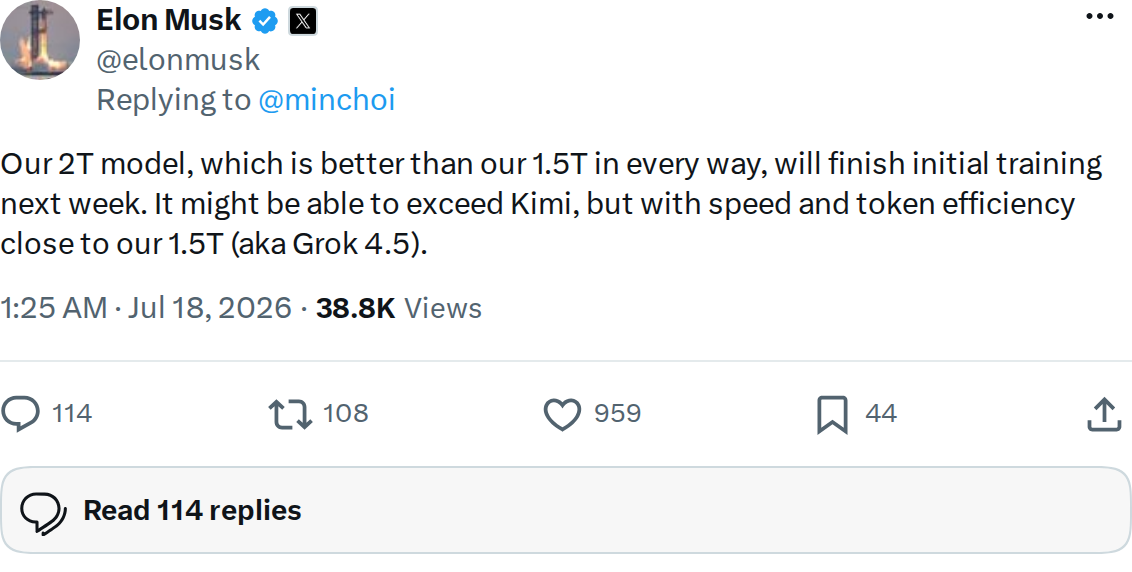
Elon Musk dropped a significant update late Thursday: xAI's next frontier model — a 2-trillion-parameter system — is wrapping up its initial training run and could be ready for broader availability as soon as August 2026. The announcement came as a reply on X and was light on marketing language, which makes it worth reading carefully. Here's what the details actually tell us.

What exactly is the 2T model?
It's xAI's next-generation foundation model, built on 2 trillion parameters — a 33% increase in scale over the current 1.5T V9 model that powers Grok 4.5. Musk described it as better than the 1.5T "in every way," which is a fairly unambiguous claim about a direct successor rather than a specialized variant. Think of Grok 4.5 as the current ceiling; the 2T model is being positioned as what comes next.
When does training finish, and when can users expect access?
According to Musk, initial training wraps up next week — placing that milestone in the final days of July 2026. Initial training completion doesn't mean immediate public access; model evaluation, safety testing, and infrastructure deployment typically follow. According to background reporting, general availability is currently slated for August 2026, though xAI has not published an official release date.
Musk mentioned Kimi — what's that comparison about?
Kimi refers to the frontier model from Chinese AI lab Moonshot AI, which has drawn attention for strong benchmark performance. Musk said the 2T model "might be able to exceed Kimi" — notably hedged language. He's not claiming a guaranteed win; he's flagging it as a plausible outcome after training completes and evaluation begins. It's a competitive signal more than a confirmed benchmark result.
Will it be significantly slower or more expensive to run than Grok 4.5?
This is where the announcement gets practically interesting. Musk specifically noted that speed and token efficiency should remain "close to our 1.5T" — meaning the 2T model is not simply a brute-force scale-up that trades cost for capability. If that holds through deployment, users and API developers shouldn't expect a dramatic increase in latency or inference costs relative to Grok 4.5. That's a meaningful engineering claim, and one worth watching when the model actually ships.
What does this mean for Grok users right now?
Nothing changes today. Grok 4.5 remains the current production model. But if the 2T model lands in August as indicated, the upgrade cycle from 4.5 to the next tier could be unusually short — Grok 4.5 itself only arrived earlier this year. For users on xAI's API or Grok subscription tiers, it's worth monitoring xAI's official channels for access announcements, since early rollouts have historically gone to heavy API users before broader consumer availability.
The honest caveat here is that "initial training complete" is an early milestone. Models at this scale go through extensive post-training alignment, red-teaming, and infrastructure hardening before public release. August is the current target, but frontier model timelines have a way of shifting. What Musk's comment does confirm is that the 2T model exists, is progressing on schedule, and is being benchmarked against current top-tier competition — which is more than xAI has publicly said about it until now.
Sources & reporting notes
The links below identify the material source records used for this report.
- @elonmusk on X (2026-07-18T01:25:22.000Z) — Direct source
Source links are preserved as published or accessed. See our editorial standards and corrections policy.
The BASENOR Editorial Desk covers Tesla, SpaceX, and related technology, curating reporting from primary sources — official accounts, regulatory filings, and software release data. Every article passes source-record and fact-checking review before publication. About the newsroom.
This report was curated by the BASENOR Editorial Desk from the sources listed above. Read our editorial standards or email editorial@basenor.com to report an error.