How Much Horsepower Does the Model Y Juniper Have?
If you are shopping the refreshed 2025+ Tesla Model Y Juniper, the horsepower answer is less clean than most spec sheets make it sound. Tesla does not consistently publish one simple combined horsepower and torque table for every market and trim, so we separated verified vehicle facts from third-party database estimates.
Our short answer: treat power figures as useful comparison numbers, not the only buying signal. Juniper fitment, cabin layout, range, and daily storage/heat-control needs matter more for most owners than a single horsepower headline.
Bottom line up front
Long Range RWD: EV Database lists the EU/UK Juniper Long Range RWD at 220 kW / 299 PS, with torque marked as No Data. We will not invent a torque figure.
Long Range AWD: EV Database lists the 2025 Juniper Long Range AWD at 378 kW / 514 PS and 493 Nm.
Performance: EV Database lists the 2025–2026 Juniper Performance at 461 kW / 627 PS and 741 Nm. These are third-party spec-database figures, not a Tesla press-release table.
Model Y Juniper horsepower and torque by trim
The cleanest available comparison source we found was EV Database, because it splits refreshed Juniper trims into separate pages. We are using its kW/PS/Nm values below and labeling them as database values. Where a page says “No Data,” we leave it blank instead of guessing.
| Market / trim reference | Power listed | Torque listed | Acceleration listed | How to use it |
|---|---|---|---|---|
| Model Y Juniper Long Range RWD, EU/UK-listed Tesla 4680 reference | 220 kW / 299 PS | No Data | 0–100 km/h in 7.2 sec | Best as the efficiency baseline; do not quote a torque number. |
| Model Y Juniper Long Range AWD, 2025 EU/UK reference | 378 kW / 514 PS | 493 Nm | 0–100 km/h in 4.8 sec | The balanced comparison point for traction and passing power. |
| Model Y Juniper Performance, 2025–2026 EU/UK reference | 461 kW / 627 PS | 741 Nm | 0–100 km/h in 3.8 sec after EV Database rollout correction | The fast trim; make sure acceleration methodology is stated. |
Note: PS is metric horsepower. We keep the source units to avoid rounding drift. If you convert to mechanical horsepower, label it as a conversion, not a factory-published value.
Why horsepower numbers differ by source
Tesla often markets acceleration, range, charging, and trim positioning more prominently than combined motor output. That creates a vacuum where forums, media outlets, spec databases, and accessory retailers publish different horsepower and torque answers.
The safest editorial rule is simple: cite the source, market, trim, and unit every time. “Model Y Juniper makes 627 PS” is incomplete. “EV Database lists the EU/UK Model Y Juniper Performance at 461 kW / 627 PS and 741 Nm” is specific enough for readers to understand the scope.
We also verified the competitor article that ranks for this topic. It gives a convenient table, but because it summarizes other outlets and calls some figures official, we are not using it as the authority for our final numbers. It is a SERP benchmark, not our proof source.
The torque trap
The Long Range RWD page we checked lists torque as “No Data.” That is exactly where many summaries go wrong: they fill the gap with a number from another market, another motor setup, or a prior Model Y generation. For this draft, no reliable RWD torque value means no RWD torque claim.
What these numbers mean in daily driving
For most owners, the practical difference is not whether a spec sheet says 299 PS or 514 PS. It is how quickly the car responds when merging, how confidently it accelerates with passengers and cargo, and whether the tire/wheel setup suits your roads.
Long Range RWD is the calmest power delivery in this set. It is still quick compared with ordinary gas crossovers, but the spec profile says efficiency first. If your driving is commuter-heavy and you do not need all-weather AWD traction, the lower-output trim can still make sense.
Long Range AWD is the middle ground. The extra motor changes traction and response more than it changes cabin life. If you drive in rain, snow, steep grades, or frequently load the car for family trips, AWD is the practical upgrade.
Performance is about response and speed. The listed 741 Nm torque is the headline, but the real ownership questions are tire wear, wheel comfort, insurance category, and whether you value acceleration enough to accept those tradeoffs.
How we would choose between the trims
For a Juniper buyer, horsepower should narrow the trim choice only after the basics are settled: range target, charging routine, weather, passenger load, tire comfort, and budget. A single motor RWD car can feel quick enough because electric torque arrives instantly, but the AWD and Performance trims change confidence when the road is wet, the car is loaded, or the driver asks for repeated high-speed passing.
Choose RWD when efficiency leads
RWD is the practical pick when your daily use is commuting, school runs, and predictable charging. The missing torque figure does not make the trim weak; it means the honest article should lean on acceleration, range, and real-use context instead of pretending a hidden number is verified.
Choose AWD when traction matters
AWD is the trim we would point owners toward when they drive through rain, hills, snowbelt trips, or packed family travel. The listed 378 kW / 514 PS makes sense as a response upgrade, but its bigger ownership value is all-weather confidence.
Choose Performance for acceleration
Performance is the emotional choice. It has the strongest listed output and the quickest acceleration reference, but the tradeoff is not fake “premium pricing”; it is tire wear, wheel comfort, insurance category, and whether the extra acceleration is used often enough.
Our source method
We verified each public source URL before putting it into the draft. The first web extraction path was blocked by the local SSRF/fake-IP guard, so we used the project’s public URL probe fallback and then extracted readable snippets through a normal requests path where available. Tesla’s Model Y page returned an access-denied response in this environment, so we did not use it to support any horsepower or torque number.
The EV Database pages were reachable and split the refreshed Juniper trims cleanly enough for a first draft. Wikipedia was reachable and useful for general Model Y context, dimensions, and powertrain family language. The competitor page was reachable too, but we treated it only as a SERP benchmark because our article needs to beat the result with clearer sourcing, not repeat its claims.
This is why the draft keeps phrases like “EV Database lists” and “third-party spec reference.” That wording is not hesitation; it is precision. It protects the article from turning estimated or market-specific data into a universal factory claim.
Three mistakes to avoid when quoting Juniper power
Mistake 1: mixing markets. A number from a European Long Range AWD listing should not automatically become a U.S. spec claim. Battery pack, certification, software calibration, and launch timing can differ. If the source does not name the market, the article should not pretend the number is universal.
Mistake 2: mixing generations. Earlier Model Y figures are not automatically Juniper figures. The refresh changed more than trim names, and the accessory-fitment lesson is similar: legacy Model Y parts and refreshed Juniper parts need explicit compatibility checks.
Mistake 3: turning acceleration into horsepower. A 0–100 km/h or 0–60 mph time is helpful, but it is not a direct horsepower measurement. Tires, launch behavior, surface, temperature, payload, and software all affect acceleration. Use acceleration to explain the driving feel, not to back-calculate a fake factory horsepower number.
For BASENOR content, the safest final answer is transparent: here are the best current third-party figures we verified, here is what the source does not publish, and here is how the number should influence the owner decision. That is stronger than a perfectly neat table with hidden assumptions.
The BASENOR accessory angle after the spec answer
A horsepower article can still help BASENOR if it answers the spec question fast and then routes the reader into fitment decisions. The key is not to force a product pitch into the wrong moment. Someone asking about power is usually comparing trims, so the product bridge should explain what does and does not change after the trim choice.
Interior organizers, roof sunshades, windshield sunshades, cargo protection, mud flaps, and most daily-use accessories are generation-fitment decisions. A Long Range AWD Juniper and a Performance Juniper may have different wheels or ride feel, but the same refreshed body/cabin generation is what determines most accessory compatibility.
That is the conversion path this draft should use: answer power, clarify source uncertainty, remind owners not to confuse Juniper with Highland, then link to generation-specific Model Y buying guides and collections. It is useful for the reader and safer for the brand than pretending horsepower changes every accessory recommendation.
What power does not change: Juniper fitment
Power trim does not make a console organizer, sunshade, mud flap, or cargo accessory fit differently. Generation does. Our verified vehicle fact is that the 2025–2026 Model Y Juniper retains a physical turn-signal stalk while using touchscreen shifting. That is different from the Model 3 Highland interior, which removed the stalk.
When buying accessories, the safest check is the product fitment range: 2025–2026 Model Y Juniper means Juniper-specific; 2020–2024 Model Y means legacy Model Y; 2024–2026 Model 3 Highland is not the same cabin. Horsepower trim is usually secondary unless the part touches wheels, tires, brake clearance, or aero.
For broader shopping, start with BASENOR's Model Y Juniper accessories guide and the Model Y accessories collection. For specs context across the whole vehicle, Wikipedia's Model Y page is useful for dimensions and powertrain family notes, but trim-specific Juniper horsepower still needs separate sourcing.
Our editorial recommendation
If the article promise is “how much horsepower and torque,” answer it directly in the first screen. Then slow the reader down: the number is not a universal Tesla factory figure, market matters, and torque data can be missing. That honesty is more useful than copying a neat but under-sourced table.
Our team would write the final buyer takeaway this way: choose RWD for efficiency, AWD for traction and response, and Performance only if acceleration is a real priority. For BASENOR accessories, choose by Juniper generation and product fitment, not by horsepower trim.
BASENOR product fit after you choose a trim
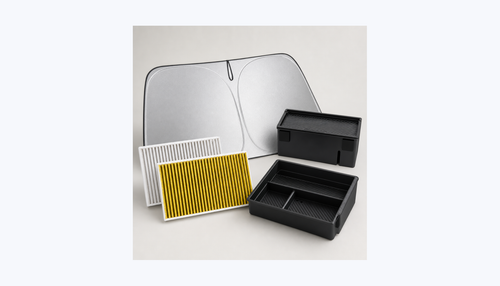
Once the trim decision is made, the BASENOR buying path is generation-specific. Two examples show the difference clearly: the 2025–2026 Model Y Juniper roof sunshade is a refreshed-Model-Y heat-control part, while the 2025–2026 Model Y Juniper mud flaps are exterior protection parts for the same generation. Neither choice depends on whether the car is RWD, Long Range AWD, or Performance; it depends on Juniper body/cabin fitment.

Juniper roof sunshade
Best for parked heat and glass-roof comfort. Tradeoff: it must be installed and removed seasonally or whenever you want the open-glass feel.

Juniper mud flaps
Best for reducing road spray and rocker-panel grit. Tradeoff: it adds visible hardware behind the wheels.
Fitment rule
Horsepower trim usually does not affect cabin, roof, cargo, or splash-protection accessories. Juniper generation fitment does.
FAQ
Does Tesla officially publish Model Y Juniper horsepower?
Not as one consistent public table for every market and trim. Tesla tends to emphasize acceleration, range, and trim positioning. For this draft, we use EV Database as a third-party spec reference and label it clearly.
How much torque does the Model Y Juniper Long Range RWD have?
We did not find a reliable torque value in the checked EV Database RWD page; it lists torque as “No Data.” We should not fill that gap with a number from a different trim or market.
Is the Juniper Performance much quicker than Long Range AWD?
Yes. EV Database lists the Performance at 0–100 km/h in 3.8 seconds after its rollout correction, versus 4.8 seconds for the Long Range AWD reference page. Always compare acceleration methodology before quoting.
Does horsepower affect Model Y Juniper accessory fitment?
Usually no. Cabin, cargo, sunshade, mud-flap, and storage accessory fitment depends on generation and body details. Power trim matters more for wheel, tire, brake, and aero-related decisions.
What is the key Juniper interior fact owners should remember?
The 2025–2026 Model Y Juniper retains a physical turn-signal stalk and uses touchscreen shifting. Do not confuse it with the Model 3 Highland, which removed the turn-signal stalk.
Sources
Match accessories to Juniper fitment, not horsepower claims
Once you know your trim, the next practical step is generation-specific fitment: cargo, heat control, mud protection, and cabin organization for the refreshed Model Y.
Read the Juniper accessory guide
Jacob Guo
Founder & Editor-in-Chief
Founder of BASENOR. Industrial designer and Tesla owner since 2019. Writes the foundational fitment guides and Design Stories — the ones explaining why a product was engineered the way it was.