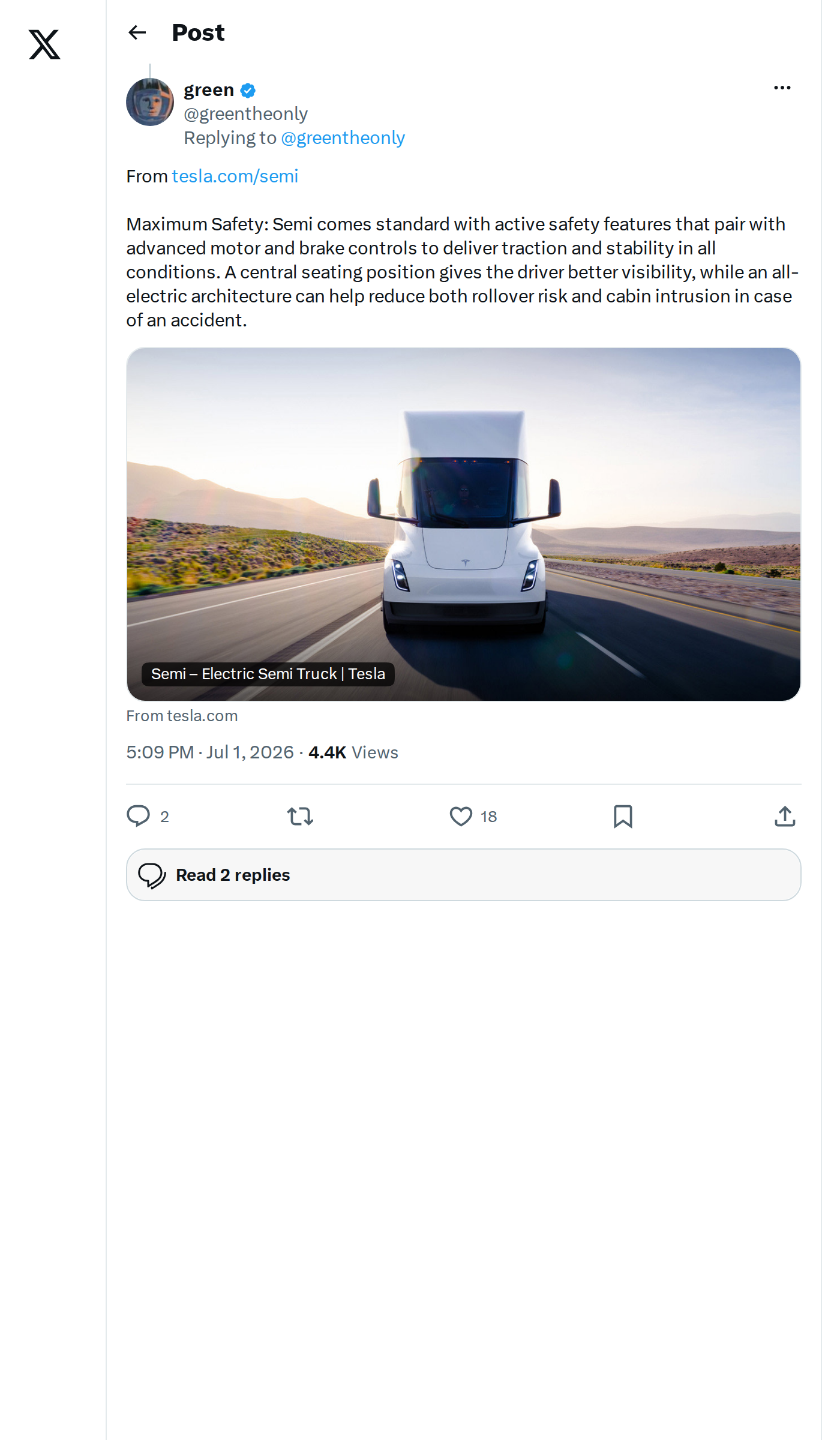
New details surfaced by @greentheonly from Tesla's own documentation confirm that the Semi's safety architecture isn't an add-on — it's baked into the vehicle's fundamental design. From its low center of gravity to a 10-camera suite, here's a breakdown of what makes the Semi's safety case genuinely different from a conventional Class 8 truck.

1. Active Safety Features Come Standard
Unlike many commercial vehicles where advanced safety packages are optional upgrades, the Tesla Semi ships with active safety as a baseline. These systems work in concert with the electric drivetrain's motor and brake controls to deliver traction and stability across all road conditions — wet, icy, or uneven surfaces included. Because torque is applied electrically and near-instantaneously, the Semi can respond to traction loss faster than any hydraulic or pneumatic system could.
2. Integrated Traction and Stability — Not Sequential Systems
Traditional heavy trucks rely on separate, sequentially reacting mechanical systems for traction and stability control. The Semi replaces that with a single integrated platform. Precise, instant electric torque control means the vehicle can modulate power to individual wheels in milliseconds — a meaningful advantage when a 40-ton rig starts to slide. According to Tesla's documentation, this integration is a core design principle, not a retrofit.
3. Central Seating Position for Maximum Visibility
The driver sits in the center of the cab — not offset to the left as in every conventional semi-truck. This positioning keeps both 16-inch QHD displays within the driver's natural forward sightline, eliminating the need to turn the head to check mirrors or gauges. More practically, it reduces the asymmetric blind spots that plague standard cab designs, particularly on the passenger side during lane changes and turns.
4. Low Center of Gravity Reduces Rollover Risk
The Semi's battery pack is mounted low in the chassis, which dramatically lowers the vehicle's center of gravity compared to a diesel truck with a high-mounted engine and fuel tanks. According to Tesla's documentation, this architecture directly reduces rollover risk — one of the leading causes of fatal commercial truck accidents. The same low-slung design also reduces the risk of cabin intrusion in a side-impact collision.
5. Ten Exterior Cameras Plus Driver Monitoring
The updated Semi carries 10 exterior cameras and one interior driver monitoring camera. Side-mounted camera pods — added as part of a November 2025 design refresh above the front wheel arches — specifically target the blind-spot zones that have historically made large trucks dangerous in urban environments. These cameras feed into existing active safety features including automatic emergency braking and lane keep assist, and are also being used for real-world FSD data collection, with Tesla reportedly running ground-truth validation equipment on public roads as recently as June 2026.
Taken together, these features represent a safety architecture that's fundamentally different from what fleet operators are used to evaluating. The question for fleet buyers won't just be total cost of ownership — it'll be how to quantify the liability reduction that comes with a truck that was engineered around safety from the ground up.
Related Gear
Gear up your Tesla with tested, custom-fit BASENOR accessories — shop Tesla accessories →
Sources & reporting notes
The links below identify the material source records used for this report.
- @greentheonly on X (2026-07-01T17:09:13.000Z) — Direct source
Source links are preserved as published or accessed. See our editorial standards and corrections policy.
The BASENOR Editorial Desk covers Tesla, SpaceX, and related technology, curating reporting from primary sources — official accounts, regulatory filings, and software release data. Every article passes source-record and fact-checking review before publication. About the newsroom.
This report was curated by the BASENOR Editorial Desk from the sources listed above. Read our editorial standards or email editorial@basenor.com to report an error.