Elon Musk posted a brief but pointed claim on September 14: AI data centers will result in lower electricity prices for consumers. It's an optimistic take — and one that cuts against a significant body of evidence showing the opposite trend in many markets right now. Here's what the full picture actually looks like.

1. Musk has previously warned of the opposite
This optimistic post is a notable shift in tone. Musk has previously warned that the exponential growth in AI chip production — combined with largely stagnant global electrical grids — could push power supply beyond its limits by the end of 2026 or 2027, potentially triggering an energy crisis. The concern wasn't hypothetical: it came alongside announcements about xAI's own power infrastructure buildout, including natural gas turbines to support a Tennessee facility projected to need one gigawatt of capacity. The new framing doesn't erase those warnings — it suggests Musk believes the infrastructure investment will eventually flip the equation.
2. The Ratepayer Protection Pledge is the policy backstory
On March 4, 2026, xAI joined Google, Amazon, Microsoft, Meta, Oracle, and OpenAI in signing a White House "Ratepayer Protection Pledge." The voluntary commitment requires AI companies to build, acquire, or otherwise supply their own power for data centers and cover associated grid upgrade costs — rather than passing those costs to ordinary utility customers. If that pledge holds, it structurally separates AI energy demand from household bills. That's the mechanism behind Musk's optimism: companies paying their own way instead of loading costs onto the grid that everyone shares.
3. Current market data tells a more complicated story
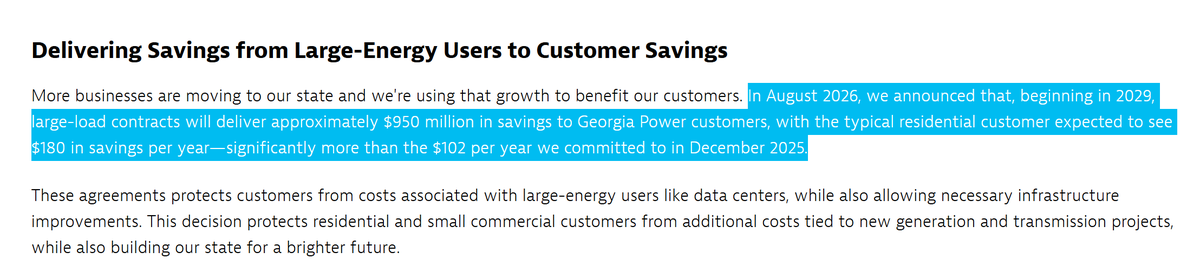
In the PJM market — which covers 13 states — the price for grid "capacity" surged 833% in a recent auction, with data centers accounting for roughly three-quarters of that increase. That cost ultimately flows through to household bills. In parts of Tennessee where data centers have concentrated, home electricity bills rose 3.2% between 2023 and 2024. New York and Texas have moved to slow new data center construction specifically because of high electrical demand. The lower-prices thesis requires the Ratepayer Pledge to be enforced and for new generation capacity to outpace demand growth — neither of which is guaranteed.
4. Tesla Energy's solar strategy is part of the same bet
Tesla isn't just a bystander in this debate. According to verified reporting, Tesla has entered long-term agreements to purchase power from utility-scale solar projects — approximately 600 megawatts of planned capacity from projects in Arizona and Texas — to support its own growing AI-related energy needs. Musk has described solar paired with batteries as the optimal solution for adding grid capacity at scale. If large industrial buyers like Tesla and xAI build their own generation rather than drawing from the shared grid, that reduces pressure on utilities and could, over time, benefit residential ratepayers.
5. Orbital computing is Musk's longer-term wildcard
Looking further out, Musk has suggested that within roughly 30 to 36 months from mid-2026, space could become the most economically viable location for running AI workloads. The argument: higher solar efficiency in orbit and no battery overhead for storage. If even a fraction of compute demand migrates off-planet, the pressure on terrestrial grids eases considerably. It's speculative — but it's the kind of long-horizon thinking that shapes how Musk frames near-term infrastructure investments as ultimately deflationary for energy costs.
The honest answer is that AI data centers are currently raising electricity costs in specific markets, while the policy and infrastructure moves now underway are designed to reverse that trend. Whether Musk's prediction proves correct depends heavily on whether voluntary pledges hold, whether new generation capacity comes online fast enough, and whether industrial buyers genuinely self-supply rather than leaning on the shared grid. Tesla owners who pay attention to their utility bills will find out before most.
Related Gear
Gear up your Tesla with tested, custom-fit BASENOR accessories — shop Tesla accessories →
Sources & reporting notes
The links below identify the material source records used for this report.
- @elonmusk on X (2026-09-14T14:18:56.000Z) — Direct source
Source links are preserved as published or accessed. See our editorial standards and corrections policy.
The BASENOR Editorial Desk covers Tesla, SpaceX, and related technology, curating reporting from primary sources — official accounts, regulatory filings, and software release data. Every article passes source-record and fact-checking review before publication. About the newsroom.
This report was curated by the BASENOR Editorial Desk from the sources listed above. Read our editorial standards or email editorial@basenor.com to report an error.